General Council Report 2025
Introduction
Welcome to the 157th TUC Congress in Brighton.
I’m looking forward to a vibrant, lively debate as the TUC’s 48 unions come together to decide our priorities for the year ahead. From the future of our public services to the challenges posed by artificial intelligence, we have a packed agenda.

And this year’s Congress takes place amid huge global uncertainty. The far right poses a clear and present danger across the world, with President Trump unleashing chaos in America and far beyond. As well as attacking federal workers, trade unions and migrants, the new regime in Washington has introduced punitive tariffs and turned its back on European security.
The Employment Rights Bill represents the biggest upgrade to workers' and trade union rights in a generation.
All of this, coupled with a dire economic inheritance from the Conservatives, has made it harder for our government to deliver its manifesto commitments. The TUC welcomed the agreement the UK reached with the EU in May to build a closer trade relationship, tackling some of the damage caused by Brexit.
We continue to work with the government to deliver the change people voted for last July. With Reform UK emerging as the largest party in the local elections, our priority must be to deliver the better jobs, rising living standards and improved public services working people deserve. That’s the best way to challenge the right’s narrative about a country in decline.
Despite a tight spending review, positive change is happening. The government is investing in public services, with NHS waiting lists coming down and 6,500 new teachers being recruited. The TUC continues to work with our affiliates to secure a fair deal for public sector workers who are fundamental to delivering better services.
Meanwhile, the new industrial strategy will create good, skilled jobs in every region, helping us meet the profound challenges posed by technological change and the climate emergency. The National Wealth Fund will deliver new investment in innovation and research. And Great British Energy, publicly owned railways and support for British Steel all signal a welcome recalibration of our economy.
At the heart of the government’s plan for change is the Make Work Pay agenda. The Employment Rights Bill represents the biggest upgrade to workers’ and trade union rights in a generation. Unions have campaigned vigorously for the legislation to be delivered in full, urging ministers to resist the business lobby’s orchestrated campaign to water down the reforms. Throughout, we have shown that stronger rights will deliver improvements in growth, productivity and industrial relations.
With insecurity a massive problem in our labour market, we have also urged the government to implement the new laws at the earliest opportunity. Stronger rights at work are overwhelmingly popular with the British people, including voters from across the political spectrum. Delivering better work isn't just good economics - it's also sound politics.
Inevitably, the government has not got everything right. The TUC opposed cuts to the winter fuel allowance and we had real concerns about plans to reform social security, making clear our opposition to cuts to disability benefits. Rather than hitting some of our poorest citizens with £5bn of cuts, we instead urged ministers to raise taxes on those at the top. Industrial- scale tax avoidance by the likes of Amazon only underlines the need for a fairer tax system.
We are the largest democratic mass movement in the country, and our five million-plus members work across a vast spectrum of occupations. But to remain the authentic voice of Britain at work, and to win for working people, we too must adapt to a world that is changing fast.
While government must take the lead in improving working people’s lives, trade unions remain powerful agents of change in their own right. We are the largest democratic mass movement in the country, and our five million-plus members work across a vast spectrum of occupations. But to remain the authentic voice of Britain at work, and to win for working people, we too must adapt to a world that is changing fast.
The TUC’s new organising strategy will help our affiliates recruit the next generation of trade union members and activists. I remain determined that we build a stronger, more inclusive movement, reflecting the diversity of today’s workforce. That’s why the TUC continues to develop schemes like our new Black activists’ programme, helping us diversify our reps base – the lifeblood of our movement.
I saw first-hand the appalling situation facing the Palestinian people in the West Bank, suffering under an illegal occupation. I also heard harrowing accounts of the humanitarian catastrophe in Gaza, where thousands of people have been killed.
More than ever, we must bring people together. With the far right and populist right pitting worker against worker – scapegoating migrants for problems caused by a failed economic system – our movement must promote unity. Rooted in antiracism, the TUC’s new anti-far right strategy shows how unions can tackle the politics of hate and division. And because the far-right threat is global, we must work with our sister unions overseas to defend the interests of workers, whatever their background.
Internationalism will always be part of our DNA. As I write, devastating conflicts continue to rage in Ukraine, Sudan and Gaza. In April, I travelled to Israel and Palestine where I met Israeli peace campaigners and trade unionists, Palestinian politicians and human rights defenders, and workers in the West Bank. I also addressed the conference of our Palestinian sister union centre, the PGFTU, in Ramallah.
During my visit, I saw first-hand the appalling situation facing the Palestinian people in the West Bank, suffering under an illegal occupation. I also heard harrowing accounts of the humanitarian catastrophe in Gaza, where thousands of people have been killed in the latest Israeli onslaught. The IDF’s blockade of Gaza – cutting off supplies of food, aid and medicines – rightly attracted international revulsion.
Throughout, the TUC has reiterated our calls for a new, immediate and permanent ceasefire; for the release of all hostages and political prisoners; and for respect for international law, including an end to all licences for arms traded with Israel. We have also called on the UK government to immediately recognise the state of Palestine, so we can begin the road towards a two-state solution.
In the Middle East and across the world, there's never been more need for our values of solidarity, equality and respect. Despite the huge challenges we face, I'm optimistic we can make progress - securing the better work, wages, rights and services working people are crying out for.
Let's build our movement - and win for the change we need.
Solidarity to all.
Paul Nowak
1.1 Organising strategy
The TUC is actively implementing a new organising strategy, developed through extensive consultation with affiliated unions and agreed by the TUC Executive Committee in May 2025. In line with resolution 72, this strategy is designed to support union organising and our affiliates’ efforts to secure union growth and high-quality, unionised jobs across the
UK economy. It reflects the collective priorities and insights gathered from unions following a series of focused roundtables and attendees at the collective bargaining summit, provides leadership and innovation, and facilitates the sharing of best practice to maximise impact.
The TUC’s strategy is acutely focused on three critical areas: engaging young workers, enhancing digital capacity for organising and expanding union presence in the private sector.
The strategy is being delivered through six interconnected activity strands:
- Supporting union recognition: We’re shaping policy through legislation like the Employment Rights Bill to extend union reach and secure recognition, especially for young workers in the private sector.
- Fostering inter-union relationships: The TUC facilitates joint initiatives, like the Our Work Matters campaign, to enhance
collective organising capacity and share best practices on vital issues. - Boosting union capacity: We’re increasing TUC-led training and expanding diversity programmes, including Black Activist Programmes, to equip organisers with skills to engage young workers and utilise new rights.
- Closing the digital skills gap: The TUC is piloting innovative digital tools (eg data visualisation and peer-to-peer texting) and establishing a digital organisers’ academy to boost digital organising capacity.
- Growing union power through communication: We’re running impactful public campaigns and refining messaging to demonstrate union relevance and highlight new rights’ benefits, encouraging new members.
- Utilising data for organising: The TUC provides crucial research and analysis to help unions target potential new members and identify the full potential of new rights for growth.
This strategy is designed to support union organising and our affiliates’ efforts to secure union growth and high-quality, unionised jobs across the UK economy.
This strategy, born from extensive collaboration with unions, ensures the TUC is providing practical and targeted support to our affiliates. We are working to ensure that unions are well-equipped to capitalise on new opportunities, particularly those arising
from changes to employment legislation, and to navigate the complexities of modern workplaces, ultimately driving recruitment and strengthening the collective power of working people.
1.2 TUC supporting unions in dispute: industrial action
From healthcare assistants to lecturers and phlebotomists to refuse workers, since Congress 2024 we have supported multiple unions involved in high-profile industrial disputes in both the public and the private sector, balloting millions of workers. Trade unions have achieved significant victories, securing improved pay and working conditions and winning on workplace matters including health and safety, pensions, recognition and more.

Since the project launched in January 2023, the TUC’s National Dispute Database has recorded over 2,000 individual industrial disputes, involving 34 different unions. We use the data to analyse dispute patterns and relationships, identify where the TUC can
add support, extract organising lessons and identify potential for coordinated action. We produce an internal quarterly report on industrial action and unions wins, an internal monthly scorecard monitoring usage of resources and an external weekly report to
over 350 campaigners and communicators across the movement with the ‘week ahead’ guide to industrial action.
We have recorded more than 100 union wins since Congress 2024, across all sectors, demonstrating the effectiveness of targeted industrial action.
Through the Solidarity Hub website, we have directly managed 87 requests for support both locally and nationally in the last year, across 18 different unions taking industrial action.
We have recorded more than 100 union wins since Congress 2024 across all sectors, demonstrating the effectiveness of targeted industrial action and the value of trade union membership and solidarity.
The TUC Solidarity Hub project continues to grow and play a vital role in supporting unions winning for workers. Since its launch in 2023, we have supported 26 unions in some capacity and more than 450 individual national and regional union campaigns. This support includes digital campaign support through Megaphone, sharing best practice and training for reps, as well as bespoke support including balloting advice, picket line support, solidarity videos, social media messages, research
and more.
Nearly 1.14 million people have taken action through Megaphone in support of union campaigns, and the Megaphone solidarity email list has become a key organising resource.
Through our collection of Solidarity Stories, we have captured and published detailed case studies of 52 union wins, featuring 22 different unions. These in-depth case studies demonstrate the power of belonging to a trade union and the importance of organising at work. Wins on terms and conditions, health and safety, equality matters and much more have been captured and published to amplify the great work being done daily by unions, and also to promote good trade unionism.
We have now captured insight into more than 70 new union recognition wins since TUC Congress 2024. These have been secured in sectors across the economy including retail, hospitality, local government, manufacturing, aviation, engineering and more. Where unions are winning new recognition agreements, we are capturing those stories to unearth the organising journey and amplify the success stories, navigating through the process of achieving recognition and winning collective bargaining coverage, in the interest
of learning lessons for the movement and sharing best practice.
Our TUC Growth Hub was launched with a new website designed to support unions to grow the movement. This will share and promote best practice on organising and winning recognition to ensure the movement can take full advantage of the new access and recognition rights being introduced through the Employment Rights Bill.
1.3 Digital organising and Megaphone
Building a strong and diverse union movement requires new techniques, tools and technology. In 2024 and 2025, the TUC expanded its support to help unions use digital tools to strengthen organising and amplify campaigns.
The TUC now provides hands-on digital organising assistance. In 2024/25, this included supporting GMB in its recognition bid at Amazon, facilitating peer-to-peer texting training for worker leaders at the Coventry warehouse, and support for unions using Zoom calls and WhatsApp to drive member action and engagement.
The Megaphone platform enables unions to run online petitions and digital actions that apply pressure on employers, mobilise members and build public support.
Over the past year, more than 60 campaigns were launched on the platform by 18 different unions. Nearly 1.14 million people have taken action through Megaphone in support of union campaigns, and the Megaphone solidarity email list has become a key organising resource.
Supporters are regularly encouraged to join a union, recruit others, promote campaigns in their workplaces and communities, donate to strike funds, and take other actions that strengthen the wider movement. The emerging TUC StrikeFunder project raised £19,000 over the past year to support union campaigns and picket lines.
1.4 Promoting trade unions: unionfinder and social media
Our social channels support and promote national campaigns, union disputes and trade unionism in general.
This year, our social media followers grew to a total of 700,000. We had significant growth in our TikTok and Instagram accounts, which now have 273,000 followers and 214,000 followers respectively.
We had a large number of viral posts including clips about Amazon workers’ efforts to unionise (10 million views), a video from Paul Nowak attacking Elon Musk (three million views), and vox pops telling voters the truth about Nigel Farage and Reform (three million views).
We also launched on new platforms including Threads, Bluesky and WhatsApp – as part of our ongoing effort to introduce trade unionism to bigger and more diverse groups of people.
The TUC’s unionfinder tool continues to play a key role in connecting workers with the support they need. Last year alone, the tool was used over 50,000 times, making it a powerful driver for growing and strengthening our movement.
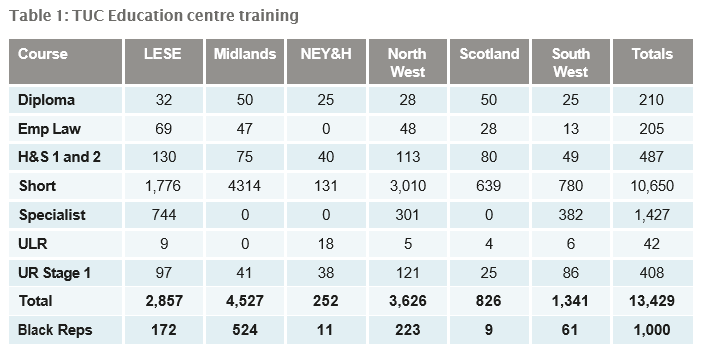
1.5 TUC Education
TUC Education continued to play a vital role in empowering union reps, officers and members through high-quality training that strengthens unions’ ability to organise, campaign and represent workers.
Delivered via classroom settings in partnership with 13 further education (FE) college across England and Scotland, and increasingly online, the training is accredited by the National Open College Network (NOCN) and aligned with the TUC Passport to Progress.
Despite funding challenges in the FE sector, TUC Education expanded its digital provision in 2024, enabling broader access for union reps. The digital team supported unions including BALPA, SoR and Nautilus International with bespoke courses, while NASUWT, CWU and others adopted customised versions of the TUC’s digital credential programme.
A key innovation was the introduction of ‘practitioner’ digital credentials for workplace activities, such as building safety inspections – offering formal recognition and insight into reps’ contributions. Similar initiatives are planned for 2025.
Participation in online training rose by six per cent in 2024, with 2,066 reps involved – up from 1,427 in 2023. Core courses saw strong growth: Union Reps 1 (272), Health and Safety 1 (202), and the Certificate in Employment Law (229). Union learning rep training tripled, and the Diploma in Employment Law rose from 89 to 128 participants.
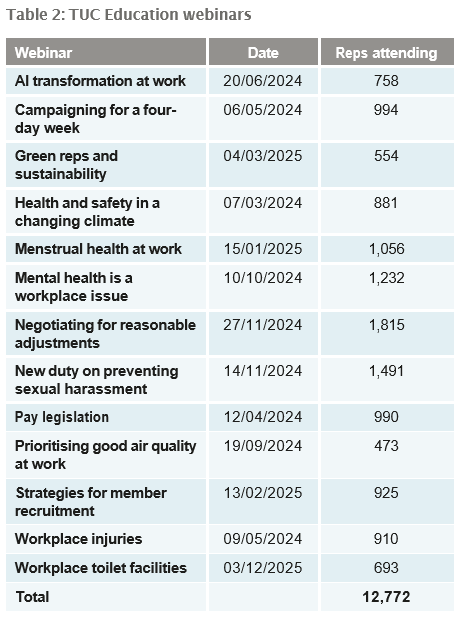
Webinars also proved popular, attracting 12,772 reps over the year. Topics such as negotiating reasonable adjustments for disabled workers (1,800 attendees) and preventing sexual harassment (1,500) highlighted the demand for accessible, expert-led learning.
The third annual Union Reps Connect conference drew a record 500 participants, reflecting strong interest in in-person learning and peer networking. Backed by the TUC Educational Trust, the event received overwhelmingly positive feedback. Plans for 2025 include regional networking and training days to prepare reps for new rights under the Employment Rights Bill.
The TUC Educational Trust has continued to support the work of educating and training workers, union members and activists. During 2024/25 the Trust continued support for the TUC Diversifying the Reps base project (including regional Black reps’ development programmes), the third Union Reps Connect conference, the launch of the new Union Reps website and regional educational events for reps about the dangers presented by the rise of the far right and right- wing populism.
1.6 Digital Lab
The TUC’s Digital Lab programme has worked to connect leaders and digital practitioners across the TUC’s affiliated unions, exploring areas of best practice in digital change for the movement.
In 2024/5, the programme produced events, training and reports, and coordinated with unions to share positive experiences more widely. The aim is to help TUC affiliates’ digital change projects to succeed – more quickly and with reduced risk or cost.
Major themes over the year have included: improving the effectiveness of unions’
digital channels for recruitment and retention; supporting unions to resist cyber-attacks, especially those originating from phishing; making practical use of generative artificial intelligence (AI), in line with union values; and supporting unions in transitioning
to a newer generation of membership systems.
Particular work in this area has focused on building data skills inside unions. A training programme and dedicated resources have supported union officers to create and share data insights with staff and reps, via dashboards and interactive visualisation.

1.7 Anti-Racism Taskforce oversight and implementation
The Implementation and Oversight Group has been highlighting ongoing initiatives to strengthen the representation of Black trade unionists. These efforts are rooted in the objectives of the TUC Anti- Racism Taskforce, established in 2020 in response to events such as the murder of George Floyd and the Covid-19 pandemic, both of which underscored systemic racial inequalities.
Following the announcement of the retirement of NASUWT general secretary Patrick Roach, who has played a significant role in chairing our Anti-Racism Taskforce, the Implementation and Oversight Group is moving into a new phase, with plans to engage more broadly with the General Council and ensure coordinated delivery.
The TUC launched the Anti- Racism Tracker at Congress in 2024 and has continued to support affiliates in delivering the commitments outlined in the Anti-Racism Taskforce Manifesto. The data dashboard concentrates on three key areas: representation, membership and union practices.
The TUC emphasises that, while setting targets and monitoring statistics are crucial, they must be balanced with reflective work to critically examine union structures. This initiative represents a pivotal moment for BME union members, as unions develop and implement measurable strategies to effectively confront racism.
Throughout the year, the TUC has engaged intensively with politicians and officials to influence the Employment Rights Bill in line with union priorities.
1.8 Make Work Pay: collective rights and defending the right to strike
After last year’s campaign to defend the right to strike, the TUC advocated for the Strikes (Minimum Service Levels (MSLs)) Act 2023’s full repeal in the Employment Rights Bill in line with composite 1. The TUC warmly welcomed the introduction of the Employment Rights Bill to parliament on 21 October, within 100 days of the election of the new Labour government. The bill sets out measures that, when implemented, will boost workers’ rights to collective bargaining and make it easier for unions to recruit and organise members.
The bill introduces rights for unions to access workplaces; measures to simplify the processes for statutory recognition and industrial action; and processes to strengthen collective consultation rights. It also abolishes the MSL legislation and almost all of the Trade Union Act 2016.
In August 2024, the government directed all public sector employers to disregard the MSL Act. This was a key moment in the TUC’s campaign, ensuring no worker faced this harmful legislation before its repeal.
In line with resolution 3, the TUC also pressed the justice minister to reach an agreement with the POA following the European Court of Human Rights granting of hearing of its case on the right to strike, though unfortunately no agreement has been reached to date.
Throughout the year, the TUC has engaged intensively with politicians and officials to influence the Employment Rights Bill in line with union priorities, which have been informed by regular discussions at the Executive Committee and General Council and the Union Legal Officers Network, to which all unions were invited to send a representative.
The government held a series of stakeholder roundtables on the bill during the autumn. The TUC organised pre-meetings for union attendees to coordinate unions’ views and input. Alongside the bill’s second reading, the government published a consultation on creating a modern framework for industrial relations. The TUC convened unions in advance of a union-roundtable with Justin Madders, parliamentary under-secretary of state at the Department for Business and Trade, to discuss union views on the proposals. The TUC’s written response argued for the inclusion of digital access and stronger enforcement of access rights; reform of the
statutory recognition process to prevent union-busting employer tactics gaming the system; and simplifying the process for industrial action.
Throughout the bill’s parliamentary progress, the TUC has circulated briefings to MPs and peers setting out TUC support for the bill and highlighting priorities for further consideration. Government amendments in the House of Commons included strengthening the enforcement of access rights and including digital access; strengthening the rules on unfair practices and freezing the bargaining unit once an application for recognition has been accepted; and introducing a formal process for agreeing access during a recognition process. In addition, the government announced that it would introduce model or off-the-shelf access agreements to facilitate fast-track access agreements.
Further details on how access rights will work in practice will be set out in secondary regulation, following further consultation.
1.9 Fair pay agreements and SSSNB
Following years of campaigning by unions and the TUC, the Employment Rights Bill sets out legislation to establish a fair pay agreement (FPA) in adult social care, through the establishment of an Adult Social Care Negotiating Body, as well as the creation of a School Support Staff Negotiating Body. This paves the way for negotiated sectoral minimum standards
for adult social care and school support staff.
The TUC has briefed parliamentarians and worked with officials and politicians to promote union priorities as the legislation has passed through parliament.
In line with resolution 48, the TUC has coordinated unions to support and shape the development of the FPA. With unions, the TUC has participated in the DHSC FPA Working Group and Task and Finish Groups covering the negotiating body, scope, dispute resolution and enforcement. A key priority has been to maximise the role of the FPA negotiating body by ensuring a broad scope in terms of remit and workforce coverage.
The TUC continues to call for the extension of FPAs to additional sectors.

1.10 HeartUnions Week
The TUC significantly expanded its HeartUnions campaign this year, leveraging its Megaphone digital platform to host 125 events nationwide, a substantial increase from 60 in 2024. These events facilitated 10,000–12,000 in-person conversations about union membership, more than doubling last year’s 4,000. Notably, one in five event organisers were new to running a union recruitment stall.
Beyond in-person outreach, TUC Education hosted a webinar on recruitment strategies, attended by 650 reps. Social media
efforts during the week were highly successful, generating 1.6 million impressions and 1 million video views for content promoting trade unionism. Each day of HeartUnions week, the TUC highlighted a new ‘solidarity story’ on its webpage, showcasing union reps’ workplace victories. The campaign also secured national media coverage, and visits to the HeartUnions web pages saw a 14 per cent increase compared to 2024.
Stay Updated
Want to hear about our latest news and blogs?
Sign up now to get it straight to your inbox