
An ambitious plan for young people
The UK faces a growing crisis in young people’s labour market participation with rising numbers out of education, employment and training and for those in employment, too many are trapped in low paid, insecure and poor-quality work.
There are currently almost a million (948,000) 16–24-year-olds who are not in education, employment and training (NEET), up from around 800,000 in 2019. This growth has largely been driven by young people who are economically inactive, meaning young people are out of work and not seeking it. Of the 873,000 18–24-year-olds who are NEET; 330,000 are unemployed (38 per cent) and 543,000 (63 per cent) are economically inactive. 1
Whilst at an overall lower rate, young people are also more likely to be unemployed; there are currently half a million young people who are looking for work and unable to find it. In April to June 2025, the unemployment rate for 16–64-year-olds was 4.8 per cent, compared to 12 per cent for 18–24-year-olds.2
Risk factors for becoming NEET can be multiple, complex, interconnected and vary from person to person, but there are some trends in the data.
- Lower educational attainment. There is wide ranging evidence that young people with below Level 2 qualifications are more likely to become NEET and that as young people’s qualifications increase, they are less likely to be NEET. TUC analysis of current data concerningly shows that 30.9 per cent of 24-year-olds do not have Level 2 English and Maths qualification. This is higher for those on free school meals, with 54.5 per cent not having Level 2 English and Maths. 3
- Disabled young people. TUC analysis of ONS data shows that disabled young people are far more likely to be NEET with almost three in ten (28.6) per cent disabled young people aged 16-24 being NEET compared to 7.1 per cent of non-disabled young people.4 Evidence from Youth Futures Foundation shows how this has risen over time. In 2025, nearly half (48.4 per cent) of NEET young people are disabled compared to one in five (22.2 per cent) in 2011. 5 This is largely being driven by increases in mental ill-health. Previous TUC analysis has shown how inaccessible and discriminatory workplaces prevent disabled people who want to work from accessing and staying in the labour market.6
- Poor quality work. TUC analysis of Department for Education destination data for 16–18-year-olds who left education in 2022-23 found that a year later 14.8 per cent of them had entered work, education or training but had not completed or continued it. This is up from 12.9 per cent in 2017-18 and is far higher for those on free school meals at 26.8 per cent and SEN young people at 25.9 per cent in 2022-23. So a significant proportion of the youngest people who are NEET are also those falling back out of education and work, which shows the need for high quality support in education and workplaces, particularly for those who experience barriers and discrimination.7 Previous TUC research has shown how poor quality work, particularly for disabled workers and BME workers,8 can drive people out of the labour market. Employment quality must be a parallel concern when thinking about lowering the number of young people who are NEET. Without this, work can perpetuate cycles of poor health and wellbeing potentially forcing people out of the labour market.
- A lack of apprenticeship opportunities. The Apprenticeship Levy, intended to boost numbers, has fallen short, leading to an overall decline in apprenticeship starts and achievements. TUC analysis of Department for Education data has found that between 2017/18 and 2023/24 apprenticeship start rates for 19–24-year-olds have reduced by 15 per cent and by 26 per cent for under 19s. This is in comparison to an increase in start rates for those aged 25 and over of 6 per cent. In addition, achievement rates for under 19 have reduced by 44 per cent and by 31 per cent for 19–24-year-olds.9
- Caring responsibilities. Looking after the home or family is cited by 13 per cent of NEET young people who are economically inactive.10 TUC analysis shows that whilst young men are more likely to be NEET than young women (13.1 per cent compared to 12.4 per cent), both are rising, and the reasons are different. Young men are more likely to be unemployed and young women economically inactive.11 Previous TUC analysis in 2023 found that difference in economic inactivity between young men and women was driven by women being much more likely to be economically inactive due to caring responsibilities.12 Again, there is a wider range of evidence demonstrating how work could be improved for those with caring responsibilities.13
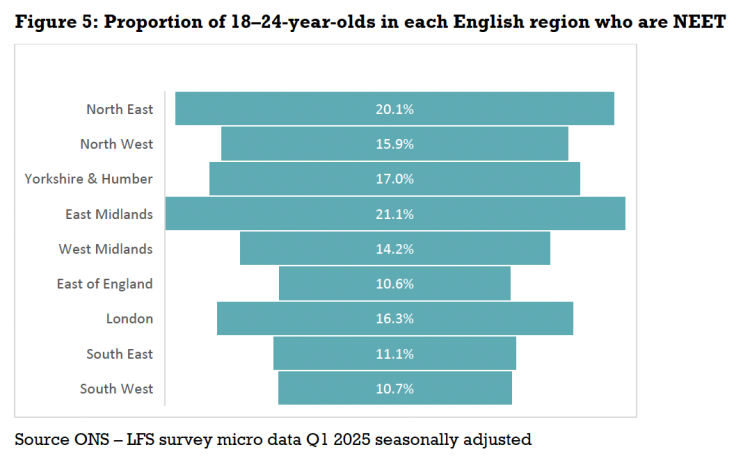
- Regional differences. TUC analysis also finds that there are disparities between regions with NEET rates highest in East Midlands (21.1 per cent) and Northeast (20.1 per cent) and lowest in the South West (10.7 per cent) and East of England (10.6 per cent). Although there are variations within regions, this suggests that improving opportunities in weaker local labour markets is an important part of the solution to NEET rates.
Young people are paying a high price for years of underinvestment and lack of support by the previous Conservative government. They have been at the sharp end of austerity with cuts to education, youth and health services, sacrificed formative years of education and work during the Covid-19 pandemic, faced increases in the cost-of-living and joined the workforce under poor working conditions, as access to apprenticeships were reduced and union rights slashed.
It is perhaps not surprising we have also seen a rise in ill-health, particularly mental health conditions amongst young people. Studies have found that in places with the largest reduction in local authority funding correlate to places with largest reduction in young people’s mental health 14 and since the pandemic we have seen a dramatic increase in demands on youth mental health services.15 In addition, Marmot and colleagues (2010) found being in poor quality work is detrimental to physical and mental health.16
This combination of factors has left us at crisis point with young people facing an uncertain future. With long-term unemployment and worklessness leading to lasting labour market scars and negative health outcomes, urgent action is needed to repair the damage done and ensure that young people have access to high-quality, well-paid work and opportunities for training, progression and development.
- 1 Office for National Statistics (ONS), published 21 August 2025, ONS website, statistical bulletin, Young people not in education, employment or training (NEET), UK: August 2025
- 2 Office for National Statistics (ONS)>, published 12 August 2025. ONS website, statistical bulletin, Labour market overview, UK: August 2025.
- 3 Department for Education. (2025, April 24). Level 2 and 3 attainment age 16 to 25, academic year 2023/24. https://explore-education-statistics.service.gov.uk/find-statistics/level-2-and-3-attainment-by-young-people-aged-19/2023-24
- 4 Unpublished TUC analysis
- 5 Youth Futures Foundation. (2025, June). Trends in young people not in education, employment or training (Q2 2025) [PDF]. Retrieved from https://youthfuturesfoundation.org/wp-content/uploads/2025/06/NEETS-TRENDS-ANALYSIS-Q2-2025.pdf
- 6 Trades Union Congress (TUC). (2025, May 12). Disabled workers' access to reasonable adjustments. https://www.tuc.org.uk/research-analysis/reports/disabled-workers-acces… and Trades Union Congress (TUC). (2025, July 31). Keep Britain working: An independent review into the role of employers in health and disability. Trades Union Congress (TUC). https://www.tuc.org.uk/research-analysis/reports/keep-britain-working-independent-review-role-employers-health-and
- 7 Department for Education. 16-18 Destination Measures, Academic Year 2022/23. https://explore-education-statistics.service.gov.uk/find-statistics/16-18-destination-measures/2022-23
- 8 Trades Union Congress (TUC., (2022, August 31). Still rigged: racism in the UK labour market. https://www.tuc.org.uk/research-analysis/reports/still-rigged-racism-uk-labour-market#footnote6_sh35p21
- 9 Department for Education. (2024). Apprenticeships, academic year 2023/24. https://explore-education-statistics.service.gov.uk/find-statistics/apprenticeships/2023-24
- 10 Learning and Work Institute. (2025, April 4). Young people who are not in education, employment or training: What does the data tell us? https://learningandwork.org.uk/resources/research-and-reports/young-people-who-are-not-in-education-employment-or-training-what-does-the-data-tell-us/
- 11 TUC analysis using - https://www.ons.gov.uk/employmentandlabourmarket/peopleinwork/employmentandemployeetypes/datasets/educationalstatusandlabourmarketstatusforpeopleagedfrom16to24seasonallyadjusteda06sa
- 12 Trades Union Congress (TUC). (2023, November 30). Jobs and pay monitor: Young workers. https://www.tuc.org.uk/research-analysis/reports/jobs-and-pay-monitor-young-workers
- 13 Carers UK (November 2024). State of Caring 2024: the impact of unpaid caring on employment. https://www.carersuk.org/reports/state-of-caring-2024-the-impact-of-unpaid-caring-on-employment/
- 14 Understanding Society. (2024, September 9). Austerity hit young people's mental health. https://www.understandingsociety.ac.uk/blog/2024/09/09/austerity-hit-young-peoples-mental-health/
- 15 UK Parliament, House of Commons. (2025, March). Cost of living crisis: Young people. https://publications.parliament.uk/pa/cm5804/cmselect/cmyouth/cost-living-crisis-young-people/summary.html
- 16 Marmot, M. (2010). Fair Society, Healthy Lives: The Marmot Review: Strategic review of health inequalities in England post-2010 (Report 2/2010). UCL Institute of Health Equity. http://www.instituteofhealthequity.org/resources-reports/fair-society-healthy-lives-the-marmot-review
Recommendations
We welcome the action the government has taken so far; the new Youth Guarantee for 18–21-year-olds, the introduction of the Growth and Skills Levy and significant investment in apprenticeships for young people and an industrial strategy which puts jobs outcomes at the heart of its success. We particularly welcome the government’s acknowledgement that work must be secure, well-paid and of high quality – an agenda which it is progressing through its plan to Make Work Pay.
These important changes will increase routes for young people into quality jobs and training. However, if we are to meet the scale of the challenge, we urge the government to introduce the following measures.
1. A Jobs Guarantee for young people in England
The government should introduce a jobs guarantee scheme in England for young people as a key component of the Youth Guarantee. The approach should be designed and delivered in partnership with trade unions.
We know that job guarantee schemes work. Evaluation of The Future Jobs Fund (FJF), set up under the previous Labour government, showed the scheme delivered clear benefits for participants, employers and society.
The national scheme should provide six months of employment paid at the national minimum wage, or the union negotiated rate for that job with placements regionally allocated based on need. Placements should be prioritised for young people aged 18- 24 who have been NEET for six or more months and young people aged 18-24 who are at high risk of becoming long-term NEET. Risk of Need Indicator (RONI) data or referral from a Work Coach should be used to identify this latter group. To ensure it targets those furthest from the labour market, placements should be prioritised for those without Level 5 qualifications.
The full report sets out the design of our proposed job guarantee scheme. Whilst the upfront investment for a scheme would be significant, TUC analysis shows that this policy would more than pay for itself over the longer term.
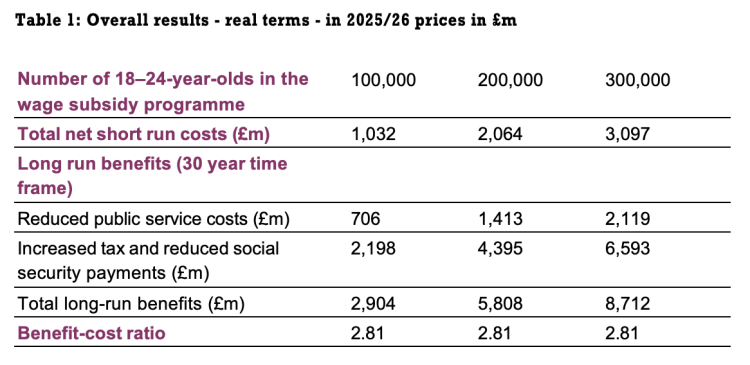
Our modelling shows that the programme has a benefit-cost ratio of 2.8 - over time every £1,000 of (net) government spending on the programme would generate £2,810 of net revenue for the Exchequer – based on the government’s own approach to cost benefit appraisal. 17 With these outcomes assessed over 30 years, the scheme hits breakeven within a decade. Given the caution we have taken in assessing the scheme’s impacts, outcomes and long-run benefits of the scheme could well be higher.
We recommend that the government provides a minimum of 100,000 job guarantee placements over a two-year period. Table 1 shows the benefits and costs for up to 300,000 placements based on modest estimates (including that 10 per cent of participants go on to long-term employment).
- 17 https://www.gov.uk/government/publications/the-green-book-appraisal-and-evaluation-in- central-government/the-green-book-2020#valuation-of-costs-and-benefits
As well as mitigating against long-term unemployment, a scheme would be an opportunity to help create good, secure jobs across the UK and generate economic growth.
2. Quality apprenticeships for young people
There is a clear opportunity to use the government’s industrial strategy to ringfence roles for young people and create long term apprenticeship opportunities. This would provide good quality jobs for life for young people and in turn a skilled, long-term
workforce that will drive economic growth in the government’s priority sectors.
The TUC recommends that:
Funding for infrastructure projects should come with requirements for apprenticeship delivery. More widely, a percentage of apprenticeships should be ringfenced for 18–24-year-olds (with apprenticeships also be targeted at older people without a Level 2 qualification). Our report provides examples of successful models where approaches of this sort are already happening.
To enable the delivery of apprenticeships, the skills strategy needs to align with industrial strategy. This includes ensuring education sectors are equipped and funded to deliver. The recruitment and retention crisis in Further Education (FE) must be addressed to safeguard apprenticeship delivery, starting with fair pay for FE workers.
The government should make use of the successful model of union-led upskilling in work and re-establish the Union Learning Fund.
Steps should be taken to ensure high quality apprenticeships, including a strong voice for workers on the Board of Skills England, fair pay rates for apprentices and more flexible, modular learning options to reduce barriers to participation.
3. Quality work for disabled young people
The government has taken significant steps to improve the quality of work for young people through its plan to Make Work Pay. We strongly believe that good quality work is key to keeping young people in the labour market. Low pay, harassment, discrimination and poor-quality work force people out of the labour market.
Given the high number of young disabled people who are NEET, we believe there are additional measures that the government could also seek to implement rapidly to improve outcomes for young disabled people at work. These include:
Improving access to reasonable adjustments by introducing a time limit on decisions regarding reasonable adjustment requests, introducing a requirement on employers to record impairment related leave taken by disabled workers separately from other sick leave, adopting the social model of disability and taking further steps to improve access to flexible working.
Improving Access to Work by removing the financial cap, ensuring flexible and personalised application processes, introducing in principle indicative awards for disabled jobseekers and ensuring consistent funding increases.
Building on improvements to statutory sick pay as part of the plan to Make Work Pay, with a review of the statutory sick pay rate, which is extremely low by international standards. This review should report by the end of Parliament.
Improving regulation and enforcement of employment and equality rights by ensuring the Equality and Human Rights Commission and Health and Safety Executive have sufficient funding.
Fully funded occupational health and NHS services. Fully-funding comprehensive rehabilitative services – encompassing mental health, physiotherapy, orthopaedic and occupational therapy – are fundamental step in supporting young disabled workers and individuals with ill health to return to and stay in employment. We recommend the government actively engage with unions representing NHS staff, who possess invaluable, practical expertise that can drive better policy- and decision-making
A full set of recommendations and an outline of the job guarantee scheme are included in the main body of the report, including how the scheme should be set up and the benefit-cost analysis. The final section of the report contains best practice international examples the government should learn from.
Introduction
The UK faces a growing crisis in young people’s labour market participation. Headline statistics related to young people (16-24) remain significantly worse than they were before the Covid-19 pandemic, and worse than for the wider labour market.
There are currently almost a million (948,000) young people (16-24) who are not in education, employment and training (NEET), up from around 800,000 in 2019. 18 Those young people who experience long-term unemployment are at risk of scarring effects across their working lives. For those who are in work, too many are in low paid, insecure and low-quality jobs which have a poor impact on health and wellbeing.
Young people are feeling the impacts of years of underinvestment and lack of support by the previous Conservative government. They have been at the sharp end of austerity with cuts to education, youth and health services, sacrificed formative years of education and work during the Covid-19 pandemic, faced increases in the cost-of-living and joined the workforce under poor working conditions, as access to apprenticeships were reduced and union rights slashed.
In response to this challenge, the new government has rightly set out a new Youth Guarantee, an industrial strategy, committed to apprenticeship reform and started to deliver its Make Work Pay agenda. Together, these important changes will increase routes for young people into quality jobs and training. In this report, we consider what more should now be done. 19 We set out a trade union approach and ambition for improving the life chances of young people up and down the country, with an approach that seeks to build on key existing government reforms.
Why is this important?
Unemployment has significant social and economic consequences for individuals, families and communities. Long-term unemployment can be especially damaging for individuals’ prospects, leading to lasting labour market scars such as increased incidence of future unemployment, a greater likelihood of being in poorer quality jobs, and lower subsequent earnings. 20
Unemployment also has detrimental physical and mental health outcomes. The 2010 Marmot Review on health inequalities 21 found that unemployed people incurred elevated health risks. It made creating 'fair employment and good work for all' one of its six recommended policy objectives, with particular emphasis on the need to 'reduce long-term unemployment across the social gradient.' Research also highlights the negative health impacts of poor-quality work.
These risks are particularly acute for young people. Evidence shows that the impact of long-term unemployment is more pronounced for those under the age of 23 than for older people."22
The risks of unemployment and poor-quality work begin early. Young people who don’t gain a Level 4 in GCSE English and Maths are more likely to become NEET later in life compared to those with five GCSEs.23 In addition, those without Level 2 24 qualifications are more likely to end up in low paid precarious work and stay there, with limited progression opportunities. 25
Urgent action is needed to repair the damage done and ensure that young people have access to high-quality, well-paid work and opportunities for training, progression and development.
Lowering the number of NEET young people will also help to drive economic growth. A 2012 study for the Commission on Youth Employment estimated that the impacts of long-term youth unemployment at that point would cost £4.8 billion to the exchequer and £10.7 billion to the economy in lost output that year alone. Accounting for longer- term scarring effects of unemployment on young people, this increased to approximately £28 billion net loss to the Treasury over the decade ahead.26 In 2023, the Youth Employment Group (YEG) estimated that UK GDP could increase by £69 billion if NEET rates were reduced to the levels in the Netherlands.27
There is also widespread public support for reducing youth unemployment. Polling in 2023 found that 74 per cent of voters believed that reducing youth unemployment supports health and wellbeing.28
- 18 Office for National Statistics (ONS), published 21 August 2025, ONS website, statistical bulletin, Young people not in education, employment or training (NEET), UK: August 2025
- 19 Whilst tackling youth worklessness must also include action during young people’s years of compulsory education, this report focuses on employment support and skills policy. In addition, the report focuses on 18–24-year-olds in England as the devolved nations have existing Youth Guarantee provisions, although some policy suggestions will be UK wide.
- 20 Arulampalam, W., Gregg, P., & Gregory, M. (2001). Unemployment scarring. The Economic Journal, 111(475), 577–584. https://doi.org/10.1111/1468-0297.00663
- 21 Marmot, M. (2010). Fair Society, Healthy Lives: The Marmot Review: Strategic review of health inequalities in England post-2010 (Report 2/2010). UCL Institute of Health Equity. http://www.instituteofhealthequity.org/resources-reports/fair-society-healthy-lives-the-marmot- review
- "22 Allen, M. (2014) Reducing the number of young people not in employment, education or training (NEET), https://www.bristol.ac.uk/media- library/sites/cmpo/migrated/documents/wp97.pdf
- 23 Gadsby, B. (2019). Establishing the Employment Gap: Research Briefing 1 [PDF]. Impetus in partnership with the National Institute of Economic and Social Research (NIESR). http://impetus- org.files.svdcdn.com/production/assets/publications/Report/Youth-Jobs-Gap-Establising-the- Employment-Gap-report.pdf?dm=1556009627
- 24 See here for definitions of educational levels: https://www.gov.uk/what-different-qualification- levels-mean/list-of-qualification-levels
- 25 Department for Education. (2024, September 24). Skills England: Driving growth and widening opportunities. GOV.UK. https://www.gov.uk/government/publications/skills-england-report- driving-growth-and-widening-opportunities
- 26 ACEVO Commission on Youth Unemployment. (2012). Youth Unemployment: The Crisis We Cannot Afford. ACEVO. http://www.acevo.org.uk/wp-content/uploads/2019/07/Youth- Unemployment-the-crisis-we-cannotafford.pdf
- 27 Impetus. (2023, September 27). Tackling youth unemployment could generate £69 bn for UK economy. Impetus. https://www.impetus.org.uk/news-and-views/tackling-youth- unemployment-69bn-uk-economy/
- 28 Youth Futures Foundation. (n.d.). Tackling youth unemployment could generate £69 bn for UK economy. https://youthfuturesfoundation.org/news/tackling-youth-unemployment-could- generate-69bn-for-uk-economy/
The experience of young people
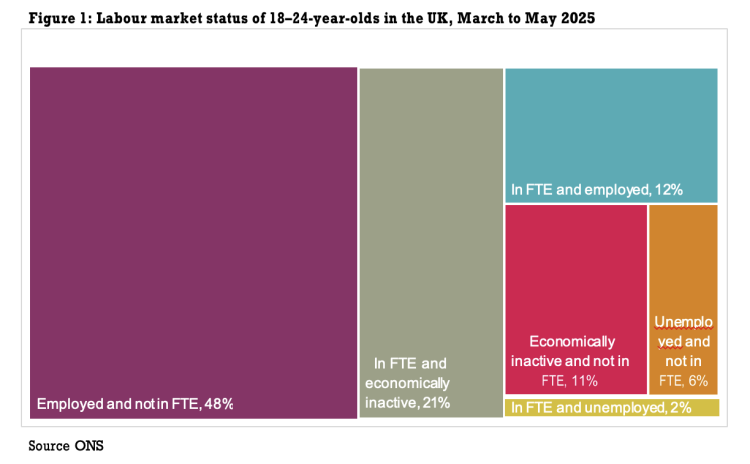
Figure 1 demonstrates that eight in ten (81 per cent) young people aged 18-24 in the UK are either employed or in full time education. Concerningly, however, 6 per cent of 18–24-year-olds not in full time education are unemployed and a further 11 per cent not in full-time education are also economically inactive. It is those outside of full-time education and unemployed or economically inactive whose prospects are of greatest concern, given the long-term impacts cited above.
Young people not in education, employment or training
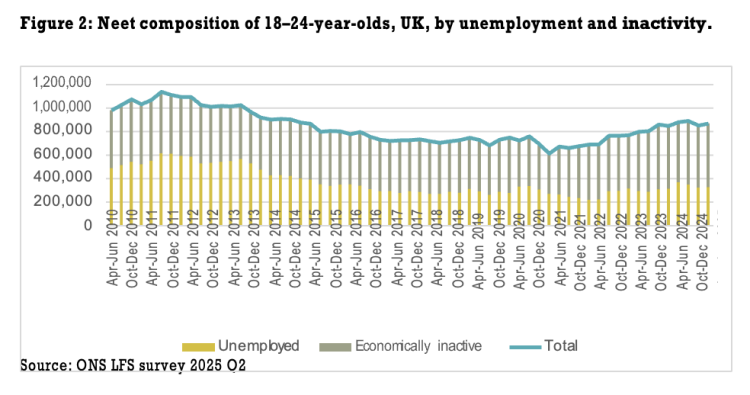
As of April – June 2025, 873,000 18–24-year-olds were not in education, employment or training, this is 15 per cent of this age group. If you widen the age bracket to 16–24- year-olds, it reaches 948,000 across the UK. This has been rising since mid-2021 and peaked in October to December 2024, the highest it has been since the end of 2014.
Data shows that 17 per cent of 22-year-olds are NEET and this is the highest proportion of any age group.29
Worryingly, analysis by the Learning and Work Institute in April 2025 found that in the UK nearly half (48 per cent) of young people are still not in education, employment or training a year after becoming NEET and 58 per cent of NEET young people in the UK have never had a job.30
TUC analysis of destination data for 16–18-year-olds who left education in 2022-23 found that a year later 14.8 per cent of them had entered work, education or training but had not completed or continued it. This is up from 12.9 per cent in 2017-18 and is far higher for those on free school meals at 26.8 per cent and SEN young people at 25.9 per cent in 2022-23. This demonstrates that a proportion of the youngest people who are NEET are also those falling back out of education and work showing the need for high quality support in education and workplaces.31
Figure 2 shows, compared to the early 2010s where NEET numbers were largely driven by young people who were unemployed, most NEET young people are now economically inactive and report they are both out of work and not seeking it. Of the 873,000 18–24-year-olds who are NEET; 330,000 are unemployed (38 per cent) and 543,000 (63 per cent) are economically inactive.
Economic inactivity is defined as those who are not in employment, have not been seeking work within the last 4 weeks, and/or are unable to start work within the next 2 weeks.
- 29 Learning and Work Institute. (2025, April 4). Young people who are NEET – what does the data tell us? https://learningandwork.org.uk/resources/research-and-reports/young-people-who-are- not-in-education-employment-or-training-what-does-the-data-tell-us/
- 30 Ibid
- 31 Department for Education. 16-18 Destination Measures, Academic Year 2022/23. https://explore-education-statistics.service.gov.uk/find-statistics/16-18-destination- measures/2022-23
Unemployment
Young workers face a higher unemployment rate than other workers.
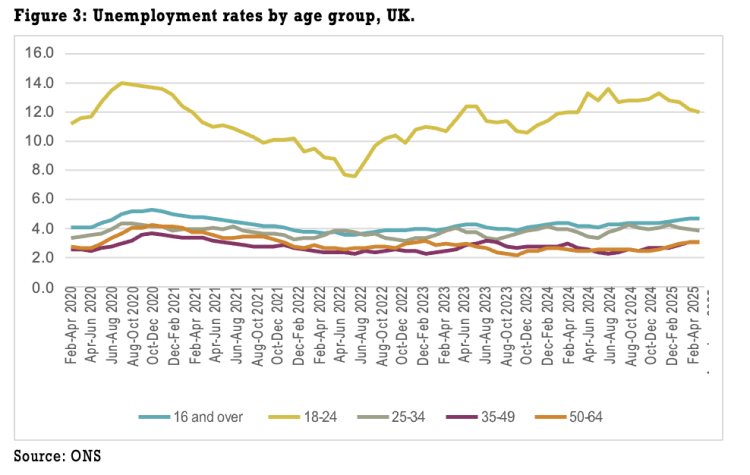
In April to June 2025, the unemployment rate for 16-64 was 4.8 per cent, but for 18- 24-year-olds this is well over double at 12 per cent. This means almost half a million young people who are looking for work are unable to find it.
Unemployment is defined as being without a job despite actively seeking work and being available to start work. It also includes those who are out of work but waiting to start a new job in the next two weeks. It therefore does not include those who are out of work and not looking for work.
The unemployment rate is the number of unemployed people as a percentage of the number of people who are “economically active” (those in employment plus those who are unemployed). It doesn’t include people who are engaged in other activities, for example studying.
As Figure 3 shows as the economy gradually reopened after Covid-19, youth unemployment fell. However, this rapidly increased for young people from mid-2022 peaking at 13.6 percent in July to September 2024. It also shows the much higher unemployment rates are for young people.
Demographic characteristics of NEET young people
Whilst the risk factors for becoming NEET can be multiple, complex, interconnected and vary from person to person, there are some trends in the data.
Qualifications
Impetus research has found that 18-24 year olds with below a Level 2 qualification are 75 per cent more likely to be NEET and that as young people’s qualifications increase, they are less likely to be NEET.32 This is supported by Learning and Work Institute analysis which found that 21 per cent of 16–24-year-olds with no qualifications are NEET compared to 11 per cent of young people who have a Level 2 qualification or higher. They also found that those without qualifications were more likely to say they were NEET due to a health condition or impairment.33
Given that young people having lower educational qualifications is a risk factor for becoming NEET and for remaining in low pay and low-quality work, it is concerning that TUC analysis of current data shows 30.9 per cent of 24-year-olds do not have Level 2 English and Maths qualification. This is higher for those on free school meals, with
54.5 per cent not having Level 2 English and Maths.34 In addition, the proportion of young people gaining a Level 2 or 3 by age 19 has stalled at lower levels than in many comparator countries.35
Disabled young people
TUC analysis of ONS data shows that disabled young people are far more likely to be NEET with almost three in ten (28.6 per cent) disabled young people aged 16-24 being NEET compared to 7.1 per cent of non-disabled young people. 36
Analysis by Youth Futures Foundation shows how this has risen over time. In 2025, nearly half (48.4 per cent) of NEET young people are disabled compared to one in five (22.2 per cent) in 2011 and around 40 per cent in 2021. This growth has been less pronounced amongst non-disabled young people in education, employment and training showing the need to reduce barriers for young disabled people. 37
Rising mental ill-health is a driving force of this with one in five children and young people aged between eight and 25 having a mental health condition 38 and an increasing proportion of NEET young people now cite mental ill-health as a leading health factor. 39 Although, it is worth noting that 48 per cent of NEET young people in the UK who have a health condition or impairment do not report their health as the main reason they are NEET, demonstrating the multiple factors young people experience. 40 In addition, Impetus research found that SEND young people are around 80 per cent more likely to be NEET compared to the average.
TUC research has consistently demonstrated how physical, attitudinal, communication and information barriers, workplace policies and cultures can discriminate against disabled people. 41 There is also evidence showing barriers disabled people experiences in education 42 and transport.43 These barriers can mean young disabled people who want to work cannot.
Caring responsibilities
Looking after the home or family is cited by 13 per cent of NEET young people who are economically inactive for why they are not looking for work or are unavailable for work. 44
Learning and Work Institute analysis also finds that a larger proportion of NEET young people are economically inactive as they enter their 20s. Whereas those under 20 are more likely to be unemployed. This is driven by increases in the percentage of young people who report that they are looking after their family or home and in those who have a health condition or disability.45
Gender
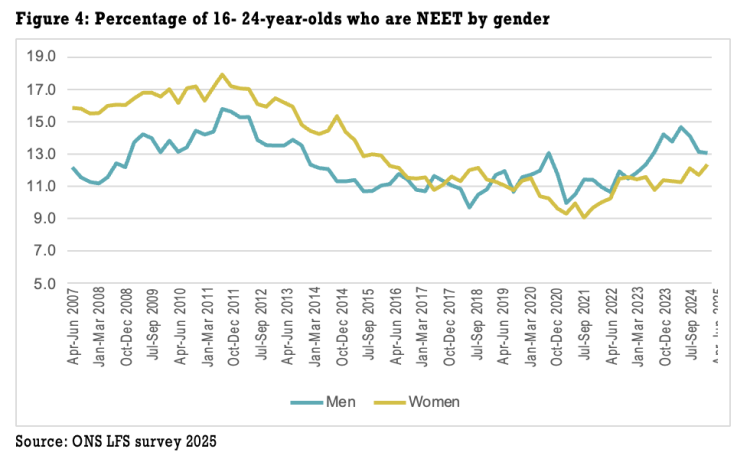
Young men are more likely to be NEET than young women, with 13.1 per cent of young men being NEET compared to 12.4 per cent of young women and as Figure 4 demonstrates the growth in young men who are not in education, employment or training since the Covid-19 pandemic has been starker. However, rates amongst both groups have been growing.
- 32 Impetus. (2019, April). Youth Jobs Gap: Establishing the Employment Gap. https://www.impetus.org.uk/policy/youth-jobs-gap
- 33 Learning and Work Institute. (2020, December 30). Fit for Purpose? Education and employment support for young people. https://learningandwork.org.uk/resources/research-and- reports/youth-commission-education-and-employment-support-for-young-people/
- 34 Department for Education. (2025, April 24). Level 2 and 3 attainment age 16 to 25, academic year 2023/24. https://explore-education-statistics.service.gov.uk/find-statistics/level-2-and-3- attainment-by-young-people-aged-19/2023-24
- 35 https://learningandwork.org.uk/resources/research-and-reports/youth-commission- education-and-employment-support-for-young-people/
- 36 Unpublished TUC analysis
- 37 Youth Futures Foundation. (2025, June). Trends in young people not in education, employment or training (Q2 2025) [PDF]. Retrieved from https://youthfuturesfoundation.org/wp- content/uploads/2025/06/NEETS-TRENDS-ANALYSIS-Q2-2025.pdf
- 38 NHS Digital. (2023, November 21). Mental health of children and young people in England, 2023 (wave 4 follow-up). https://digital.nhs.uk/data-and- information/publications/statistical/mental-health-of-children-and-young-people-in- england/2023-wave-4-follow-up
- 39 Youth Futures Foundation. (2025, June). NEETs trends analysis Q2 2025. https://youthfuturesfoundation.org/wp-content/uploads/2025/06/NEETS-TRENDS-ANALYSIS- Q2-2025.pdf
- 40 Learning and Work Institute. (2025, April 4). Young people who are not in education, employment or training: What does the data tell us? https://learningandwork.org.uk/resources/research-and-reports/young-people-who-are-not-in- education-employment-or-training-what-does-the-data-tell-us/
- 41 Trades Union Congress (TUC). (2025, May 12). Disabled workers' access to reasonable adjustments. https://www.tuc.org.uk/research-analysis/reports/disabled-workers-access- reasonable-adjustment and Trades Union Congress (TUC). (2025, July 31). Keep Britain working: An independent review into the role of employers in health and disability. Trades Union Congress (TUC). https://www.tuc.org.uk/research-analysis/reports/keep-britain-working-independent- review-role-employers-health-and
- 42 Equality and Human Rights Commission. (2021, August 19). Being disabled in Britain: A journey
less equal. https://www.equalityhumanrights.com/sites/default/files/being-disabled-in- britain.pdf
- 43 National Centre for Accessible Transport (NCAT). (2024, December). Understanding and identifying barriers to transport. https://www.ncat.uk/document/understanding-and-identifying- barriers-to-transport/
- 44 Learning and Work Institute. (2025, April 4). Young people who are not in education, employment or training: What does the data tell us? https://learningandwork.org.uk/resources/research-and-reports/young-people-who-are-not-in- education-employment-or-training-what-does-the-data-tell-us/
- 45 Ibid
TUC analysis finds that of those who are not in employment or full-time education, 46 young women are more likely than young men to be economically inactive and young men are more likely to be unemployed. In March to May 2025 5 per cent of young men are not in full time education and economically inactive compared to 12 per cent of young women. 8 per cent of young men are out of full-time education and unemployed compared to 6 per cent of women. Our analysis also shows that the percentage of young women not in full time education and economically inactive has grown since the pandemic, from 10 per cent in December to February 2020 to the current 12 per cent.
Previous TUC analysis in 2023 found that difference in economic inactivity between young men and women was driven by women being much more likely to be economically inactive due to caring responsibilities.47
Ethnicity
Overall young White people are more likely to be NEET than young BME people; 12.1 per cent compared to 9.8 per cent. However, this topline figure hides variations between ethnic groups. Data analysis by Impetus finds that young people from Irish Traveller, Roma, Mixed White and Black Caribbean and Black Caribbean ethnic groups are those most likely to be NEET. 48 Similar differences in ethnic group can be found in other data analysis 49 and Learning and Work Institute have shown how rates vary by region. 50
Young White people who are not in education, employment or training are more likely to be economically inactive whereas young BME people who are out of education, employment and training are more likely to be unemployed. 51 This tells us that BME young people looking for work have a more difficult time in the labour market than their White peers.
There is a vast body of work that shows young BME workers are more likely to be in low-paid, insecure work 52 53 and face high levels of discrimination at work 53 , all of which can perpetuate cycles of poverty and poor wellbeing. BME workers are also disproportionately denied promotions, opportunities for training and development and face discrimination in the recruitment process. 55 56 57 Racism can determine who gets hired, trained, promoted, retained, demoted, and dismissed leaving BME workers vulnerable to unemployment and low-quality work.
Regional differences
There are also disparities between regions with young people from certain regions far more likely to be NEET than others. NEET rates are particularly high in the East Midlands and the North East as seen in Figure 5.
- 46 TUC analysis using - https://www.ons.gov.uk/employmentandlabourmarket/peopleinwork/employmentandemployee types/datasets/educationalstatusandlabourmarketstatusforpeopleagedfrom16to24seasonallyadj usteda06sa
- 47 Trades Union Congress (TUC). (2025, January 15). Jobs and pay monitor: Young workers. https://www.tuc.org.uk/research-analysis/reports/jobs-and-pay-monitor-young-workers
- 48 Impetus. (2019, April). Youth Jobs Gap: Establishing the employment gap. https://www.impetus.org.uk/policy/youth-jobs-gap
- 49 Youth Futures Foundation. NEET dashboard. https://data.youthfuturesfoundation.org/dashboard/neet/
- 50 Learning and Work Institute. (2025, April 4). Young people who are not in education, employment or training: What does the data tell us? https://learningandwork.org.uk/resources/research-and-reports/young-people-who-are-not-in- education-employment-or-training-what-does-the-data-tell-us/
- 51 Ibid and Youth Futures Foundation. (2025, June). NEETs trends analysis Q2 2025. https://youthfuturesfoundation.org/wp-content/uploads/2025/06/NEETS-TRENDS-ANALYSIS- Q2-2025.pdf
- 52 Trades Union Congress (TUC). (2023, November 30). Jobs and pay monitor: Young workers. https://www.tuc.org.uk/research-analysis/reports/jobs-and-pay-monitor-young-workers
- 53 a b Youth Futures Foundation. (2022, November). Minority ethnic youth employment outcomes. https://youthfuturesfoundation.org/wp-content/uploads/2022/11/Minority-ethnic-youth- employment-outcomes-REA.pdf
- 55 Equality and Human Rights Commission. (n.d.). Recruitment of workers into low-paid occupations and industries. https://www.equalityhumanrights.com/sites/default/files/recruitment-of-workers-into-low-paid- occupations-and-industries.pdf https://hummedia.manchester.ac.uk/institutes/code/research/projects/racism-at-work/tuc-full- report.pdf
- 56 Fawcett Society. (2021). Broken ladders: Barriers to women’s progression in the workplace. https://www.fawcettsociety.org.uk/broken-ladders https://www.fawcettsociety.org.uk/broken- ladders
- 57 University of Manchester, Institute for Collaborative Research on Racism at Work. (2020). Racism at work: Full report. https://hummedia.manchester.ac.uk/institutes/code/research/projects/racism-at-work/tuc-full- report.pdf
How did we get here?
An effective policy response must acknowledge the factors that have resulted in less opportunities for today’s young people, and that there are unique factors facing this generation that has created higher and different needs to previous cohorts of young people.
Legacy of austerity
Young people are still experiencing the impacts austerity has had on wellbeing and educational outcomes. TUC analysis showed that in the last financial year before the pandemic, government spending per capita was still significantly below 2010 levels in many services, including social care, transport, housing, childcare, schools and higher education. 58
These cuts have led to a dramatic reduction in public services, for example mental health support 59 , youth services 60 and education 61 that prevent youth unemployment and services that offer support when young people do experience periods of difficulty.
The legacies of austerity are also linked to the impact of the pandemic. TUC research showed that austerity was one factor that meant younger people were more likely to have experienced worse outcomes during the pandemic for physical and mental health, and in the case of children for educational progress. 62
Finally, when we look at the current rise in mental ill-health amongst young people, studies have found that in places with the largest reduction in local authority funding correlate to places with largest reduction in young people’s mental health. 63
Legacy of Covid-19
Young workers faced ongoing challenges during the Covid-19 pandemic and cost-of- living crisis. TUC analysis at the time of the pandemic showed that young workers were more at risk of job losses during the pandemic as they were more likely to work in industries affected by social restrictions. 64 ONS data demonstrated that under 25s accounted for three in five of the nearly 700,000 jobs lost between February 2020 and February 2021. 65 Learning and Work Institute analysis also found that the decline in working hours for young people with no qualifications had been five times higher than the decline for those with degree level and the decline in hours worked was higher for BME young people (49 per cent) than White young people (16 per cent).66
Young people now turning 24 would have entered the labour market at 18 during this period - this cohort has experienced multiple periods of uncertainty in short succession, with the potential to have long-term scaring effects.
Young people today will have also experienced more significant challenges in the education system due to Covid-19 meaning they may feel less job ready than those entering the labour market previously. 67 Despite efforts by schools to support students and address the disadvantage gap following the pandemic, this was not met with a robust programme of recovery by the previous government. In addition, unions highlighted that the attainment gap between students from disadvantaged backgrounds and their peers had grown. 68
- 58 Trades Union Congress (TUC). (2023, June 5). Austerity and the pandemic: How cuts damaged four vital pillars of pandemic resilience. https://www.tuc.org.uk/research- analysis/reports/austerity-and-pandemic
- 59 Understanding Society. (2024, September 9). Austerity hit young people's mental health. https://www.understandingsociety.ac.uk/blog/2024/09/09/austerity-hit-young-peoples-mental- health/
- 60 The Guardian. (2020, January 20). Youth services suffer 70% funding cut in less than a decade. https://www.theguardian.com/society/2020/jan/20/youth-services-suffer-70-funding-cut-in- less-than-a-decade
- 61 Institute for Fiscal Studies. (2019). 2019 annual report on education spending in England. https://www.ifs.org.uk/publications/14369
- 62 Trades Union Congress (TUC). (2023, June 5). Austerity and the pandemic: How cuts damaged four vital pillars of pandemic resilience. https://www.tuc.org.uk/research- analysis/reports/austerity
- 63 Understanding Society. (2024, September 9). Austerity hit young people's mental health. https://www.understandingsociety.ac.uk/blog/2024/09/09/austerity-hit-young-peoples-mental- health/
- 64 Trades Union Congress (TUC). (2020, June 12). Young workers are most at risk from job losses due to the coronavirus crisis. https://www.tuc.org.uk/research-analysis/reports/young-workers- are-most-risk-job-losses-due-coronavirus-crisis
- 65 Office for National Statistics. (2021, March 23). UK labour market: March 2021. https://www.ons.gov.uk/employmentandlabourmarket/peopleinwork/employmentandemployee types/bulletins/uklabourmarket/march2021
- 66 King’s Trust. (2021). Facing the future: Employment prospects for young people. https://www.kingstrust.org.uk/about-us/our-research/2021-facing-the-future-employment- prospects-for-young-people
- 67 Institute for Public Policy Research (IPPR). (2025, July 8). Towards universal opportunity for young people. https://www.ippr.org/articles/towards-universal-opportunity-for-young-people
- 68 National Association of Schoolmasters/Union of Women Teachers (NASUWT). (n.d.). Written evidence submitted by NASUWT. UK Parliament. https://committees.parliament.uk/writtenevidence/118611/html/
Poor quality work and the cost-of-living crisis
Young people have entered the labour market at a time of acute unfairness, low productivity and falling living standards.
Forthcoming TUC analysis shows insecure work has steadily risen in the last 14 years reaching 4 million in 2024 meaning 1 in 9 workers in the UK were employed in precarious employment. Meanwhile wages have flatlined. Real pay in half of the published industry groups (9 out of 19) is still below the position ahead of the global financial crisis in 2008 Q1, and across all industries is only up 1.4 per cent over the same period. 69 In addition, labour market protections in the UK lag behind those of comparable countries. 70 This is despite a range of evidence that demonstrates the link between labour protections and economic growth. 71
Young people have been at the sharp end of this. Previous TUC analysis shows that young workers aged 16-24 are almost four times more likely than the wider work force to be employed on a zero-hours contract (13 per cent compared to 3.4 per cent of all workers) 72 . In addition to being in insecure work, young people tend to be lower paid overall. Whilst lower hourly pay amongst young workers as they first enter the labour market can be expected, too many young people still earn below a living wage as they are overrepresented in low paid occupations, in insecure work and because minimum wage legislation permit young workers to be paid less for the same work. 73 Alongside this, young people have also been hit hard by the cost-of-living crisis, impacted by rising energy, housing, transport and food costs. The Age of Insecurity report by the RSA found that 47 per cent of young people in the U.K. are financially precarious. 74
Poor quality work with a lack of flexible working, low pay, high rates of discrimination can force people out of the workplace and has been shown to have a damaging impact on young people’s mental health. 75
Since Marmot and colleagues (2010) found being in poor quality work is potentially more detrimental to health than being unemployed or inactive, employment quality must be a parallel concern when thinking about lowering the number of young people who are NEET. Low quality work will cause a cycle of young people joining and dropping out of the workplace and worsening mental health. Through the government’s Make Work Pay agenda, outlined below, improvements to working conditions have begun.
Apprenticeship challenges
Despite policy efforts such as the Apprenticeship Levy, the UK apprenticeship system continues to face significant challenges in uptake, quality, and accessibility—particularly for small and medium-sized enterprises (SMEs).
The Apprenticeship Levy, intended to boost numbers, has fallen short, leading to an overall decline in apprenticeship starts and achievements.
TUC analysis has found that between 2017/18 and 2023/24 apprenticeship start rates for 19–24-year-olds have reduced by 15 per cent and by 26 per cent for under 19s. This is in comparison to an increase in start rates for those aged 25 and over of 6 per cent. 76
In addition, achievement rates for under 19 have reduced by 44 per cent and by 31 per cent for 19–24-year-olds. Those aged 25 and over have also experienced a decline in completion rates of 33 per cent.
In 2023/24, on average 60 per cent of apprentices completed their programme. The Sutton Trust have demonstrated that the UK has a much higher drop-out rate than European countries with a dual system for example Germany and Austria. In addition, our apprenticeship dropout rate is higher than for other education programmes in the UK. 77
Reasons cited for leaving apprenticeships include poor quality training and financial issues. Previous surveys indicate that 44 per cent of leavers cite insufficient training time and 43 per cent cite poor training quality as reasons for leaving early. 78 Among Level 2 apprentices who dropped out, nearly 40 per cent mentioned financial problems as contributing factors. 79
In regard to quality of apprenticeships, over half (54 per cent) of levy-paying employers have admitted to rebranding existing in-house training as apprenticeships.80
TUC have concerns that the recruitment and retention crisis within Further Education jeopardises apprenticeship delivery, that apprenticeship pay is unsustainable for many adults and the apprenticeship system is complicated, disconnected from workplaces and difficult to navigate for learners, providers, schools and employers.
Increased poor mental health
Given the impact of the pandemic, cost-of-living crisis, poor work and training opportunities and the ongoing impact of austerity, it is perhaps not surprising we have seen a rise in ill-health, particularly mental health amongst young people. 81 82 More young people today are disabled or have health conditions which impact on their likelihood of being in work or education. In the past decade, the percentage of young people reporting ill-health as the primary reason for being economically inactive has more than doubled, from around 10 per cent in 2013 to around 27 per cent in 2024. 83 As highlighted above TUC research has consistently shown the barriers that disabled people experience in the workplace due to a lack of reasonable adjustments and accessible workplace policy and practices. 84 In addition, periods out of work and education can have a detrimental impact on mental health.
The Youth Select Committee have also highlighted the dramatic increase in demands on youth mental health services since the pandemic but that prolonged waiting lists and a lack of support in education has left ‘young people grappling with exacerbated
mental health challenges alone, [which can]…..have a detrimental effect on their ability to engage with education and employment opportunities.’ 85
Conclusion
This is a crisis that has been years in the making. Young people today are yet again facing an uncertain future, with unemployment risking further scarring to their pay and progression prospects. Given the scale and nature of the problem, we welcome the announcements the government has made to tackle this issue and urge them to be bold in their efforts to ensure young people’s futures and in turn drive economic growth.
Current government ambition
The government has set out a long-term ambition to achieve an 80 per cent employment rate with lowering the number of young people who are NEET as a core part of this.86 Their approach is based on three pillars:
a modern Industrial Strategy and Local Growth Plans – to create more good jobs in every part of the country.
improving the quality and security of work through the Plan to Make Work Pay.
the biggest reforms to employment support for a generation, bringing together skills and health to get more people into work and to get on in work.
The following section provides a brief overview of these areas.
Employment support
In November 2024, the government committed to a Youth Guarantee, so that every young person aged 18-21 has access to learning or an apprenticeship, or support to find a job. The aim of the Guarantee is to meet the needs of those facing barriers and disadvantages including relating to mental or physical health, unpaid caregiving, homelessness or transport. The Youth Guarantee is initially starting with eight trailblazers across in England run by mayoral authorities; the learning of which will inform the future development of the Youth Guarantee.
The Pathways to Work Green Paper includes plans to remove the access to the health element of Universal Credit for under 22s and raising the age someone transitions from Disability Living Allowance to PIP from 16 to 18. The government have said this is to underpin and fund the Youth Guarantee.
Apprenticeships and skills
To support the Guarantee, the government has announced that the Apprenticeship Levy will be replaced by a more flexible Growth and Skills Levy. They are also investing
£40 million, which will help to deliver new foundation and shorter apprenticeships in key sectors. Seven new foundation apprenticeships for 16–21-year-olds will be available to serve as an introduction to the sector. The first ones expected include Production
Assistants in the creative sectors, Dual Fuel Smart Meter Installers supporting clean energy initiatives and Healthcare Support Workers, a vital role for the NHS.87
The Department of Education have also made several other skills announcements to support young people into apprenticeships or learning, particularly in construction. These include:
i). An increase to apprenticeship budget, rising to £3billion which will lead to an additional 30,000 apprenticeship starts across the parliament.
ii). From January 2026, Level 7 apprenticeships will only be funded for those under 22 at the time of starting the apprenticeship and applies to all sectors. Care leavers and those with an Education, Health and Care Plan will be funded up to age 24.
iii). £14 million for adult skills in construction will be devolved, adding 13 new courses to the Free Courses for Jobs Offer and delivering up to 5,000 additional adult learners.
iv). £136 million for local areas to provide Skills Bootcamps in construction, funding over 40,000 learners, plus £100 million to expand construction Skills Bootcamps.
v). The launch of ten Technical Excellence Colleges, specialising in construction skills in September 2025.
vi). Removal of the mandatory requirement to achieve Level 2 English and Maths qualifications (functional skills) to complete an apprenticeship for those aged 19 and over. Apprentices will still be assessed on core English and Maths skills relevant to their occupation, to be determined by the employer.
vii). From August 2025, the minimum number of off-the-job training hours required for each apprenticeship standard will be specified.
Industrial strategy
In June 2025, the government published its Industrial Strategy 88 , laying out how government will support the growth of eight key industries, including advanced manufacturing, clean energy and the creative industries.
The strategy includes jobs outcomes as one of its six core metrics of success, as well as the creation of a new generation of large British champion companies driving the growth of its eight target sectors. The Strategy proposes targeting government procurement “to create good quality local jobs and boost skills”, by having criteria on jobs outcomes in contracting processes.
The strategy also commits to reforming the skills and employment support system to create a strong pipeline into the eight sectors. As part of the Strategy, the aerospace sector has committed to 40,000 new apprentices over the next ten years, and to growing its direct workforce from 100,000 to 127,000 by 2050. As sector plans mature, there will be opportunities for other sectors to adopt ambitious targets on good job creation.
In addition, any sector that struggles to recruit, train or retain workers will have a dedicated Workforce Strategy. This approach will provide an opportunity to establish skills and training pathways and ensure high quality good jobs that people will want to apply for and stay in. The first of these strategies will be for the clean power sector.
Plan to Make Work Pay
As outlined above, young people are often stuck in low paid, insecure and poor-quality work where their basic rights are not protected. This can be damaging to young people’s long-term health and in extreme circumstances force them out of the labour market.
TUC research has also consistently showed how inaccessible and discriminatory work can prevent disabled people from accessing and staying in work. 89 Given the higher numbers of young people out of education, employment and training due to health conditions, accessible workplaces are vital in ensuring access to work.
The government’s plan to Make Work Pay represents the first concrete steps in addressing the systemic barriers disabled people and young people face getting into, staying and progressing in work for the last 14 years. These includes measures such as the banning of exploitative zero-hour contracts, the provisions of day one rights for all workers including to sick pay, strengthening rights to flexible working, ensuring all adult workers are paid the minimum wage and introducing disability pay gap reporting.
These actions will make a significant difference to young peoples, and in particular disabled young peoples, access to and experiences of work. For example, more regular hours and better access to flexible working will make it easier for people to secure working patterns that fit around their impairments and/or health conditions.
TUC recommendations
The TUC welcomes the government’s ambition and the acknowledgement that quality and security of work are core to opportunities for young people. Improving working lives by reducing the rate of young people who are NEET should be a central priority for this government. It will require long term planning, sustainable investment and joined up government action. It should include a proper route map of learning and earning options, including decent apprenticeships, job guarantee schemes for those with the most barriers and learning from the parts of the UK and Europe that are doing better.
This following section lays out our recommendations for how the government could put a plan in place to achieve this aim.
Employment Support
A comprehensive Youth Guarantee
The TUC recommends the following overarching features of a Youth Guarantee to ensure it reaches those most in need of support.
i). An expanded age range. The current age range of 18-21 is narrow and may not fully target those most in need given that NEET rates in England are highest for those aged 20 – 24. 90 In addition, international Youth Guarantees offer a wider age range. The European Youth Guarantee has included people up to the age of 30 and the Welsh and Scottish Youth Guarantees are 16-24. In the first instance, the Guarantee should be extended to 18 -24-year-olds.
ii). A cross-government approach. Given the complex nature of the issue and high need of young people there must be a cross-governmental approach, including local authorities, to identifying, preventing and supporting young people at risk of becoming NEET. Identifying those who are at risk of becoming NEET early is vital to reducing numbers.91 The government must also ensure that there are multiple partners working together on the ground so young people can be referred to relevant services from multiple entry points, and that they are not lost when they leave school.
iii). Targeted and personalised support. Risk factors for becoming NEET vary and some young people will experience multiple compounding factors. All provision must therefore be targeted and personalised and take account of the diverse needs of young people, particularly those at risk of long term worklessness. Research shows that highly individualised support and a central service that can signpost, refer and provides individualised support are vital to success of employment programmes.92 Job Centre Plus Work Coaches should receive support to make sure they are able to signpost and are aware of the full range of services available to young people. PCS have set out how Work Coaches would be better able to support people including having a national network of offices in every town and city. 93
iv). Informed by the voices of young people and trade unions. Trade unions will be able to provide unique insight on the connection between training and employment, the skills needed for the labour market and what good quality employment looks like, which is essential to a successful Youth Guarantee. In European countries where social dialogue is a common objective, unions have played a key role in support for young people. The voices of young people and trade unions must inform the operation of the Guarantee as it is rolled out.
v). Ring fenced funding. The Youth Guarantee should not be funded by removing benefits for young people. Cuts to the health element of Universal Credit for under 22s, which were previously proposed by the Government, could remove vital financial support that helps young people into work, education and training. The risk is that an approach based on cutting young people’s entitlements would leave those young people most in need of support even further from the jobs market. The Guarantee should receive a ring fenced centrally funded budget to be delivered locally.
A Jobs Guarantee for young people
Given the rising rates of NEET young people and the risks of long-term scarring, we believe the government should introduce a jobs guarantee scheme for young people as a key component of the Youth Guarantee. The approach should be designed and delivered in partnership with trade unions.
We know that job guarantee schemes work. Evaluation of The Future Jobs Fund (FJF), set up under the previous Labour government, showed the scheme delivered clear benefits for participants, employers and society. The real selling point of the FJF was that it gave participants recent experience of a real job with a real wage, opportunities to gain new skills and an employer reference, over other government employment schemes offering lesser pay, terms and conditions and opportunities - such as workfare, which trade unions oppose.
As well as mitigating against long-term unemployment, a scheme could also be an opportunity to help create good, secure jobs across the UK, ensuring more people have access to decent pay and secure livelihoods in a job that provides meaning both for them and the wider community.
Target group
It is important that such a scheme is designed to take account of the labour market challenge young people face today. We therefore recommend that the scheme prioritise young people aged 18-24 who have been NEET for six or more months and young people aged 18-24 who are at high risk of becoming long-term NEET. Risk of Need Indicator (RONI) data can also identify those most in need of the scheme. Data or referral from a Work Coach should be used to identify this latter group.
Given that young people with lower educational attainment are more likely to be NEET and more likely to become trapped in poor quality work, the government should prioritise placements for those without Level 5 qualifications to ensure those with the most barriers receive support. Level 5 qualifications include diploma of higher education, foundation degree, higher national diploma (HND) and Level 5 NVQ. 94
Given that just under half (48 per cent) of NEET young people receive any form of social security, claiming benefits should not be part of the criteria for receiving a placement as it will fail to capture some of the target group. 95
Job criteria
Our assessment is that job placements should:
provide six months of employment paid at the national minimum wage, or the union negotiated rate for that job.
be additional. This means the money should only be used to create jobs that would not have been created in the absence of a scheme, ensuring that job guarantee participants are not replacing existing workers. Assessment panels like the FJF could be put in place to ensure this.
provide community, public benefit and/or help decarbonise.
meet local labour market needs to ensure sustainability of skills and experience. This means the ability for the money to be used to create jobs in sectors which correspond with regional or local economic plans.
be designed to ensure the worker gets experience that will better equip them to move into permanent work in the open labour market.
include quality training that puts workers on a pathway to a Level 3 qualification.
promote and protect equality and be free from discrimination.
adhere to health and safety law.
ensure access to trade unions. This must be for the person but also recognised trade unions must be informed of use of scheme and involved in design of positions in workplaces.
have clear minimum standards for quality, for example standard job descriptions and the same terms and conditions as other employees in similar roles.
have a sustainability route for example the placement could transition into an apprenticeship, or the person be guaranteed a job interview at the end. For employers this is an option to target the areas where a skilled workforce will be needed in the future.
Equality measures
As we set out above, many young people who are NEET are disabled. But evidence suggests that previous schemes such as Kickstart were less effective for young disabled people as almost half (47 per cent) of young people with a health condition left their placement without completing the full six months. 96 TUC research found that for the majority of disabled workers who have made a request for reasonable adjustments wait from four months to over a year of their adjustments to be implemented (82 per cent).97 Given the high number of young disabled people with health conditions who are NEET, it is essential that placements are accessible and employers are aware of their duties under the Equality Act 2010. To ensure that those most in need are accessing the scheme, the following equality measures should be put in place.
Jobs should be offered on part time basis but with the same number of equivalent hours.
All participants in the scheme should be offered ongoing Work Coach support from the Department for Work and Pensions. This will ensure they can access any further support during the placement and have regular check-ins. 98
The scheme should include a one-off discretionary support into work payment to cover the upfront costs of employment i.e. new clothes, or travel.
Employers should have fast track access to Access to Work to increase disabled
young people’s access to jobs.
Employers should be required to respond rapidly to requests for reasonable adjustments – ideally within two weeks. Considering the short-term nature of placements, it would be advantageous for employers and young disabled people to have agreed reasonable adjustments before a placement starts. For the government to achieve its aims systems must be put in place to ensure reasonable adjustments are put in place as soon as is possible. The TUC also recommends using reasonable adjustment passports.99
There should be monitoring of take up at a local level to ensure that those with protected characteristics have equal access to the scheme and that action can be taken if there is evidence that particular groups are disproportionately missing out – this is particularly important for BME groups.
Training measures
For the individual, the job guarantee needs to come with an entitlement to government funded learning with all participating workers taking an initial assessment to explore where their specific upskilling needs are, and what pathway they could look to continue on following the placement with an aim to achieve a Level 3 qualification subsequently. The minimum time spent in learning should be 20 per cent of working time, mirroring the apprenticeship programmes’ entitlement.
There must also be clear guidance on what training needs to take place and how this will be evidenced to assess quality. Training should go beyond CV and employability support and should put participants on a pathway to at least a Level 3 qualification, if they do not already have it.
As mentioned above, given the high need of some young people, all young people in the scheme should have ongoing access to a Work Coach who can support with signposting to additional training and support. This would help address the risk of drop-out and ensure the burden to provide additional support does not just fall on the employer.
Costs and benefits
The TUC has considered costings of such a scheme in a comprehensive estimate provided by Landman Economics.
The data looks at England only and estimates there are 611,000 18–24-year-old NEETS without a Level 5 qualification. Due to data limitations this number has not been broken down by length of NEET status or by wider risk factors for becoming long-term NEET – but these data could inform the design of a government scheme.
The proposed scheme would cover a six-month placement, paid at the minimum wage for the relevant age group. Government investment would cover all employer NI contributions and minimum automatic enrolment pension contributions. 75 per cent of all jobs would be worked at 35 hours per week for six months and 25 per cent of jobs worked at 21 hours per week for ten months (ensuring that NEET young people who participate part-time still receive equivalent employment experience to full-time participants). In addition, the scheme includes an individual payment to all participating employers of £2,170 to cover any additional training and onboarding costs. This is consistent with previous schemes, including Kickstart.
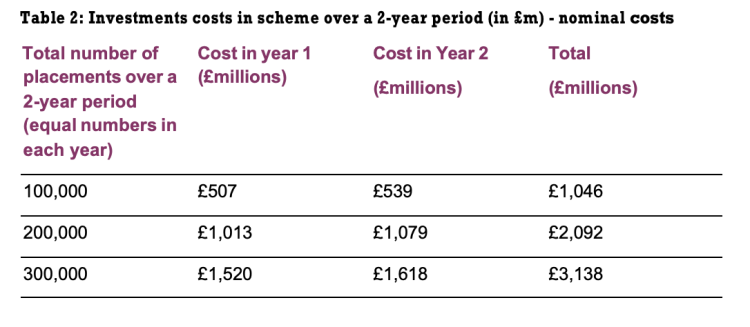
Our assessment is that guaranteeing a 100,000 job placements equivalent to 6 months full time for those 18–24-year-olds furthest away from the labour market would cost the government £1.046bn net. This £1.046bn is based on providing 50,000 placements a year over a two-year period.
A job guarantee will not be the right intervention for all NEET young people – but for a significant number it will. We therefore recommend that the government provides a minimum of 100,000 placements.
The table below sets out the investment costs for potential options of up to 300,000 placements. Should the government provide the maximum number of placements, this would provide a genuine opportunity for a significant percentage of NEET young people in England.
- 69 TUC analysis of June 2025 pay data on ONS table EARN03, adjusting for price with CPI.
- 70 Trades Union Congress (TUC). (2024, August 2). Falling behind on labour rights: Worker protections in the UK compared to the rest of the OECD. https://www.tuc.org.uk/research- analysis/reports/falling-behind-labour-rights
- 71 Trades Union Congress (TUC). (2018, December 11). The OECD says collective bargaining is the best way to deliver better work. https://www.tuc.org.uk/blogs/oecd-says-collective-bargaining- best-way-deliver-better-work
- 72 Trades Union Congress (TUC). (2024, September 25). Make work pay: TUC analysis shows government commitments could be life-changing for young workers. https://www.tuc.org.uk/news/tuc-analysis-shows-governments-make-work-pay-commitments- could-be-life-changing-young-workers
- 73 Trades Union Congress (TUC). (2023, November 30). Jobs and pay monitor - young workers. https://www.tuc.org.uk/research-analysis/reports/jobs-and-pay-monitor-young-workers
- 74 Royal Society for the Encouragement of Arts, Manufactures and Commerce (RSA). (2024, December). Age of insecurity. https://www.thersa.org/articles/press-release/dec-age-of- insecurity
- 75 Institute for Employment Studies (IES). (2024). Young people’s mental health in the workplace. https://www.employment-studies.co.uk/resource/young-people’s-mental-health-workplace
- 76 Department for Education. (2024). Apprenticeships, academic year 2023/24. https://explore- education-statistics.service.gov.uk/find-statistics/apprenticeships/2023-24
- 77 Sutton Trust. (2020). A world of difference: Social mobility and the classroom. https://www.suttontrust.com/our-research/a-world-of-difference/
- 78 Apprenticeships, Academic year 2024/25 - Explore education statistics - GOV.UK
- 79 IFF Research. (2023). Apprenticeship evaluation 2023: Learner and non-completer surveys.
- 80 Apprenticeships, Academic year 2024/25 - Explore education statistics - GOV.UK
- 81 King’s Trust. (2024). Prince’s Trust/NatWest youth index 2024. https://www.kingstrust.org.uk/about-us/news-views/princestrustnatwestyouthindex2024
- 82 Resolution Foundation. (2024). Efforts to tackle Britain’s epidemic of poor mental health should focus on lower-qualified young people. https://www.resolutionfoundation.org/press- releases/efforts-to-tackle-britains-epidemic-of-poor-mental-health-should-focus-on-lower- qualified-young-people/
- 83 Learning and Work Institute. (2025, April 4). Young people who are not in education, employment or training: What does the data tell us? https://learningandwork.org.uk/resources/research-and-reports/young-people-who-are-not-in- education-employment-or-training-what-does-the-data-tell-us/
- 84 Trades Union Congress (TUC). Reasonable adjustments: Guidance for employers. https://www.tuc.org.uk/ReasonableAdjustments
- 85 UK Parliament, House of Commons. (2025, March). Cost of living crisis: Young people. https://publications.parliament.uk/pa/cm5804/cmselect/cmyouth/cost-living-crisis-young- people/summary.html
- 86 Department for Work and Pensions. (2025, May). Get Britain working: White paper. https://www.gov.uk/government/publications/get-britain-working-white-paper/get-britain- working-white-paper
- 87 NQual. (2025, February 11). Maths and English functional skills policy change – what we know. https://www.nqual.co.uk/post/maths-and-english-functional-skills-policy-change
- 88 Department for Business and Trade. (2025, June 23). Industrial strategy. https://www.gov.uk/government/publications/industrial-strategy
- 89 Trades Union Congress (TUC). Reasonable adjustments: Guidance for employers. https://www.tuc.org.uk/ReasonableAdjustments
- 90 Learning and Work Institute. (2024, November 20). A youth guarantee for England. https://learningandwork.org.uk/resources/research-and-reports/a-youth-guarantee-for- england/
- 91 Learning and Work Institute. (2023, October). The Young Person’s Guarantee. https://learningandwork.org.uk/resources/research-and-reports/the-young-persons-guarantee/
- 92 Ibid
- 93 Public and Commercial Services (PCS) Union. (2025). Reforming jobcentres: Written evidence submitted by the Public and Commercial Services (PCS) union (RJ0069). UK Parliament. https://committees.parliament.uk/writtenevidence/138448/pdf/
- 94 For full description of level 5 qualifications - What qualification levels mean: England, Wales and Northern Ireland - GOV.UK
- 95 Youth Futures Foundation. (2025, February). Trends in young people not in education, employment or training (October – December 2024)https://youthfuturesfoundation.org/publication/trends-in-young-people-not-in- education-employment-or-training-2021-2024/
- 96 Department for Work and Pensions. (2023, July). Kickstart Scheme: Process evaluation. https://assets.publishing.service.gov.uk/media/64ae8a56c033c100108060f2/kickstart-evaluation- process-evaluation.pdf
- 97 Trades Union Congress (TUC). (2025, July 31). Keep Britain working: An independent review into the role of employers in health and disability. https://www.tuc.org.uk/research- analysis/reports/keep-britain-working-independent-review-role-employers-health-and
- 98 Department for Work and Pensions. (2025, March 6). Government bolsters employment support to unlock work for sick and disabled people. GOV.UK. https://www.gov.uk/government/news/government-bolsters-employment-support-to-unlock- work-for-sick-and-disabled-people
- 99 Trades Union Congress (TUC). (2025, March 6). Reasonable adjustments disability passports. Retrieved from https://www.tuc.org.uk/reasonable-adjustments-disability-passports
The full benefits of the scheme depend on longer-run employment outcomes for those who participate in the scheme. The assessment of benefits we have made is based on judgements across better employment and earnings outcomes, reduced benefit spending and higher taxes and lower costs to public services. The total benefits of the scheme are set against costs over time, using the standard Treasury approach. 100 Overall the benefit to cost ratio of the programme is estimated at 2.81, with every
£1,000 of (net) government spending on the programme generating £2,810 of net revenue for the Exchequer. With these outcomes assessed over 30 years, the scheme hits breakeven within a decade.
This can also be explained as:
100,000 placements in a 2-year period would cost £1.03 bn but return £2.9bn.
200,000 placements in a 2-year period would cost £2.06 bn but return £5.8bn.
300,000 placements in a 2-year period would cost £3.1bn but return £8.7bn.
The full breakdown of costs and savings can be seen below in Table 3. 101
Regional allocation
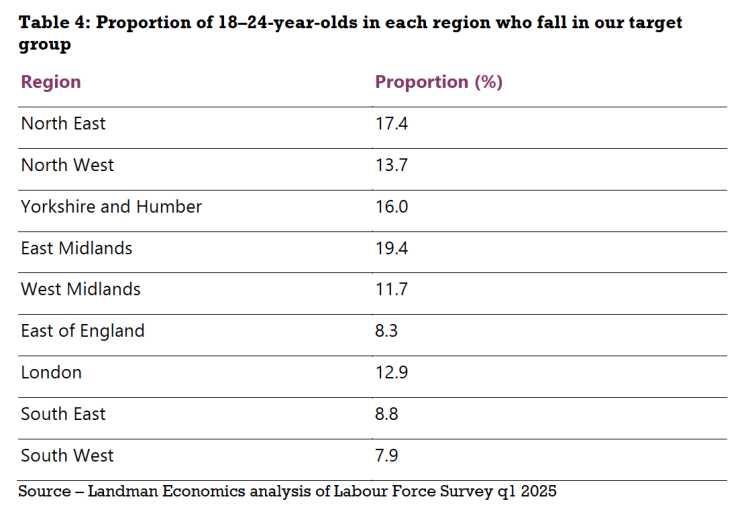
We propose that placements are allocated across regions reflecting the regions with the highest proportion of NEETs. Table 4 below shows the proportion of 18–24-year- olds who are NEET and do not have a Level 5 qualification in each region to demonstrate where allocations might be best targeted.
- 100 Treasury (2022)– The Green Book - https://www.gov.uk/government/publications/the-green- book-appraisal-and-evaluation-in-central-government/the-green-book-2020#valuation-of- costs-and-benefits#
- 101 The overall figures in table 3 are slightly different to table 2 as the results are in real terms at 2025/26 prices which is needed to carry out cost benefit analysis.
Industrial strategy
There is a clear opportunity to use the government’s industrial strategy to ringfence roles for young people and create long term apprenticeship opportunities. This would provide good quality jobs for life for young people and in turn a skilled, long-term workforce that will drive economic growth in the government’s priority sectors.
The TUC recommends that funding for infrastructure projects should come with requirements for apprenticeship delivery; a certain percentage of apprenticeships should be ringfenced for 18-24 year olds and apprenticeships should also be targeted at people without a Level 2 qualification. In the UK, some projects have already followed this approach, for example at Hinkley Point C, EDF and trade unions on site have agreed on a target of one apprentice for every eight trades workers on site.
Introducing a requirement tied to government funding would go a long way towards securing future industry workforce requirements and providing opportunities for young people.
IPPR polling shows that this policy would likely be popular with 77 per cent of respondents saying young people under the age of 25 should have the highest priority access to apprenticeship opportunities. 102
To enable the delivery of apprenticeships, the skills strategy needs to align with industrial strategy. This includes ensuring the education sectors are equipped and funded to deliver, addressing the historic underfunding of both further and adult education in particular which saw the number of adult learners in FE fall by nearly half between 2010-2021. 103 Higher education also has a huge role to play in delivering on both a skills and industrial strategy. The current funding model is putting pressure on the sector, endangering the widening participation programme and putting some providers at risk. 104 Ultimately, a limited sector focusing on a narrow range of provision and only open to those most able to afford it will put any industrial strategy at risk.
Government should also make use of the successful model of union-led upskilling in work and re-establish the Union Learning Fund. 105
Apprenticeships and Skills
To ensure the successful delivery of apprenticeship reform, we also recommend the government:
Ensure a Strong Voice for Workers: The Board of Skills England should work with unions, employers and providers to ensure apprenticeship design and implementation meets the needs of all stakeholders.
Simplify System Access: The apprenticeship system should be streamlined and access to high quality advice for schools, workers, and businesses improved. This will be vital to widen access to and participation from workers from marginalised backgrounds.
Establish Fair Pay for Apprentices: To recruit and retain apprentices, government should increase the apprenticeship minimum wage, aligning it to the national minimum wage overtime.
Utilise Union Capacity: Unions can increase participation in apprenticeships and make a significant difference by negotiating for better training standards, ensuring apprentices receive sufficient training time, and working to improve the organisation and quality of apprenticeship programmes, which will reduce dropout rates and enhance the overall apprenticeship experience.
Widen Participation: Introduce more flexible, modular learning options to reduce barriers to participation.
Strengthen the FE Workforce: Address the recruitment and retention crisis in FE to safeguard apprenticeship delivery, starting with fair pay for FE workers.
- 102 Institute for Public Policy Research (IPPR). (2025, July 8). Towards universal opportunity for young people. https://www.ippr.org/articles/towards-universal-opportunity-for-young-people
- 103 Trades Union Congress (TUC). (2022, November 14). Number of adult learners has halved since 2010. https://www.tuc.org.uk/news/tuc-number-adult-learners-has-halved-2010
- 104 University and College Union (UCU). (2024, June). General election manifesto 2024: Building a fair and sustainable post-school education system. https://www.ucu.org.uk/media/14491/UCU- general-election-manifesto-2024/pdf/UCPU_manifesto_2024.pdf
- 105 Unionlearn. Union Learning Fund. https://www.unionlearn.org.uk/union-learning-fund
Case study: Apprenticeships at Hinkley Point C
The construction of new nuclear power station Hinkley Point C (HPC) has become a flagship for large-scale, high-quality apprenticeships in major infrastructure. EDF (the developer) originally pledged to create 1,000 apprenticeships during construction, but hit this target ahead of schedule in 2022 and has since expanded delivery to around 1,500 apprentices by 2025.
The programme covers a broad range of disciplines, from civil trades such as steel-fixing and tunnelling, to electrical and instrumentation, welding, project controls, construction management and business support. Training is anchored locally through Bridgwater & Taunton College and the National College for Nuclear, with additional provision from employer-led academies and the HPC Jobs Service. The majority of apprentices are recruited from the South West.
HPC’s apprenticeship policy is integrated within a site-wide industrial relations framework agreement. This agreement covers all contractors and subcontractors on site, ensuring consistent pay, conditions and skills standards across the multi-tier supply chain.
Unions have played a central role in:
Pay and progression: securing wage structures that allow apprentices to step onto skilled grades upon completion.
Quality assurance: resisting de-skilling and ensuring apprenticeships are trade- specific, accredited and portable.
Health, safety and welfare: embedding union safety reps and joint inspections into site governance.
Dispute resolution: providing structured channels that have resolved issues, including in tunnelling, without prolonged disruption
The results demonstrate that large infrastructure projects can deliver apprenticeships at scale and quality when union involvement is built-in from the outset. Benefits include achieving target numbers at pace, retention of a skilled local workforce, and enhanced safety culture.
Challenges remain, particularly around maintaining standards across complex contractor chains and ensuring that welfare issues are addressed promptly.
HPC shows the value of setting ambitious, transparent apprenticeship targets, embedding union agreements site-wide that provide the context for training policies, aligning pay progression with skills growth, and creating strong local training partnerships.
Make Work Pay
The government has taken significant steps to improve the quality of work for young people via it’s Make Work Pay agenda. We strongly believe that good quality work is key to keeping young people in the labour market. Low pay, harassment, discrimination and poor-quality work force people out of the labour market.
Given the high number of young disabled people who are NEET, we believe there are additional measures that the government can implement rapidly to improve outcomes for young disabled people at work outlined below. The full description of these can be found in the TUC’s response to the Keep Britain Working independent review into the role of employers in health and disability.106
1. Improving access to reasonable adjustments
TUC research has found that over half of disabled workers are not getting the reasonable adjustments they need or only getting some of them and a third have had disability related leave counted as sick leave, potentially forcing them down punitive HR processes. In addition, 82 per cent of those who requested reasonable adjustments reported waiting between 4 months and over a year to have the agreed adjustments put in place.107 We therefore believe the government needs to improve access to reasonable adjustments by taking action including the following:
a). Introduce a requirement for employers to notify employees on decisions regarding reasonable adjustment requests within a set time period, ideally within two weeks of an application.
b). Introduce a requirement on employers to record impairment related leave taken by disabled workers separately from other sick leave. This would stop disabled workers from being pulled into automated HR processes by triggering an employers’ sick leave policy.
c). Adopt the social model of disability. One way of bringing the social model of disability into the heart of UK law would be to make the United Nations Convention on the Rights of Disabled Persons (UNCRPD) enforceable within UK law.
d). The TUC believes the government has a key role to play in making flexible working the default, which can be an important reasonable adjustment for disabled people. The government should introduce a legal duty on employers to consider which flexible working arrangements are available in a role and publish these in job advertisements, with new postholders having a day one right to take up the flexible working arrangements that have been advertised. If an employer does not think that any flexible working arrangements are possible, they should be required to set out that no form of flexible working is suitable in the job advert and why. This would ensure disabled workers know what is available to them before applying for a job and will have access to flexible working from day one.
2. Improving Access to Work
Another existing approach that has been successful in aiding workers and removing barriers is Access to Work. However, the programme has faced issues with funding shortfalls, long waiting times and fundamentally with employers and workers often being unaware it exists. To improve the offer, the government should:
a). Remove the financial support cap
b). Take action to ensure the application and renewal processes are efficient, personalised, and flexible for disabled workers.
c). Ensure any changes to Access to Work involve codesign with disabled people, their organisations and trade unions to be a success.
d). Introduce ‘in principle’ indicative awards for entitled disabled jobseekers.
e). Ensure consistent funding increases and a full assessment of unmet needs. It should be reformed to provide quick and efficient access to the service with reduced waiting times.
Access to Work is, and remains, a positive government initiative that is already ensuring disabled people can get into and stay in work – and it could be easily expanded and further improved.
3. Improved statutory sick pay (SSP)
While the improvements to SSP introduced as part of the plan to Make Work Pay are important, a medium-term plan to higher rates is needed. There is an urgent need for a wider review of the statutory sick pay rate, which is extremely low by international standards. This review should report by the end of Parliament.
4. Improved regulation and enforcement
Enforcement of the law is an important element in improving the employment rates and pay of disabled young workers.
The government should ensure the Equality and Human Rights Commission (EHRC) has sufficient funding to discharge their legal duties and should receive additional ring- fenced resources to conduct targeted enforcement of workers’ right to reasonable adjustments.
The EHRC should work with employers to develop practical guidance to increase their understanding and confidence in using the positive action provisions permitted in the Equality Act 2010 to address the under-representation of disabled people.
The Health and Safety Executive, Britain’s primary OSH regulator, has sustained 54 per cent budget cuts since 2010. To ensure all workers are prevented from risk to ill-health in the first instance, funding must be reinstated and sustained. It has been repeatedly demonstrated, by TUC and HSE studies, that workplaces with trade union representation tend to have fewer instances of work-related illness and injury, and workers are better informed of health and safety policies and procedures. For this reason, we want to see the scope of the Safety Reps and Safety Committees Regulations extended, and for accredited trade union health and safety representatives to have a ‘roving rep’ right: access to any workplaces where they have membership.
5. Fully funded occupational health and NHS services
Fully-funding comprehensive rehabilitative services – encompassing mental health, physiotherapy, orthopaedic and occupational therapy – are fundamental step in supporting young disabled workers and individuals with ill health to return to and stay in employment. This aligns with the government’s ambition to shift services into community-based, preventative care, which, if adequately resourced, can significantly improve pathways to work. We recommend the government actively engage with unions representing NHS staff, who possess invaluable, practical expertise that can drive better policy- and decision-making.
Examples of other models
The government should ensure it learns from best practice both in the UK and internationally to inform methods to reduce NEET rates of young people.
The Future Jobs Fund (FJF)
The FJF was introduced in 2009 by the previous Labour government in response to rising unemployment after the global economic crisis. The scheme funded 200,000 jobs from 2009 to 2012. Jobs were six months funded at the minimum wage, were additional, had to benefit local communities and providers were required to support for employees to move into long term sustained employment. Two years after starting the programme, participants were less likely to be in receipt of welfare support by 7 percentage points (or 16 per cent less likely) and more likely to be in unsubsidised employment by 11 percentage points (or 27 per cent more likely) per participant than they would have been had they not participated. 108 Lessons should be learnt from the FJF as it had a very large impact for an active labour market programme.
European Youth Guarantee
The EU Youth Guarantee was agreed to by member states in 2013, to ensure that those under the age of 25 receive ‘a good quality offer’ of employment, continued education, an apprenticeship, or a traineeship within four months of becoming unemployed or leaving formal education. The Reinforced Youth Guarantee was introduced in response to the impacts of Covid-19 and extended the target group to 15 – 29-year-olds.
Member states implement the Guarantee via national implementation plans. 109
The EU states that almost 57 million young people have started an offer of employment, continued education, apprenticeships and traineeships since the start of the Guarantee. An OECD paper on the lessons from the programme, that the UK should seek to learn from, highlights the importance of giving local areas flexibility to tailor the scheme, strong partnerships with trade unions and young people’s organisations, ensuring sufficient human and financial resources and ensuring high quality of placements. 110 The Youth Guarantee has not been without it’s bumps and has been most effective when implemented fully. 111 Challenges with the scheme, highlighted by the ETUC, have been quality of offers provided, poor outreach to those furthest from the labour market and difficulties providing the offer within 4 months. 112
Germany
Germany’s NEET rate has consistently stayed below 9 per cent since 2014, often attributed to their successful apprenticeship model. 113 There is a dual system whereby vocational training and general education are combined with at least 12 hours per week in vocational school. There is a strong emphasis on on-the-job training and the Federal Institute for Vocational Education and Training (BiBB), is responsible for setting quality frameworks. 114 Every employer who wants to employ apprentices must also have qualified trainers. Apprenticeships average three to three and a half years and focus on Level 3 and 4 qualifications. There is a lower dropout rate, when compared with the UK of 25 per cent. 115
Unions are involved in ensuring quality apprenticeships as they sit on the board of BiBB and are involved in quality assurance at a regional level. 116 Collective bargaining agreements will often cover apprentice pay as a core demand to ensure apprentices are paid above the minimum.
In recognition of the fact that apprenticeship opportunities can be very localised, the government has introduced a monthly travel pass that can be used across the country for everyone and travel discounts for apprenticeships. The German government have also introduced a training assistance programme whereby apprentices are given a training supervisor who can support in organising training, assist with applications and help with problems. Individuals can access the service via the employer, careers advisor or job centre. The assistance is free to young people and the employer, and the cost is borne by the job centre. According to the BIBB Data Report 2024, in 2022, 32,400 young people used the assisted training service and almost half of participants (46.7 per cent) had a lower secondary school certificate, and about a tenth had no school certificate.
The Netherlands
The Netherlands has a low NEET rate of around five per cent. 117 Like Germany, the VET system is a dual system combining vocational education with work-based learning.
There are four levels of courses starting with level one: a one-year course for young people furthest from the labour market. Levels two, three and four are vocational training, professional training and middle-management training which vary by length and qualification but are a minimum of two years. 118
The one-year practical certificate is new and although the structural effects on youth unemployment are still being researched, FNV tell us there are clear indications it is making a practical contribution to improving young people’s prospects.
To ensure high quality training in the VET system, training companies must be accredited and registered on a public website. At least 20 per cent of practical training must be carried out by the company by an in-house qualified trainer and there are clear quality criteria. Employers may also receive a grant of up to £2,300 per apprentice per year and don’t have to financially contribute towards off-the-job training costs. 119
Trade unions are involved through collective agreements on both apprentices’ wages and training quality, via social dialogue at sectoral level and unions are part of the Foundation for cooperation on Vocational Education, Training and the Labour Market (SBB). 120 The SBB overseas the qualification structures, accreditation of work placements and advising training firms.
Following successful pilots in 2018, legislation is being introduced in 2026 in the Netherlands to improve the school to work transition. This includes a new model to identify risk of early school leavers, prioritizing resources towards regions with higher risks of early school leavers and mandatory career guidance at school and after graduation that must be individually tailored. 121
Wales
The Welsh Government’s Young Person’s Guarantee provides everyone between 16 and 24 in Wales with the offer of support to gain a place in education, training, or an apprenticeship, find a job, or become self-employed. 122 It is mainly accessed through Working Wales, which signposts young people to a range of existing services.
Part of the Guarantee is Wales Jobs Growth Plus (JGW+) 123 ; introduced in 2022 with the aim of providing training, development and employability support to NEET 16-19-year- olds, including a wage subsidy programme. Employers are given a wage subsidy for the equivalent of the National Minimum Wage for a six-month placement. Jobs Growth Plus also offers one-to-one coaching for all participants to create individual learning plans to support them to enter a range of activities including work experience and work placements. The support is intended to be highly individualised.
Welsh government’s evaluation of JGW+ has shown greater success in engaging the target group than previous policy interventions, reaching approximately 30- 40 per cent of the eligible cohort. The programme has had particularly positive impact on young people's wellbeing and tutor support is highly valued by participants.124
Conclusion
The Conservatives left a grim legacy, with a growing number of young people facing uncertain futures and heightened risks of long-term worklessness. The government now has the opportunity to act to reverse this trend and not only improve the lives of young people but build long term, secure and high-quality jobs into the future.
Examples from other countries show what is possible with varied policy approaches and a central role for unions.
The government has already taken steps to improve young people’s access to work and apprenticeships via its Youth Guarantee, industrial strategy, apprenticeship reform and Make Work Pay plan. Given the scale and nature of the problem, there is now a chance to put in place even bolder solutions. These should expand the offer of learning and earning options via a national jobs guarantee scheme, ringfenced high quality apprenticeship opportunities, investment in skills and further improvements to ensure jobs are accessible, stable and secure.
Appendix 1 - Wage subsidy scheme: Modelling methodology
This document sets out the detailed methodology used by Landman Economics for modelling the wage subsidy scheme set out by the TUC.
Estimating the number of NEETs
The analysis uses micro-data from the Labour Force Survey (LFS) 2025 quarter 1 (January-March). This starts with the ONS’s figures for Not In Education, Employment or Training (‘NEET’) by age: number of people (not seasonally adjusted), which is 804,000 for January-March 2025. 125
The LFS NEET data were filtered to exclude:
Adults living in Scotland, Wales or Northern Ireland (so the sample only includes adults in England)
Adults with a level 5 or higher educational qualification This resulted in a remaining NEET sample of 575,000.
As we wanted to use seasonally adjusted estimates (but seasonally adjusted weights are not available in the LFS micro-data), all the estimates for the number of NEETs in this analysis are inflated using a scaling factor equal to the total number of 18-24 NEETs in the ONS seasonally adjusted data divided by the total number of 18-24 NEETs in the ONS non seasonally adjusted data.
NEETs by age group (18-20, 21-24)
The LFS NEET sample was broken down into two subgroups by age: 18-20 years old, and 21-24 years old. These subgroups match the age categories for the National Living Wage hourly rate for employees aged 21 and over (£12.21 per hour from April 2025) and the National Minimum Wage hourly rate for employees aged 18-20 (£10 per hour from April 2025). The composition of the England NEET sample is approximately 43% 18-20 year olds and 57% 21-24 year olds. We assume that the adults who are eligible for the programme enter in these proportions.
Receipt of Universal Credit among NEETs
Analysis of the LFS NEET sample showed that 48% of 18-20 year olds in this sample, and 64% of 21-24 year olds in the sample, were in receipt of Universal Credit. These proportions have been used in the short run calculations tab for the results.
Payment levels for Universal Credit
The LFS does not include information on the payment levels for Universal Credit (only whether individuals are in receipt of the benefit or not). To estimate payment levels for Universal Credit claimants in this group, an equivalently defined NEET sample in the Family Resources Survey 2023/24 was analysed to determine average weekly payment levels for NEETs aged 18-24 in England without a Level 5 or greater qualification who were in receipt of Universal Credit. This analysis showed that the average payment for those in receipt of UC was £130.00 per week (for 18-20 year olds) and £143.74 per week (for 21-24 year olds).126
Job assumptions
Full time/part-time split
We assume that three-quarters of participants on the scheme work 35 hours per week and the other one-quarter work 21 hours a week.
Placement length
Full-time job placements are assumed to run for 6 months (26 weeks) and part-time job placements for 10 months (43 weeks).
Short-run calculations of net and gross employment costs
We assume that the employment programme runs for two years, with equal numbers of participants taking part in Year 1 and Year 2. The results present costings for versions of the programme with 100,000, 200,000 and 300,000 total participants.
The gross cost to the government per participant in the programme is the sum of the following items:
Gross earnings
These are calculated using the relevant minimum wage rate for the age group. In Year 1 these are £12.21 ph for 21-24 year olds and £10.00 per hour for 18-20 year olds. In Year 2, we assume that the National Living wage for 21-24 year olds increases to £12.71 per hour in April 2026 (as set out by the Low Pay Commission in its August 2025 forecasts) and that the national Minimum Wage for 18-20 year olds increases to £11.35 per hour (this would be in line with the real-terms increase for this age group between April 2024 and April 2025).
Employee and employer pension contributions
We assume a 5% employee pension contribution above £6,240 per year. We assume a 3% employer pension contribution above £6,240 per year.
Income tax and National Insurance Contributions
Income tax and employee and employer National Insurance Contributions are calculated for each worker on the scheme based on the specified gross earnings levels.
Reduction in Universal Credit payments for scheme participants
We assume that 48% of 18-20 year old entrants to the scheme, and 64% of 21-24 year old entrants, are claiming Universal Credit. For these people, we model the reduction in Universal Credit payments based on the net earnings (after income tax and employee NICs) using a taper rate of 55%. We also take the Universal Credit work allowance (an amount which some claimants can earn per month before being subject to the taper) by analysing the proportion of UC claimants in the NEET 18-24 sample who are eligible for the UC work allowance (either through being disabled, or a parent, or both) and those who are claiming for housing costs compared with those who are not (as this affects the level of the work allowance). The average value of work allowance across the UC claimant sample is then used for the calculations.
Gross wage costs of scheme to the government
These are equal to: (gross earnings + employer pension contributions + employer NICs). The employee pays employee pension contributions, income tax and employee NICs.
Net costs of the scheme to the government
The net costs of the scheme to the government are equal to the gross costs minus the following elements:
Income tax payments
Employee NICs
Employer NICs
Reduction in Universal Credit due to net earnings taper.
These are summed over the number of placements in the scheme.
Training costs of the scheme
These are calculated using two evaluations of previous wage subsidy schemes:
1) The Future Jobs Fund evaluation (2012) 127 : non-wage expenditure per scheme member (£1,400 at 2010 price levels)
2) The Kickstart Evaluation (2024) 128 : additional sum of money to cover costs on top of wages, per scheme member (£1,692 at 2020 price levels)
Both of these are uprated to 2025/26 levels using the Consumer Price Index and give very similar values for annual training costs per person - £2,170 for the FJF Evaluation and £2,159 for the Kickstart Evaluation. We use a value of £2,170 per placement for the training costs of the scheme.
The total costs of the scheme are equal to the net cost to the employer plus the training costs.
Long run benefits of the scheme
These are calculated over a 30-year time period, beginning in 2027/28 and running through to 2056/57. The calculation of net gain to the Government is run for each year using the following assumptions:
Earnings: the analysis assumes that hourly wages for former scheme participants grow by 2% per year in real terms, starting at the National Living Wage rate for people aged 21 and over in 2026/27.
Employment rate: the analysis assumes that 10% of former scheme participants stay in work in the long run after the scheme ends.
FT/PT hours: we assume that 75% of jobs are full-time and 25% are part-time.
Income tax, NICs and Universal Credit rates: we assume that these grow in line with CPI each year (so are constant in real terms).
Net wage benefits: these are equal to (income tax payments plus employee NICs plus employer NICs) plus reduction in Universal Credit payments.
Non-wage benefits: we estimate these using calculations from a report by the University of York on the long-run costs of NEETs (Estimating the life-time cost of NEET) to public services such as the NHS and criminal justice system (but excluding the York figures on cost of NEETs to the benefit system which are dealt with separately as explained above). The 2010 figure for the long-run costs per NEET adult to public services is £45,572, which - uprated to 2025 prices using CPI - equals £70,627.
Estimating the Net Present Value (NPV) of long-run benefits
The benefits of the scheme over the 30 years from 2027/28 to 2056/57 are discounted using the assumption of a 3.5% discount rate per year (cumulative) in the Treasury Green Book.
Benefit-cost ratio of the programme
The total benefit-cost ratio of the programme is calculated as:
(Total long run benefits) / (total net short run costs), after discounting long-run benefits to produce a Net Present Value. The results show that the benefit-cost ratio of the programme to the Government is 2.81, meaning that for every £1,000 of (net) government spending on the programme, £2,810 of net revenue is generated for the Exchequer.
- 106 Trades Union Congress (TUC). (2025, July 31). Keep Britain working: An independent review into the role of employers in health and disability. https://www.tuc.org.uk/research- analysis/reports/keep-britain-working-independent-review-role-employers-health-and
- 107 Trades Union Congress (TUC). (2025, May 12). Disabled workers' access to reasonable adjustment. https://www.tuc.org.uk/research-analysis/reports/disabled-workers-access- reasonable-adjustment
- 108 Department for Work and Pensions. (2012). Impacts, costs, and benefits of the Future Jobs Fund. https://assets.publishing.service.gov.uk/government/uploads/system/uploads/attachment_data/ file/223120/impacts_costs_benefits_fjf.pdf
- 109 European Commission. Reinforced youth guarantee. https://employment-social-affairs.ec.europa.eu/policies-and-activities/eu-employment-policies/youth-employment- support/reinforced-youth-guarantee_en
- 110 European Trade Union Confederation (ETUC). (2020, September). Reinforced Youth Guarantee: Brochure. https://www.etuc.org/sites/default/files/page/file/2020- 09/Reinforced%20Youth%20Guarantee-Brochure%20Final.pdf
- 111 International Labour Organization (ILO). (2017). The European Youth Guarantee: A systematic review of its implementation across countries. https://www.ilo.org/wcmsp5/groups/public/--- dgreports/---inst/documents/publication/wcms_572465.pdf
- 112 European Trade Union Confederation (ETUC). (2020, September). Reinforced Youth Guarantee: Brochure. https://www.etuc.org/sites/default/files/page/file/2020- 09/Reinforced%20Youth%20Guarantee-Brochure%20Final.pdf
- 113 Eurostat. (2024). Statistics on young people neither in employment nor in education or training. https://ec.europa.eu/eurostat/statistics- explained/index.php?title=Statistics_on_young_people_neither_in_employment_nor_in_educatio n_or_training
- 114 Federal Institute for Vocational Education and Training (BIBB). https://www.bibb.de/en/198718.php
- 115 Sutton Trust. (2020). A world of difference: Social mobility and the classroom. https://www.suttontrust.com/our-research/a-world-of-difference/
- 116 Federal Institute for Vocational Education and Training (BIBB). https://www.bibb.de/en/198718.php
- 117 Organisation for Economic Co-operation and Development (OECD). (2024). Education at a glance 2024: Netherlands country notes. https://www.oecd.org/content/dam/oecd/en/publications/reports/2024/09/education-at-a- glance-2024-country-notes_532eb29d/netherlands_e5118ee7/f17c5d6a-en.pdf
- 118 Eurydice. Organisation of vocational upper secondary education (MBO) in the Netherlands. https://eurydice.eacea.ec.europa.eu/eurypedia/netherlands/organisation-vocational-upper- secondary-education-mbo
- 119 Sutton Trust. (2020). A world of difference: Social mobility and the classroom. https://www.suttontrust.com/our-research/a-world-of-difference/
- 120 Stichting Beroepsonderwijs Bedrijfsleven (SBB). https://www.s-bb.nl/en/
- 121 Rijksoverheid. (2024, December 10). Wetsvoorstel van school naar duurzaam werk (K2-13026). Retrieved from https://www.rijksoverheid.nl/documenten/besluiten/2024/12/10/k2-13026- wetsvoorstel-van-school-naar-duurzaam-werk
- 122 Welsh Government. Young Person’s Guarantee. https://workingwales.gov.wales/how-we-can- help/young-persons-guarantee
- 123 Welsh Government. Jobs Growth Wales Plus. https://workingwales.gov.wales/jobs-growth- wales-plus
- 124Welsh Government. Formative evaluation: Jobs Growth Wales Plus final report summary. https://www.gov.wales/formative-evaluation-jobs-growth-wales-plus-final-report-summary- html
- 125 See https://www.ons.gov.uk/employmentandlabourmarket/peoplenotinwork/unemployment/dataset s/youngpeoplenotineducationemploymentortrainingneettable1
- 126 Note that UC is actually paid on a monthly basis but FRS amounts are reported in weekly terms and using a weekly measure made it easier to do the net income calculations anyway,so we converted all amounts into weekly terms which were then annualised when estimating overall short-run costs and long-run benefits.
- 127 https://assets.publishing.service.gov.uk/media/5a7c00bde5274a7318b906f1/impacts_costs_bene fits_fjf.pdf
- 128 https://www.gov.uk/government/publications/kickstart-scheme-a-quantitative-impact- assessment/kickstart-scheme-a-quantitative-impact-assessment
Stay Updated
Want to hear about our latest news and blogs?
Sign up now to get it straight to your inbox
