
The growth of trade union membership in the UK – a focus on London, the South East, and the East of England

But here are 6 more takeaways from the latest data.
1. Modern rights for modern workers
Those who are hostile to trade unionism need to swallow the fact that, of their own free will, 6.6 million people chose to be a member of a union in their workplace in 2025. They wanted to be represented by that union in collective bargaining, and they chose to pay their membership subs. Some commentators seek to characterise unions as anachronisms left over from the Victorian age. But the reality is that unions are organising in the modern economy, confronting contemporary challenges. Dignity and respect for all, justice for all, better health and safety, winning equalities gains in the workplace, fair pay, and making employers responsible for preventing sexual harassment in the workplace, are not old fashioned. Negotiating about the impact of AI on workers, minimising its hazards and seeking to share gains, securing a just transition to a low-carbon economy, are confronting tomorrow’s problems today. Are unions perfectly attuned to meet all the challenges of the modern workplace? No. But we are evolving, we are essential, and we are valued.
2. Please, park the Death Star in the lay-by
Anyone who has been around the labour movement for a long time will have met a few trade unionists from the “we’re doomed, we’re all doomed” mindset. They point to the number of trade union members compared to 1979, to the average age of members and the lack of penetration into the private sector. Their conclusion is that we are inexorably sleep- walking towards a cliff edge. Those are important metrics, but the numbers were not great 25 years ago either. Yet, despite the challenge of an evolving labour market the union movement in the UK is growing, and it is changing too. TUC LESE is mid-way through our fourth Black Activists Programme, and it has been heartening to witness participants moving forwards in their journey in our movement, becoming branch officers, union organisers and stronger better-connected activists. We are building a stronger and more representative trade union movement. The union movement must transform at pace, but this is best done from a position of optimism, hope, faith and conviction.
3. Union membership in London, the South East, and the East of England grew rapidly
Between 2024 and 2025 union membership in London, the South East, and the East of England grew by 132,000. Trade union density in our region is far lower than we wish, but density grew in each of our sub-regions last year. And trade union density in both the South East and in the East of England, 1997-2025, was far more robust than in any other UK region or nation. There might well be underlying factors, such as the growth in the number of jobs in our region, that partly explain the growth in the number of union members in the TUC LESE region over time. But the exceptional growth in our region warrants some detailed spatial analysis, as this is hopefully strong evidence of union organising succeeding at scale.
4. There is long term growth of union membership in the TUC LESE region, against the national trend
The government’s trade union membership figures are based on a survey so we will not over-read one year’s finding. But the data has been compiled on the same basis for decades, and comparing things over time offers much greater certainty. We have chosen 1997 as a comparator year, because it marks the end of 18 years of Conservative government that was openly hostile to unions and the beginning of the TUC’s work to ramp up organising culture in the trade union movement in the UK.
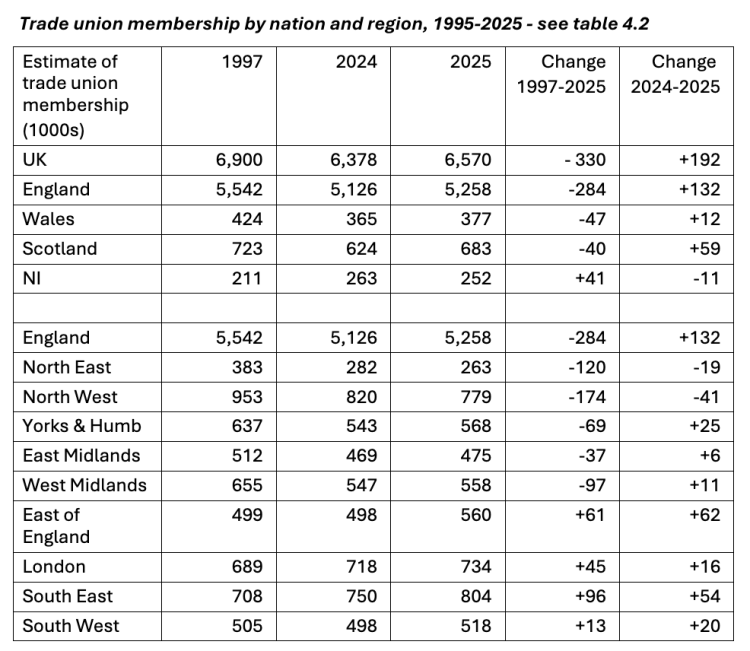
Source: https://www.gov.uk/government/statistics/trade-union-statistics-2025, see Table 4.2
In the period 1997 to 2025 trade union membership in England, as a whole, fell by 284,000. But in that same period of time trade union membership in London, the South East, and the East of England grew by 202,000. This merits deeper analysis. Is there any evidence that unions in the TUC LESE region were confronted earlier with labour market changes, such as the decline of manufacturing, increasing employment in the third sector, outsourcing and precarious employment, and that organising strategies evolved to meet those challenges? Are there learnings to be shared?
5. Are there really more trade union members in London, the South East, and the East of England, than in France?
We are being mischievous with a purpose. The latest UK statistics tell us that there were 2.1 million trade union members in the TUC LESE region in 2025. Current estimates of trade union membership in France are as low as 2.15 million, (Institut Montaigne). But in France, typically, only the workplace representatives join a union.
The real point here is that it is not solely the number of members that matters, it is the level of organisation, the legal infrastructure of industrial relations, the collective bargaining coverage and trade union culture that matter.
So, TUC LESE is delighted that union membership is growing in our region and having more than 2 million members in our region is a powerful statement, but this sits alongside activism, industrial campaigns, the number of reps, diversity, organising capacity and collective bargaining as core features of stronger unions.
6. Don’t be a passenger, help the union movement grow and strengthen
If you see an issue at work, that you know is a matter of concern with other colleagues, it could be the root of a workplace union organising campaign. And if you are thinking ‘Oh no I am too busy’, a key organising practice is to get others involved to share the workload. This is how new workplace leaders emerge.
Effective union organising isn’t spontaneous, it is planned, its sits within a strategy, it uses a mentality that is based on values, and it is supported by skills and competencies. Every trade unionist can become a better organiser. Check out the TUC’s resources support organising at work:
- TUC Growth Hub - Growth Hub | TUC
- Organising Guide for reps - Organising course for union reps | TUC
- TUC Pocket Guide to Organising and Campaigning - Pocket guide to organising and campaigning
- The Organising Academy Award in Supporting Organising course, (3 days) and The Organising Academy Diploma in Organising course, (16 days) - TUC Education Organising Academy 2025-26 Course Programme | TUC
- And if you are a full-time officer, check out the TUC’s Organisers Network
Stay Updated
Want to hear about our latest news and blogs?
Sign up now to get it straight to your inbox