
Jobs guarantee for young people
As the TUC submission to the Milburn review showed - the NEET crisis has been years in the making. Young people do not lack ambition – most who are NEET want to work. But they are being held back by a lack of entry level roles, regional and local labour market inequalities, the rise of insecure work, and cuts to education, health and social security. Together they have created a perfect storm, making it harder for this generation to get in to work and progress in it.
Real experience of paid work is the most effective ways of getting young people into sustained, unsubsidised employment in the long term. The jobs guarantee has a central role here – Government support will help give young people their first experience of the working world.
And on our calculations it is strong value for money, with young people more likely to be in work, paying taxes, and less likely to claim social security than if they hadn’t had a chance at the scheme.
Why the jobs guarantee matters
We know that job guarantee schemes work. The previous Labour government’s Future Jobs Fund was highly effective, giving participants recent experience of a real job with a real wage, opportunities to develop new skills and an employer reference.
A recent Resolution Foundation report also found that targeted employment programmes, such as the Jobs Guarantee, are significantly more cost-effective than broad demand-side measures, including changes to employer National Insurance contributions.
The TUC welcomed the government’s decision to adopt our long-standing call for a Jobs Guarantee for young people. The scheme offers eligible 18- to 24-year-olds a fully funded, six-month paid job for 25 hours a week. Eligibility is currently limited to those who are on Universal Credit and been seeking work for 18 months. The government expects the scheme to support more than 90,000 young people over three years, but the TUC is calling for a more ambitious approach.
The TUC proposal
The TUC is calling on the government to bring forward access to the scheme and increase the number of places available. By
- reducing the time young people have to be on Universal Credit before they can access the Jobs Guarantee from 18 months to 6
- scaling up the number of places from 90,000 to 225,000 over three years.
We estimate that this expansion would require an additional £1 billion of government investment.
Even a more moderate change to the criteria bringing eligibility forward to 12 months and increasing the places to 135,000 over three years would only cost the government an additional £337 million to what it has already committed too.
Costs and long-term benefits
These costs would be far outweighed by the benefits of an effective scheme that gets young people into work, and reduces the amount of time they spend unemployed or inactive.
- We estimate that the long run benefits of scaling up the job guarantee scheme to 225,000 places would be almost £4.6 billion, the total benefits of the scheme are set against costs over time, using the standard Treasury approach. This far outweighs the upfront investment by a ratio of 2.69. This means for every £1,000 of (net) government spending on the programme, £2,690 of net revenue is generated for the Exchequer in the long run.
- Even the more moderate change to the criteria bringing eligibility forward to 12 months and increasing the places to 135,000 over three years would produce £2.74bn of benefits in the long run compared at a cost to benefit ratio of 2.67.
Assessed over 30 years, both options would break even within eight years. Our estimates are deliberately cautious, so the programme’s employment outcomes and long-term benefits could be higher.
Overall results in real terms - in 2026/27 prices
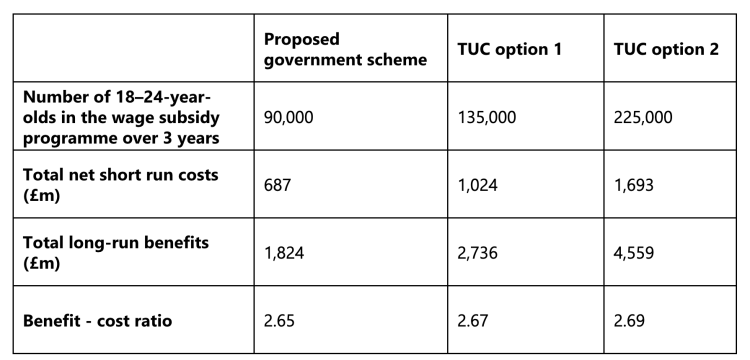
Source - Analysis on costings and cost benefit analysis has been carried out by Landman Economics - full report can be downloaded here.
Put the guarantee on a permanent footing
As well as scaling up the scheme, the Government should end the constant re-writing of youth support programmes. Under the Tories, multiple youth offers were created and then scrapped, giving hardly enough time for any benefits to be bed in.
The upcoming 10-year plan for Britain due to be unveiled by the Prime Minister provides an opportunity for the Jobs Guarantee scheme to be central to a 10-year ambition to turn the country around. An expanded Jobs Guarantee should be placed on a permanent footing, with the flexibility to grow when youth unemployment rises and scale back as the labour market strengthens.
Stay Updated
Want to hear about our latest news and blogs?
Sign up now to get it straight to your inbox