
90th Anniversary of the Battle of Cable Street – to honour the past and shape the future
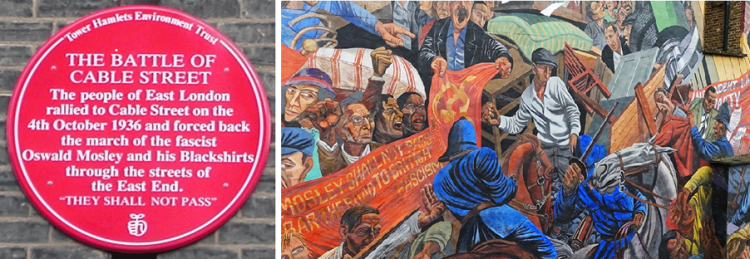
In the mid-1930s the economy was recovering from a deep recession. During the crash the UK’s trade flows had halved, the output of heavy industry had fallen by a third, and the unemployment rate reached 25 percent in 1933. People were hurting and angry.
Politics at the time was febrile and divided. Oswald Mosley had founded the "Blackshirts" in October 1932 as the paramilitary wing of the British Union of Fascists, modelled on Mussolini’s Blackshirts in Italy and Hitler’s Sturmabteilung in Germany. Mosley’s programme was explicitly founded on antisemitism. Mosley’s plan to march his Blackshirts through the East End in October 1936 both targeted the Jewish community and was designed to provoke violent division. But his “Blackshirts” did not pass.
We also live in troubled times, with our economy ‘bumping along the bottom’ since 2008 after a global financial crash that was caused by greedy bankers, a cost-of-living crisis, millions of ‘working poor’, the consequences of illegal wars, and the politics of hate, division and rupture in our news, in our workplaces and in our communities too.
In the UK migrants are stereotyped and vilified, Muslims are stereotyped and vilified, antisemitic incidents are on the rise and many people with racist views feel emboldened to express those views openly. We have political parties using racism as a wedge issue and we have hundreds of masked men dressed in black blocking roads, intimidating the public, and targeting RNLI volunteers.
Across Europe far-right parties have gained considerable electoral support in the last 30 years, and policies that were recently regarded as extreme have become normalised. A far-right party is in government in Italy, and far-right parties participate in government in Austria, Finland and Slovakia. The Front National, now National Rally, has been a feature of politics in France for decades, it is the largest opposition party in the National Assembly, has the largest number of MEP seats, has just won more seats in the French Senate, and it a force in the upcoming Presidential election. The far-right Alternative for Germany (AfD) recently won its highest ever vote in a regional election in Germany's eastern state of Saxony-Anhalt, far ahead of mainstream rivals, winning 43.8 percent of the vote, just 3 seats short of an overall majority. A far-right party has not controlled a German state since World War Two. To date other political parties have maintained a firewall against working with the AfD, but from December it could be in government in Saxony-Anhalt, with powers over policing, local education and culture. This would be an immense moment in European politics.
This isn’t a re-run of the 1930s. The politics of today has its own dynamics, and today we have the modern-day problem of far-right tropes, lies and disinformation on social media. But there are parallels to the 1930s and there are lessons that we can learn from the Battle of Cable Street.
Resistance matters
The weather 4 October 1936 was fine. The easy thing to do that day was to get out of the way, ignore the Blackshirts, and go to Victoria Park for the day. But all that is needed for evil to triumph is for good men and women to do nothing. Bravely, tens of thousands answered the call, organised, built barricades, acted with courage and solidarity, defended their streets and saw off the Blackshirts and the police. Their victory still resonates today.
Networks, Organisation and Leadership matter
The defence of Cable Street didn’t just bubble up from the pavement, it was mobilised, organised and led. These skills are learned and honed. Organised labour does what it says on the tin. Trade unions are one of the few social structures with reach across workplaces, communities and the public realm. The union movement has a responsibility to lead the challenge against the politics of hate. If you are not in a union, join one. If you are in a union, organise and change the world.
Solidarity in the community and beyond is essential
Cable Street was not a narrow victory for one group. Nor was it a victory for an alliance of segmented groups. It was a triumph for a diverse and politicised local community of trade unionists, communists, socialists, members of the Labour Party and ILP, and working-class families, many of them Jewish and Irish. Jewish women garment makers were women, maybe mothers, active members of a union, possibly Communist Party members, and almost certainly activists challenging awful housing standards, opposing evictions and participating in rent strikes. This lesson remains vital, antisemitism cannot be tackled in isolation, racism cannot be tackled in isolation, tackling xenophobia is a common cause, and winning good jobs for all is a collective task. The fights are linked and mutually dependent. History proves we achieve more together than we do apart. Division is toxic and drags us all down. Join our Unity Works campaign for updates
Building stronger communities
Cable Street 90 is not a coalition built to organise an event and then dissolve. We know that through intense joint working we will forge a stronger broad based local community that is better able to advocate and organise for the community, and better able to respond robustly to hate politics online and on its streets. It is capacity building.
So, Cable Street 90 is not a heritage event, it is a call to action. Let’s make every street Cable Street
The TUC has organised a briefing to discuss the significance and lessons of the Battle of Cable Street, European perspectives, with CGIL (Italy), CGT (France) and CCOO (Spain) and other key partners, 2 October, in person, 14:00-17:00, at Congress House, Great Russell Street, London WC1B 3LS. More information and registration
TUC LESE is part of the Cable Street 90 coalition that has organised rallies and a march in the East End of London, 4 October. Assemble outside Whitechapel Tube Station, E1 1BY, at midday for an opening rally, march moves off 13:00 and processes to St George’s Gardens. This is a celebration and family event. Please bring trade union banners and flags. More information and updates
More information about signing up to be a steward at Cable Street 90
Stay Updated
Want to hear about our latest news and blogs?
Sign up now to get it straight to your inbox