Blog listing
Stay Updated
Want to hear about our latest news and blogs?
Sign up now to get it straight to your inbox
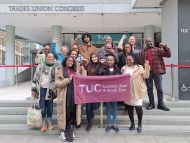
Applications open for the 2027 Black Activist Programme
As applications open for the 2027 Black Activist Programme, it's an opportunity to reflect on the impact the programme has had on Black* trade unionists across the London, East and South East region.
There is a major policy opening for worker power on technology right now
Trade unions must take this opportunity for collective rights on algorithmic management, paving the way for worker voice on all tech at work.

90th Anniversary of the Battle of Cable Street – to honour the past and shape the future
Sunday 4 October 2026 is the 90th anniversary of the Battle of Cable Street when ordinary men, women, and some feisty children, literally stood shoulder to shoulder in the East End of London determined that organised fascists would not march through their community. This remains a massive moment in our history but the celebrations that are being organised 4 October 2026 are not a heritage event – they are a commitment to action.

Cost of living affects us all - what can we do for young people
The cost of living remains the top concern for most people. After a fourteen-year pay squeeze, poor growth and price shocks, too many people are struggling to afford essentials or achieve a decent quality of life.

TUC Skills 2050 - building a worker centred skills ecosystem in the UK
In July, we launched a new project – Skills 2050. The project brings together unions, employers and policy experts, rooted in worker voice, research, and robust discussion, to develop a vision for the UK skills settlement in 2050.

Unions are calling time on outsourcing
Decades of outsourcing has been disastrous for workers, disastrous for taxpayers and disastrous for Britain.

From online hate to workplace harm: understanding the manosphere
Misogyny in our society is not new, but the context is changing. Advancements in technology are used to harass and abuse; misogynistic content amplified on social media; the global roll back of women’s rights and an emboldened far right is weaponising the safety of women and girls to justify a racist, sexist, divisive anti-migrant agenda.

Jobs guarantee for young people
The TUC believes the Government’s jobs guarantee for young people should be central to our response to the growing number of young people not in education, employment or training (NEET). Expanding eligibility and providing more places would give thousands more young people access to the scheme.

Welcome to TUC Congress 2026!
A great deal has happened since last year. We have seen a new prime minister enter Downing Street. We have witnessed conflict, instability and uncertainty on the international stage. And, of course, the ridiculous spectacle of Nigel Farage taking on a bin in Clacton.

Unions are building a fairer Britain, pushing for unity over division
The TUC Equality Audit, published every two years, is an essential yardstick and benchmarking tool with which we can measure our collective efforts. This year’s equality audit focuses on what steps unions have taken in the last four years to promote equality in their membership, structures and processes, and to ensure they reflect the diversity of our membership.

A decade of fighting for workers harmed by asbestos
There are some workplace dangers that belong firmly in the past. Asbestos should be one of them.

Why does Reform UK want to rip up workers' rights? Follow the money
Reform UK invited unions to their conference, so we showed up to remind workers that Reform is not on their side. Last week, we held two major campaign actions outside the Reform Party conference in Birmingham to expose their links to offshore billionaires and how damaging their anti-worker policies are.

Funding a cut in energy bills with a bank tax
Working people are struggling to pay their bills, while banks make billions in windfall profits and pay out their biggest bonuses in years. It's time they contributed their fair share, and that money was used to cut energy bills for everyone on low and middle incomes.

Equality doesn't end at the workplace door
At a time when Reform UK is calling for equality protections to be rolled back and some Reform-led councils are reducing visible support for LGBT+ communities, the public continues to back equality protections and LGBT+ inclusion.

Real devolution puts working people at the heart of decision making
Devolution is key if Burnham wants to remake Britain. But it must be delivered with working people, not merely forced upon them.

Nigerian Government investigated for anti-union interference
2024 arrest of NLC President on his way to TUC Congress raised with UN workers’ rights watchdog

The growth of trade union membership in the UK – a focus on TUC London, East and South East
The official statistics published in May showed a big rise in trade union membership in the UK between 2024 and 2025. We at the TUC rightly celebrated the increase of 192,000 members to 6.57 million. Read the TUC’s excellent blog about the membership figures.

Workers actually have significant leverage on AI right now
In talk of the ‘AI transformation’ workers are often cast as the subjects or even victims of change. They are to be trained, maybe protected or perhaps just discarded. It is true that workers face instability. But two dynamics are playing out in a way that is giving workers, representatives and allies significant leverage right now.

A global breakthrough for platform workers: what the new ILO Convention means
Platform workers are for the first time the subject of a global labour standard following the adoption of the Decent Work in the Platform Economy Convention at the 114th International Labour Conference (ILC) in Geneva.

Shaping a social security system that works - getting PIP right
At this year’s TUC Disabled Workers Conference, held at the Bournemouth International Centre on 19–20 May 2026, over 250 delegates came together to debate some of the most pressing issues facing disabled people today.

The skills gap crisis and why workers can't wait
While technological and industrial changes are not new, we all know that working people are living through one of the biggest changes to jobs in a generation or more.

Union Learning - 20 years on
A legacy worth rebuilding in a changing world of work. As unionlearn reaches its 20-year milestone, working people are navigating one of the biggest transformations in jobs for a generation.

Government insourcing move shows why Our Work Matters
The government's decision to bring around 2,000 facilities co-workers back in-house is a significant victory for workers and public services.

You have our support. It's time for the biggest wave of insourcing in a generation!
Last month, as part of the Our Work Matters campaign, seven brilliant public sector workers met with Chris Ward, the minister in charge of the government’s insourcing commitments.

Reform UK wants to steal your rights - here's how workers are fighting back
Yesterday, union members and supporters held a day of action as part of the stop the steal campaign. Thousands of posters were delivered to workplaces and communities around the country to help spread the word about Reform UK’s threat to repeal the Employment Rights Act.

Good work is good for you: the link between job quality and life expectancy for North East workers
The North East has some of the lowest Healthy Life Expectancy rates in the country, but this isn't inevitable. Continuing to improve the quality of work is key to bringing long term positive change for working people across the region.

Poverty won't fix itself - organised labour must act
We are deep into the twenty-first century, living and working in the sixth largest economy in the world, and yet millions of people in the UK struggle to afford basic items such as food, energy and a decent home to live in.

Why more than one million young people are out of work, education or training
The Milburn Review confirms the UK's NEET crisis is a long-term structural problem – not a result of workers' rights or higher pay.

A record-breaking rise in trade union membership
The most recent trade union stats brought some good news: trade union membership is up. In 2025, trade union membership rose by 192,000 and now sits at 6.57 million. This is the highest it’s been since 2020.
Discovering true democracy
Young GMB activist Rosie McKenna shares her experience of the NEY&H Regional Conference - reflecting on how it has deepened her understanding of the movement and inspired her to stay active.