
The experience of insecure work
The UK’s insecure work crisis is deepening, with 4 million people now trapped in jobs that deny them stability, dignity, and fundamental rights. One in eight workers face precarious employment - whether through zero-hours contracts (ZHCs), agency work, or low-paid self-employment - amid a labour market increasingly designed around employer flexibility at the expense of worker security.
This report, based on TUC-commissioned polling of over 2,500 workers, including more than 500 in insecure roles, examines the human cost of insecure work: unpredictable hours, cancelled shifts, inadequate sick pay, and financial strain. Far from providing the flexibility often claimed, these contracts impose insecurity and stress on workers already facing disadvantage, particularly Black and minority ethnic (BME) workers, young people, carers and working mothers.
Key findings include:
- Insecurity is widespread and growing: Insecure work has grown much faster than secure employment. BME workers face a disproportionate burden, with 16% now in insecure roles compared to almost 12% of the wider workforce. This increases to 18.9 per cent among BME men - almost a fifth of all BME male workers.
- BME workers face deeper insecurity: BME workers are more likely to be in insecure work and experience more extreme instability. 60% of BME workers surveyed said they were given less than 24 hours’ notice for shifts, and almost two thirds reported working while unwell due to financial pressure. This raises concerns that insecure contracts may be entrenching racial inequality in the workplace.
- Unpredictable and exploitative hours: Over half of insecure workers are offered shifts with less than 24 hours’ notice. Four in five workers on ZHCs report frequent last-minute scheduling, rising to 85% among carers on ZHCs.
- Cancelled shifts without pay: Two-thirds of ZHC workers received no compensation the last time their hours were cancelled, with mothers and carers the most likely to lose out.
- Workers want regularity, not precarity: Most insecure workers say they would prefer stable hours, with over 80% of ZHC workers wanting consistent schedules with optional overtime. Yet one third of people on ZHC said that their employer had denied their request for guaranteed hours. This shows the pressing need for the Employment Rights Bill’s rapid implementation.
- Flexibility is a myth for many: One in four insecure workers cannot refuse hours. Of those who have refused hours previously, around a fifth of workers get penalised for doing so while a further fifth face bullying from managers as a result.
- Poverty pay and economic hardship: Nearly two-thirds of insecure workers struggle to cover basic living costs. Over 70% have worked while sick due to lack of sick pay, and nearly 80% of students on ZHCs say their education suffers as a result.
Support for stronger rights is overwhelming. Majorities across all worker groups back proposals in the Employment Rights Bill, including contracts that reflect regular hours after 12 weeks, day-one rights, and expanded access to sick pay and a higher minimum wage.
Encouragingly, the government has begun to take significant steps to address the rise of insecure work. New legislation will give workers the right to predictable hours, stronger protections from day one, and fairer access to sick pay. These reforms are urgently needed after decades of insufficient protections for workers. They represent a critical shift towards a fairer labour market and provide a vital opportunity to end the routine exploitation of insecure workers.
Introduction
The pursuit of a flexible labour market and inadequate employment rights protections have led to a surge in the number of workers employed on insecure contracts. According to the most recent figures, there are now 4 million workers in insecure work, representing 1 in 8 workers. Insecure work is currently growing at three times the rate of secure jobs.
The TUC uses a broad definition of insecure work to cover a range of employment relationships where workers are disadvantaged. When discussing the number of people in insecure work the TUC includes:
- those on zero-hours contracts
- agency, casual and seasonal workers (but not those on fixed–term contracts)
- the low-paid self-employed who miss out on key rights and protections that come with being an employee and cannot afford to provide a safety net for when they are unable to work.
Black and minority ethnic (BME) workers are disproportionately affected by the growth of insecure work. Since 2011, the proportion of the working population in insecure work has grown from 10.7 per cent to 11.7 per cent. BME workers have borne the brunt of this increase. Between 2011 and 2024, the proportion of BME workers in insecure employment has risen from 12.2 per cent to 16.3 per cent. 1
The TUC recently commissioned a survey to better understand the working conditions and challenges of those on these insecure contracts, as well as their attitudes to policies which may address the scourge of insecure work. We surveyed just under 2500 workers, of whom more than 500 were on insecure contracts of which 300 were on zero-hour contracts. For this survey, insecure workers were defined as working through an agency, on a ZHC or fixed term part-time contract, or self-employed while having a C2DE social grade.
Findings
Typical working patterns
We asked participants whether they typically worked the same or similar hours each week, or if their working patterns varied. The responses reveal stark differences between those in secure and insecure employment.
Three quarters of workers in secure jobs said they usually worked consistent hours. In contrast, only two in five workers in insecure roles reported having regular weekly hours. Among those on zero-hours contracts, this dropped to just one in five. Almost as many said they worked only when required, highlighting the unpredictable nature of this form of employment.
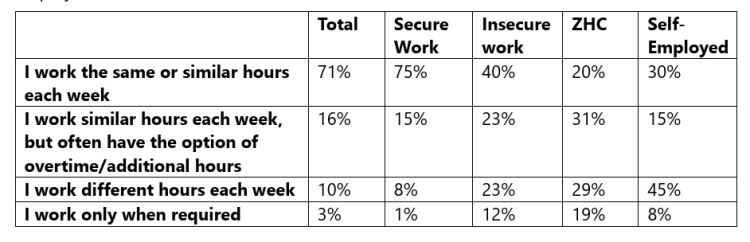
More than half of workers on ZHCs did report that they work the same or similar hours each week (compared to 90 per cent of workers in secure jobs), sometimes with the option of overtime, but because of the nature of their contract they have no job security. This shows that many zero hours contract workers would benefit from a guaranteed hours contracts which truly reflects the regular hours they already work.
For mums on zero-hours contracts, the situation was even more precarious. Only around one in four reported working regular hours, suggesting that insecure work disproportionately affects this group. Furthermore, a third of respondents in this group said they that worked different hours each week, suggesting that they were particularly affected by precarious working patterns.

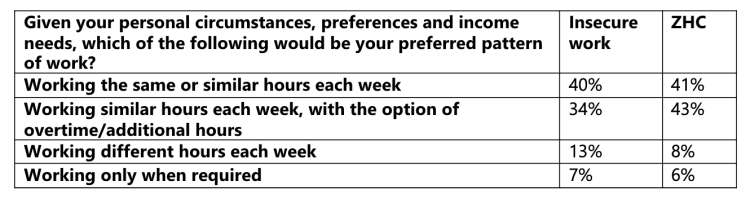
For many insecure workers, this is not their ideal working arrangement. The overwhelming majority of workers in insecure work or on ZHCs would prefer to work the same or similar hours each week, possibly with the option of overtime. Almost three quarters of those in insecure work would prefer that arrangement, and more than four fifths of those on ZHCs would prefer it.
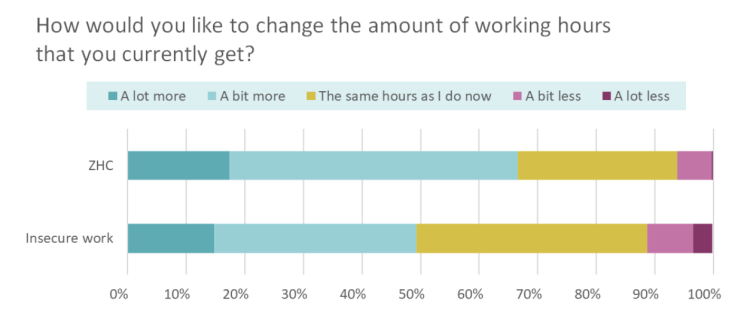
Almost half of those in insecure work said that they would ideally like to work more, and this rose to more than two thirds of those on ZHCs. This was highest among mums and carers where almost three quarters on ZHCs said that they would like to more working hours.
Furthermore, the survey revealed that a third of workers on zero-hour contracts asked to receive guaranteed core hours and had this request rejected.
Changes to shifts
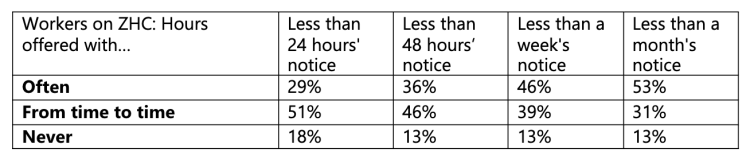
Workers in insecure jobs are frequently expected to accept or cancel shifts at very short notice, making it difficult to plan ahead or manage household budgets. More than half of insecure workers said they were offered shifts with less than 24 hours’ notice, either often or from time to time.
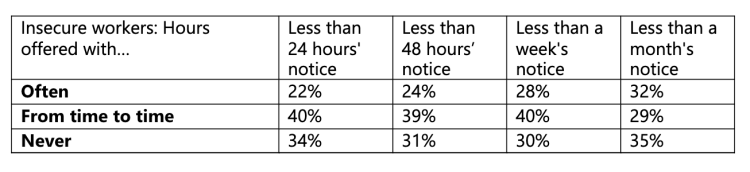
These figures were even more stark among workers on ZHCs, where four fifths of respondents said that they often or sometimes had shifts offered with less than 24 hours’ notice. Young workers were more likely to experience this kind of scheduling: over 70% of 18–24-year-olds said they were given less than 24 hours’ notice at least occasionally.
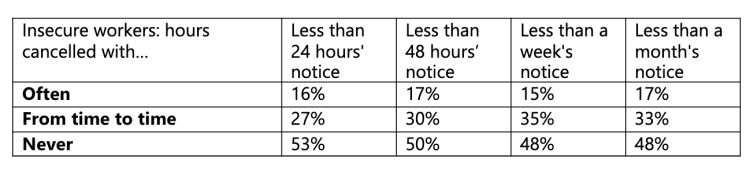
A similar pattern was seen for cancelled shifts. Two in five insecure workers said their hours were cancelled with less than 24 hours’ notice at least occasionally. Half of insecure workers said that they often or sometimes had their shifts cancelled with less than a week’s notice.
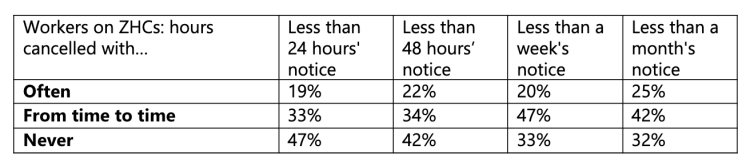
Among those on zero-hours contracts, over half said that they often or sometimes had shifts cancelled with less than 24 hours’ notice. This rose to almost two thirds for carers’ on ZHCs. More than two thirds of those of ZHCs said that they often or sometimes had shifts cancelled with less than a week’s notice.
Compensation for cancelled shifts
Despite this disruption, most workers on insecure contracts received no compensation for cancelled shifts. Over half of all respondents said they were not paid the last time their hours were cancelled. This rose to two-thirds among workers on zero-hours contracts.
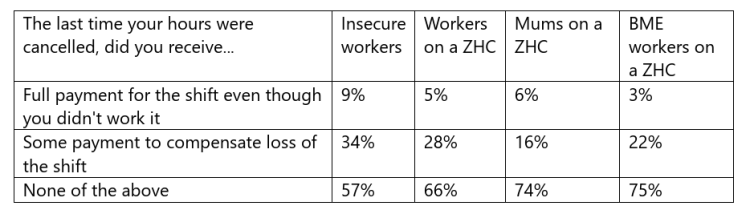
The issue was particularly acute for mothers and BME workers in insecure roles. Three quarters of these workers said they received no payment when their shifts were cancelled.
This lack of financial security leaves many workers struggling to manage their income and undermines their ability to plan and budget.
Impact of refusing hours
Some argue that zero-hours contracts offer flexibility for workers as well as employers. However, our findings suggest that this flexibility is not evenly shared.
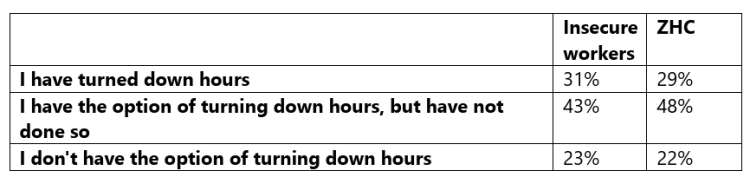
Fewer than one in three insecure workers said they had ever turned down hours offered to them, with zero hours contract workers less likely than other workers to have turned hours down. A further 43% said they could decline hours but had never done so, and nearly one in four reported that they were not allowed to refuse shifts at all. These figures were similar for those on zero-hours contracts, undermining claims that these roles offer genuine control over working time.
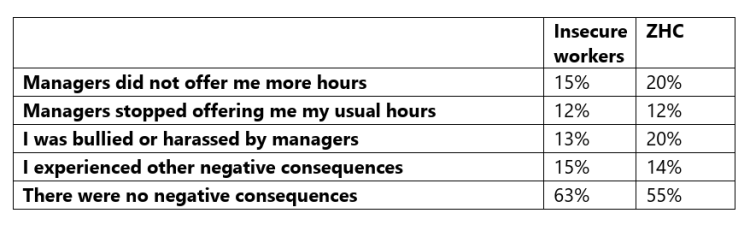
While a majority of workers reported that they didn’t experience any negative consequences for turning down hours when offered, a still significant portion did experience difficulties after refusing hours. A fifth of those on ZHCs who had turned down hours within the last year reported that managers stopped offering them more hours, and a further fifth reported that this had resulted in bullying or harassment from managers. One in eight reported that, after rejecting additional hours, managers stopped offering them their usual hours.
Financial strain
Unpredictable hours and cancelled shifts have real consequences for workers’ financial wellbeing. Nearly two-thirds of those in insecure work said they often or sometimes struggled to meet their basic living costs due to not being offered enough hours. This figure rose to three quarters for workers on zero-hours contracts, and one third of this group said they often experienced difficulty.
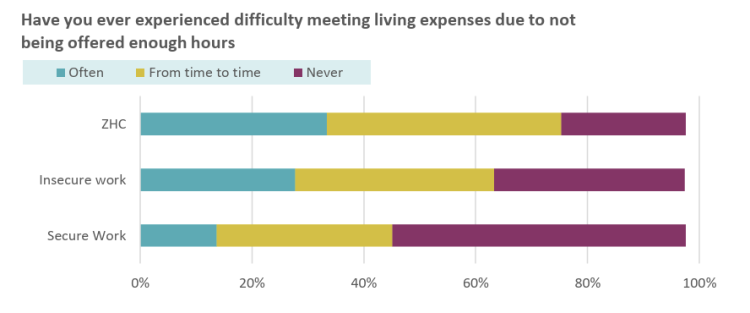
Again, mothers and BME workers were particularly affected. Among mothers on zero-hours contracts, 41% said they struggled to meet living costs due to insufficient hours.
Working while unwell
Financial pressure also led many workers to work when sick. Almost three quarters of those in insecure work said they had felt compelled to work despite being unwell. This was especially common among carers on ZHCs, of whom 87% said they often or sometimes felt that they had to work despite being unwell. This suggests a troubling link between insecurity and poor health outcomes.
Managing education alongside work
Zero-hours contracts are often promoted as a flexible option for students. However, the survey results suggest that this flexibility is more damaging than helpful.
Nearly half of all students on zero-hours contracts reported that they often found it difficult to manage their studies alongside work, compared to just over a quarter of students who aren’t on ZHCs. A further third said they sometimes struggled. These findings indicate that the unpredictability of insecure work can undermine education and personal development.
Reasons for being on ZHCs and preferred working patterns
For many of those in insecure work, it is not their preferred working pattern. Three fifths (61%) of workers on ZHCs said that a contract that offered some guaranteed shifts would be better in their view. This was highest among carers on ZHCs, where almost four fifths (78%) said that it would be preferable for them.
Just one fifth of respondents said that they were working on a ZHC due to the additional flexibility they would need to care for a child, or others close to them. This finding, alongside other key findings above, which show a significant proportion of insecure workers are unable to turn down shifts and pick up the shifts they need, dispels the myth that insecure contracts offer workers the flexibility they need. Despite this, a third of mums on ZHCs reported that they often had difficulty managing childcare or caring responsibilities alongside their jobs, compared to a fifth of mum surveyed who are not on a ZHC.
When asked why workers were on ZHCs, the most common answer what that it was the typical working arrangement for the type of work they do, suggesting that these workers did not actively choose this working arrangement for the flexibility it offered, but were rather constrained by employer demands.
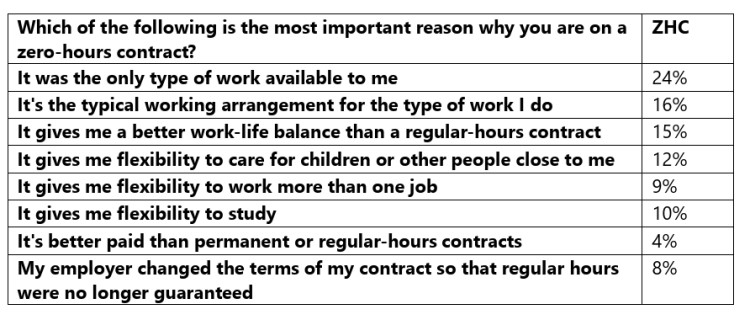
Furthermore, when asked why they were on zero-hour or insecure contracts, two in five (41.1%) of workers in low-paid households (annual household income below £25k) responded that it was the only type of work available to them. This suggests that their choice was constrained rather than deliberate.
Attitudes towards improved protections for those on ZHCs
Most workers in secure contracts, insecure work and zero-hour contracts supported the proposals in the Employment Rights Bill to give more protections and rights to workers on zero-hour contracts.
The majority of workers across all three groups believed that all workers should be entitled to a contract which reflects their typical working hours after 12 weeks with an employer. The portion of workers who disagreed with these statements was incredibly small, and the portion who felt very negatively towards these statements was between 1% and 3%.
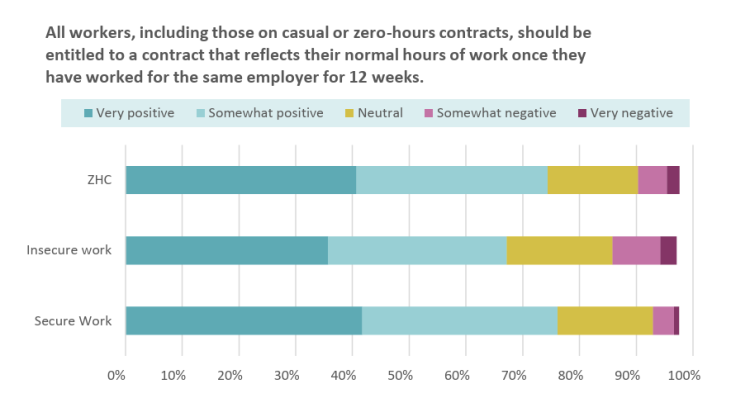
This sentiment was popular among mothers and students on ZHCs, with 78% and 83% respectively feeling very or somewhat positive towards the statement.
Attitudes towards policies proposals to strengthen workers’ rights
In addition, roughly three quarters of all three groups felt positively about expanding the full minimum wage to all workers aged 18 and over.
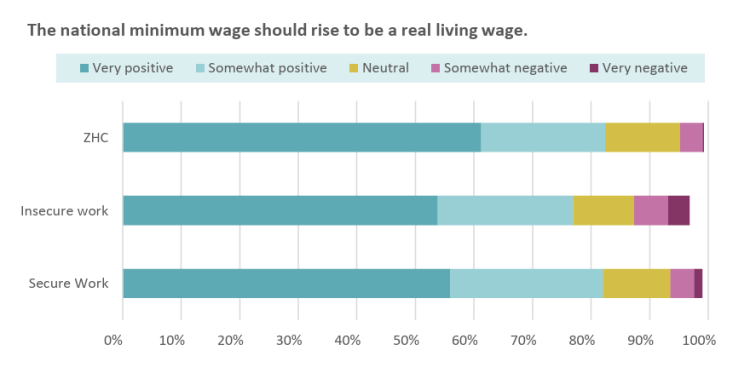
There was also strong support for raising the minimum wage to a real living wage, with more than four fifths of those in secure work and on ZHCs agreeing with the statement, and more than three quarters of those in insecure work in agreement.
Methodology
This report is based on TUC-commissioned polling of just under 2,500 workers, including more than 500 in insecure roles.
The definition of people in ‘insecure work’ used in this analysis includes:
(1) Agency, workers.
(2) Workers whose primary job is a zero-hours contract.
(3) Workers on a fixed term, part-time contract.
(4) Self-employed workers who are in the C2DE social class.
Stay Updated
Want to hear about our latest news and blogs?
Sign up now to get it straight to your inbox