
Making work pay is good economics
The consequences of labour market deregulation
The UK has experienced the longest pay squeeze in modern history, a proliferation of insecure work and stagnant economic growth. This has come alongside poor employment protection – with UK labour standards generally less protective than other developed economies.
Economic theories which promoted highly flexible labour markets have now been widely discredited. The evidence now shows that aggressive pursuit of highly flexible labour markets has led to an economy characterised by inequality and a long tail of low-quality jobs, with low pay and low job satisfaction for workers.1 The UK has some of the highest levels of pay inequality in the developed world after steep increases in the 1980s.2 Only a minority of people are satisfied with the availability of secure, well-paying local jobs. 3
Inequality is also reflected in the differential experiences of marginalised groups. Black workers and disabled workers are more likely to experience insecure work 4 , and women have borne the brunt of declining living standards over the last 15 years. 5
Health outcomes reveal some of the most concerning impacts of excessive labour market deregulation. Research shows that poor quality jobs can be more damaging to health than unemployment. There are 1.7 million workers in Great Britain who experience health conditions caused or made worse by their job. 6 Those in insecure work are much more likely to experience work-related stress.7 This takes its toll on the mental and physical health of workers and leads to costs 8 for the NHS and other public services.
A turnaround in the economic consensus
The case for labour market flexibility relied heavily on the idea of trade-offs between a strong economy and better labour market protections. However, we have seen that falling real wages and the rise of insecure work have been bad for living standards and bad for the economy. The emerging empirical evidence has ushered in a turnaround in thinking about labour market protections. Economists are increasingly of the view that “economic prosperity and social justice go hand in hand” as expressed by Chancellor Rachel Reeves.9 There is clear evidence that boosting employment rights can improve living standards, increase productivity, and promote better economic outcomes.10
The shift in economic consensus is reflected in the government’s Employment Rights Bill, which is set to deliver an important uplift in employment rights. This landmark legislation will benefit millions of workers, especially those trapped in insecure jobs. The official impact assessment 11 of the Bill estimates modest costs at less than £5bn annually, equivalent to less than 0.4% of employment costs. Many of the costs are implementation costs. But initial TUC analysis suggests that these costs should be outweighed by benefits of approximately £13 billion (central estimate), due to reduced stress, increased well-being, better labour market compliance, and reduced industrial conflict and disputes.
The shifting consensus is also reflected in the views of international institutions such as the Organisation for Economic Cooperation and Development (OECD) and the World Bank. The OECD Jobs Strategy of 1994 12 played an instrumental role in promoting labour market deregulation. It argued that governments should weaken employment protections and weaken collective bargaining with the aim of creating flexible labour markets. But by its 2018 Jobs Strategy 13 the OECD had decidedly shifted its recommendations. It now concluded that countries which promoted job quality and inclusive labour markets performed better than those which were focussed solely on flexibility. This turnaround has been documented in detail by Evans and Spriggs.14
What the latest evidence shows
The newer evidence shows that labour market protections lead to improved economic outcomes and a more equitable share of income between labour and capital. This is reflected in Deakin and Pourkermani’s research 15 based on an extensive database of employment protection legislation across much of the world. They show that labour protections can increase employment, reduce unemployment and improve productivity while making sure the proceeds are shared with workers. This fits with findings from an international meta-analysis 16 of 111 studies which finds that trade unions have positive impacts on productivity overall. A fairer labour market can be delivered alongside a stronger economy.
As the evidence has mounted, influential economists such as Nobel Prize winning Sir Angus Deaton have shifted their views.17 Deaton was the public face of the Institute for Fiscal Studies (IFS) inquiry into inequality. Recently he has found himself changing his mind on economics, including on the “importance of power in setting prices and wages”. He highlights the important of worker power in reducing inequality and producing positive economic outcomes.
Evidence from the success of minimum wage policy is also instructive. History has proven wrong those who opposed the introduction of a minimum wage. At the time, the CBI argued it "could result in rising prices, business closures and unemployment" and that it would “undermine flexibility and was a poor way to tackle poverty".18 Instead, the empirical evidence has shown that minimum wages raise pay without a negative impact on employment 19 . The success of the minimum wage suggests there is monopsony in labour markets. So as evidence from the minimum wage has shown with the wage floor, it follows that there will be a positive impact from a raised floor of employment rights under the same monopsony conditions. Stronger employment protections can deliver both improved job quality and higher employment rates.
The evidence is also building in Spain which has taken measures to tackle insecure work and strengthen labour market protections. The IMF 20 and the Economist 21 have both recognised the strong performance of the Spanish economy in 2024. The Spanish Deputy Prime Minister pushes back against the view that “deregulating, cutting off labour rights, attacking unions and lowering wages, we were going to have more jobs. And this is what, empirically, is not true, [as] we have demonstrated in our country.” 22
Conclusions: Improved labour market protections can deliver a stronger economy
The case for labour market deregulation has been discredited. The verdict is in from decades of experimentation with a low pay, low rights, flexible labour market. The evidence shows that reductions in employment protection have not produced good economic outcomes. Instead, we have seen a growth in poor quality jobs, and little growth in productivity or output.
There has been a sea-change in the consensus around labour market protections with influential institutions and economists changing their minds. The government’s Employment Rights Bill reflects the latest evidence and puts it into practice. This is an opportunity to adopt a more inclusive labour market model. This will help secure the benefits that stem from better employment relations, wage growth, improved productivity, and improved consumer confidence and higher demand.
In retrospect, the case for labour market flexibility appears ideological and poorly evidenced. Sticking with this approach would lock in poor outcomes and a low road approach to the economy. Instead, we should take heed of the evidence and realise the economic gains of making work pay.
- 1 Deakin, S & Pourkermani, K (2024) The economic effects of changes in labour laws: new evidence for the UK. Digit Policy Brief. https://digit-research.org/publication/the-economic-effects-of-changes-in-labour-laws-new-evidence-for-the-uk/
- 2 Resolution Foundation & Centre for Economic Performance, LSE (2023) Ending Stagnation: A New Economic Strategy for Britain https://economy2030.resolutionfoundation.org/wp-content/uploads/2023/12/Ending-stagnation-final-report.pdf
- 3 Ipsos Mori (2025) Understanding Society https://ipsos-insight-llc.foleon.com/understanding-society/public-services-2025/jobs
- 4 Resolution Foundation & Centre for Economic Performance, LSE (2023) Ending Stagnation: A New Economic Strategy for Britain https://economy2030.resolutionfoundation.org/wp-content/uploads/2023/12/Ending-stagnation-final-report.pdf
- 5 Women’s Budget Group (2024) Where do we go from here? An intersectional analysis of women’s living standards since 2010 https://www.wbg.org.uk/publication/where-do-we-go-from-here-an-intersectional-analysis-of-womens-living-standards-since-2010/
- 6 Commission for Healthier Working Lives, The Health Foundation; (2024) Action for healthier working lives https://www.health.org.uk/reports-and-analysis/reports/action-for-healthier-working-lives
- 7 Gable, Olivia and Rebecca Florisson, Work Foundation (2023) Limiting choices: why people risk insecure work, https://www.lancaster.ac.uk/media/lancaster-university/content-assets/documents/lums/work-foundation/reports/limiting-choices.pdf
- 8 Warhurst, C, University of Warwick Knowledge Centre (2021) Good jobs and why they matter https://warwick.ac.uk/newsandevents/knowledgecentre/business/work/good_jobs/
- 9 Reeves, Rachel (2023) The women who made modern economics, London: John Murray Press.
- 10 Deakin, S & Pourkermani, K (2024) The economic effects of changes in labour laws: new evidence for the UK. Digit Policy Brief. https://digit-research.org/publication/the-economic-effects-of-changes-in-labour-laws-new-evidence-for-the-uk/
- 11 Department for Business and Trade (2024) Employment Rights Bill: Economic Analysis https://assets.publishing.service.gov.uk/media/67c57146b0bb6528ee866cbf/Employment_rights_bill_economic_analysis.pdf
- 12 OECD [Organization for Economic Cooperation and Development] (1994) The OECD Jobs Study: Facts, Analysis, and Strategy
- 13 OECD (2018) Good Jobs for All in a Changing World of Work
- 14 Evans, J & Spriggs, W E, Economic Policy Unit (2022) The great reversal https://www.epi.org/unequalpower/publications/workers-and-economists-oecd/
- 15 Deakin, S & Pourkermani, K (2024) The economic effects of changes in labour laws: new evidence for the UK. Digit Policy Brief. https://digit-research.org/publication/the-economic-effects-of-changes-in-labour-laws-new-evidence-for-the-uk/
- 16 Arestis, P., J. Ferreiro and C. Gomez (2023) Does employment protection legislation affect employment and unemployment?, Economic Modelling, 126, Sep.
- 17 Deaton, Angus (2024) Rethinking my economics, Finance and Development, International Monetary Fund, March, pp. 20-22 https://www.imf.org/en/Publications/fandd/issues/2024/03
- 18 All quotes from Hansard 16 December 1997
- 19 Dube, Arindrajit (2019) Impacts of minimum wages: review of the international evidence https://assets.publishing.service.gov.uk/government/uploads/system/uploads/attachment_data/file/844350/impacts_of_minimum_wages_review_of_the_international_evidence_Arindrajit_Dube_web.pdf
- 20 IMF (2024) Country Report No 21/152 https://www.elibrary.imf.org/view/journals/002/2024/152/article-A000-en.xml?rskey=WSevNW&result=86
- 21 The Economist (2024) What Spain can teach the rest of Europe https://www.economist.com/leaders/2024/12/12/what-spain-can-teach-the-rest-of-europe
- 22 The Guardian (2025) ‘If you fall into the dialogue of the far right, the far right wins’: Spain’s deputy PM on the need for workers’ rights https://www.theguardian.com/business/2025/mar/10/if-you-fall-into-the-dialogue-of-the-far-right-the-far-right-wins-spains-deputy-pm-on-the-need-for-workers-rights
The status-quo: a deregulated labour market with poor-quality jobs
Deregulated labour markets have given rise to an economy characterised by high inequality, stagnant wages, poor living standards, and negative impacts on health outcomes. This has been well documented across several major studies.
As part of the IFS Deaton review 23 , Giupponi and Machin 24 open their assessment of ‘labour market inequality’:
Wage and earnings inequality has been on the rise in the UK since the late 1970s / early 1980s, and with faster increases than comparator countries, it is now one of the countries with the highest levels of wage and earnings inequality in the developed world. Labour market inequality arises in various forms: inequalities in employment opportunities, wages and hours worked, but also in other dimensions of employment, such as job security.
The Resolution Foundation and Centre for Economic Performance 25 reiterate the point:
While Britons have been living with stagnant wages for the last 15 years, high inequality has been a problem for more than twice as long. Having surged during the 1980s, and remained consistently high ever since, income inequality in the UK is higher than any other large European country. This is not a league table we should be aiming to top.
They also assess low paid work: “Too many low-paying jobs do not offer good work, and job satisfaction among low earners has fallen.” and find “minimum standards in the UK often lag other rich countries”, and stress the impact on marginalised groups:
There are imbalances in the extent to which different demographic groups bear the brunt of ‘bad’ jobs. There are large differences between ethnic groups: 22 per cent of Black workers report being on an insecure contract or experiencing volatile pay, against 13 per cent of White workers. Disability also matters: workers with a disability are roughly 20 per cent more likely than workers without a disability to express low job satisfaction, report a lack of autonomy at work, or to have an insecure job with volatile pay.
In a comprehensive assessment of outcomes since 2010, the Women’s Budget Group find 26 :
- women experiencing a higher annual loss in living standards of 9.4% compared with men losing 5.8%;
- families with children are among the most affected, and the poorest women lose out the most, with a 21% reduction in their living standards;
- women from Black and Asian backgrounds are facing a 13% decline in their living standards; and
- disabled women are facing an 11% decline in their living standards.
The Understanding Society study by Ipsos Mori finds that only a minority (22%) of people are satisfied with the availability of secure, well-paying local jobs.27 There is significant geographic inequality with fifteen out of the top twenty most satisfied local authorities in the South-East. Areas with a history of manufacturing or mining often report dissatisfaction with the quality of work today.
The health outcomes are among the most devastating. The Health Foundation’s Commission for Healthier Working Lives 28 finds that poor-quality jobs are harming health. They find that “currently 1.7 million workers in Great Britain experience health conditions caused or made worse by their job.” They argue that “ensuring work supports, rather than harms, health should be a core part of improving working-age health and increasing employment. Some measures in the government’s Employment Rights Bill are positive steps, but more action may be needed.”
The strong link between work and health outcomes was underlined by the Marmot Review of 2010 29 , which was set up under the leadership of Sir Michael Marmot to examine “the most effective evidence-based strategies for reducing health inequalities”. One of its six recommendations was to “create fair employment and good work for all”. The review recognised that being in good employment is generally good for health, while unemployment, especially if it is long-term, contributes significantly to poor health. However, being in work is not automatically good for health and a poor quality or stressful job can be more damaging to health than unemployment: “Getting people off benefits and into low paid, insecure and health-damaging work is not a desirable option”.
Echoing this judgement Gable and Florrison 30 find that insecure workers were twice as likely as secure workers to experience job related stress 4-6 days a week (26% compared with 13%). In particular, uncertainty over earnings can be a significant driver of stress and anxiety. Their survey found that one in three insecure workers are uncertain how much they will earn in the next three months, compared with one in five secure workers. Notably, people are 3.7 times more likely to say they experience poor mental health when they also lack confidence in being able to afford an unexpected expense. Likewise, Abdul Aziz and Richardson 31 show that more than two fifths (43%) of workers earning below the real Living Wage said their pay had a negative impact on their anxiety levels while almost two thirds (63%) said that receiving the real Living Wage would improve their mental health.
Warhurst (2021) emphasises the knock-on effects of these considerations: “poor quality jobs have direct and indirect costs for the Exchequer. Welfare payments, including tax credits, are a direct cost as a supplement to low wages… The mental and physical health problems that arise from poor quality jobs incur indirect costs that fall upon the NHS and social care providers. In her 2008 review Working for a Healthier Tomorrow 32 , Dame Carol Black estimates these costs to be as high as £100bn 33 each year. We all pay the cost of poor-quality jobs”.
Employment Rights Bill
The government is legislating to upgrade workers’ rights through its Employment Rights Bill. This is set to deliver important improvements in security and fairness at work. The case for taking action is rooted in a desire to tackle low-quality and insecure jobs. This is set out in a government report on the economic analysis behind the Bill.34 The government argues that “not acting would enable poor working conditions, insecure work, inequalities and broken industrial relations to persist”. They report key headlines including:
Research has emerged which shows that employment rights can be strengthened through legislation without negative impacts on workers and the wider economy.
This is supported by evidence that UK employers are exerting market power to push down pay and terms and conditions.
There is some evidence that boosting employment rights can support higher participation and increased productivity.
Labour market flexibility is not alone sufficient for a high-performing labour market, and policies that boost job quality and inclusiveness must also play a role.
The Employment Rights Bill is pro-growth and supports the Government’s objective to boost growth and improve living standards.
The official impact assessment of the Bill estimates modest costs at less than £5bn annually, including implementation and familiarisation costs. This is equivalent to less than 0.4% of employment costs. On the benefits side, government analysis was discursive, identifying a range of benefits without quantifying them. The TUC has conducted its own analysis to estimate the benefits identified by government. This found a central estimate for total benefits at £13.4bn 35 (ranging from £5.1bn to £21.6bn). A breakdown of the benefits from the TUC analysis shows:
- Workplace stress: £490 million to £974 million by reducing lost working days.
- Staff well-being: £310 million to £930 million from improved well-being.
- Minimum wage compliance: £42 million to £168 million from better compliance.
- Strikes: £255 million to £510 million by resolving disputes.
- Industrial relations: £2.7bn to £8.1bn from reduced conflict.
- Labour market participation: £1.3bn to £2.6bn by increasing employment for people looking after family or home.
The cumulative impact of even modest improvements would offset the costs of the Bill and stronger outcomes could generate even greater gains.
‘Great reversal’ in international policy
Over recent decades there has been a marked turnaround in thinking about labour market policy from influential international institutions such as the OECD and the World Bank.
Deakin and Pourkermani 36 highlight the shifting views at the World Bank:
In its 2008 Doing Business report, the World Bank argued that ‘laws created to protect workers often hurt them’. It claimed that where legal protections were unduly burdensome or rigid, firms would be deterred from hiring, and the young and unemployed would find it more difficult to find work. However, in its 2015 report, the World Bank shifted its stance. It suggested that laws protecting workers against ‘arbitrary and unfair treatment’ could ‘increase job stability’ and, notably, ‘improve productivity’. Labour laws could be not just ‘too strict’ but ‘too loose’, leading to ‘losses of employment in an economy’.
The changing views of the OECD have been documented in detail by Evans and Spriggs who characterise it as a ‘great reversal’. 37 They argue that the “original OECD Jobs Strategy in 1994 marked the high point of an era of market fundamentalism” but go on to show that “the most recent version of the OECD Jobs Strategy in 2018 came to a very different conclusion”. The OECD Jobs Strategy of 1994 38 was instrumental to the case for deregulated labour markets in many developed countries. But as empirical evidence came in, it contradicted the theoretical case for flexible labour markets. This is reflected in the 2018 Jobs Strategy 39 : “there are few systematic trade-offs, and crucially, that it is possible to design policies that simultaneously raise job quantity, job quality and inclusiveness.”
The conclusion follows from an assessment of all OECD countries, and the OECD summary table is shown below. They show (under the darker shading) quality work, high employment and fairness all coincide. The opposite is true across the lighter shading.
- 23 IFS [Institute for Fiscal Studies] (2024) The IFS Deaton Review https://ifs.org.uk/inequality/themes/the-labour-market/
- 24 Giupponi, Giulia and Stephen Machin (2022) Labour market inequality https://ifs.org.uk/publications/labour-market-inequality
- 25 Resolution Foundation & Centre for Economic Performance, LSE (2023) Ending Stagnation: A New Economic Strategy for Britain https://economy2030.resolutionfoundation.org/wp-content/uploads/2023/12/Ending-stagnation-final-report.pdf
- 26 Women’s Budget Group (2024) Where do we go from here? An intersectional analysis of women’s living standards since 2010 https://www.wbg.org.uk/publication/where-do-we-go-from-here-an-intersectional-analysis-of-womens-living-standards-since-2010/
- 27 Ipsos Mori (2025) Understanding Society https://ipsos-insight-llc.foleon.com/understanding-society/public-services-2025/jobs
- 28 Commission for Healthier Working Lives, The Health Foundation; (2024) Action for healthier working lives https://www.health.org.uk/reports-and-analysis/reports/action-for-healthier-working-lives
- 29 Marmot, M. (2010) Fair society, healthy lives : the Marmot Review : strategic review of health inequalities in England post-2010 https://www.parliament.uk/globalassets/documents/fair-society-healthy-lives-full-report.pdf
- 30 Gable, Olivia and Rebecca Florisson, Work Foundation (2023) Limiting choices: why people risk insecure work, https://www.lancaster.ac.uk/media/lancaster-university/content-assets/documents/lums/work-foundation/reports/limiting-choices.pdf
- 31 Abdul Aziz, Sakinah and Joe Richardson (2022) Employee jobs below the real living wage 2022, Living Wage Foundation. https://livingwage.org.uk/employee-jobs-below-real-living-wage-2022
- 32 Black, Dame Carol (2008) Working for a healthier tomorrow: Review of the health of Britain's working age population, London: TSO.
- 33 As a share of GDP this would be £170bn today.
- 34 Department for Business and Trade (2024) Employment Rights Bill: Economic Analysis https://assets.publishing.service.gov.uk/media/67c57146b0bb6528ee866cbf/Employment_rights_bill_economic_analysis.pdf
- 35 Reed (forthcoming) gives fuller details https://www.tuc.org.uk/news/workers-rights-reforms-could-benefit-economy-over-ps13bn-year
- 36 Deakin, S & Pourkermani, K (2024) The economic effects of changes in labour laws: new evidence for the UK. Digit Policy Brief. https://digit-research.org/publication/the-economic-effects-of-changes-in-labour-laws-new-evidence-for-the-uk/
- 37 Evans, J & Spriggs, W E, Economic Policy Unit (2022) The great reversal https://www.epi.org/unequalpower/publications/workers-and-economists-oecd/
- 38 OECD (1994) The OECD Jobs Study: Facts, Analysis, and Strategy
- 39 OECD (2018) Good Jobs for All in a Changing World of Work
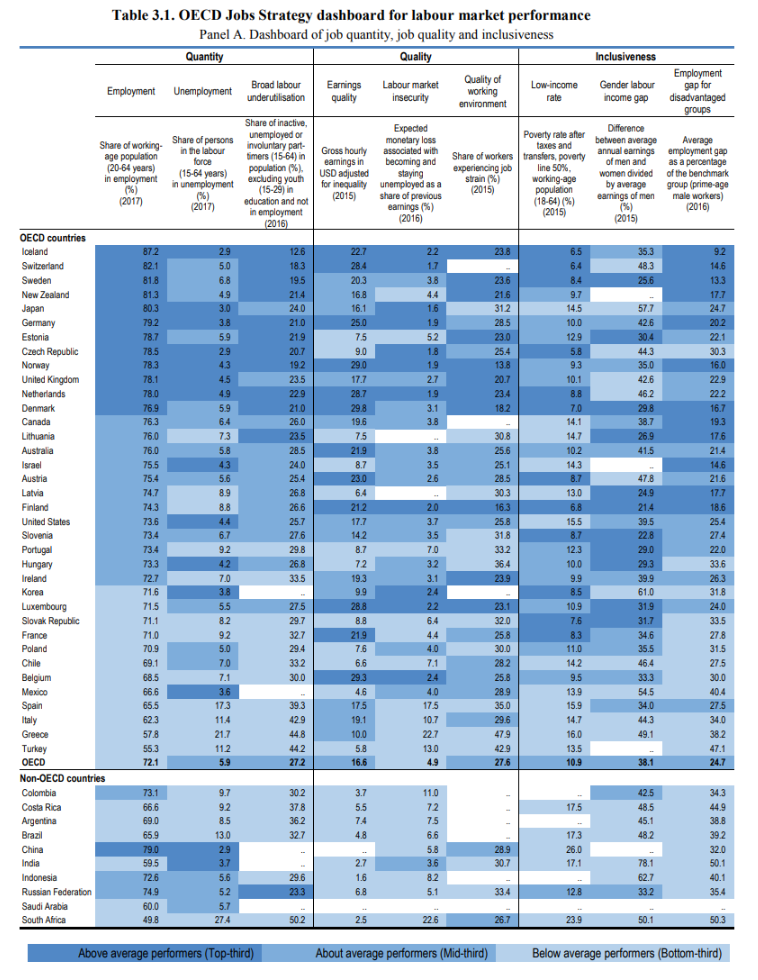
They report:
For example, the Nordic countries, such as Iceland, Denmark, Norway and Sweden, as well as Germany are among the best performing countries across at least two-thirds of the dimensions of the dashboard, while they are absent from the bottom third of low performers.
After accounting for the role of economic development … Mediterranean countries (except France and Israel), as well as Ireland and the United States are among the least well performing countries in the OECD.
The instrument is useful, but still relatively blunt – in particular the columns are not independent, and certainly not exhaustive. Nonetheless, the UK falls down on labour utilisation, earnings quality, insecurity and inclusiveness.40
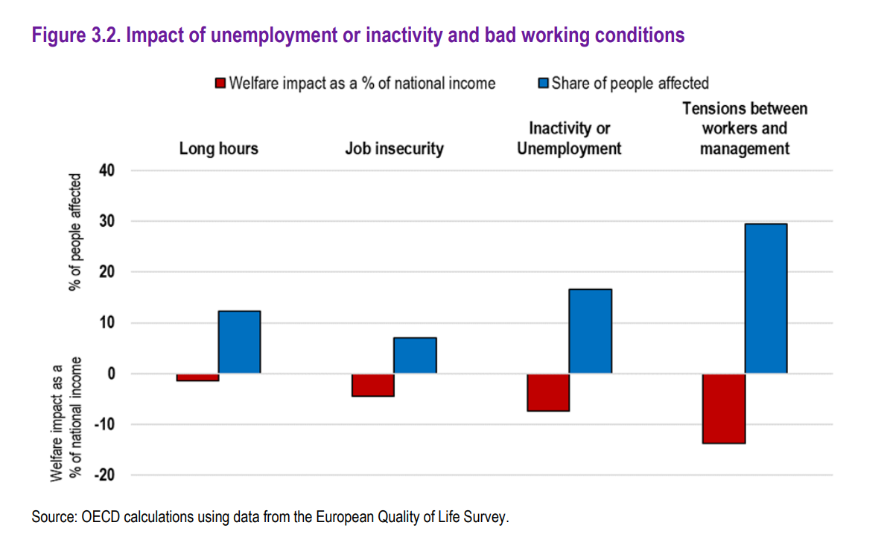
Subsequent OECD work 41
refined the analysis and drew even starker conclusions, with better jobs giving as much life satisfaction as increasing national income by a quarter.42
The study looks at 28 European OECD countries and finds that excessive working hours is associated with a welfare loss of 1.5% of national income. Job insecurity is equivalent to a loss of 4.5% of national income. Unemployment or inactivity amounts to 7.4% of national income. Tensions with management cause a welfare loss equivalent to 13.9% of national income. Improving these four metrics has the potential to deliver welfare value equivalent to 25% of national income, comparable to one or two decades of economic growth depending on the country.
- 40 A partial update in the Autumn 2024 Employment Outlook showed UK earnings quality up on 2015, but by less than the OECD average; and a deterioration between 2020 and 2021-22.
- 41 Murtin, Fabrice and Vincent Siegerink (2023) Valuing business impacts in the areas of wage inequality and employee well-being, OECD papers on well-being and inequalities, working paper no.15: https://www.oecd-ilibrary.org/docserver/740deb2f-en.pdf?expires=1727713472&id=id&accname=guest&checksum=1108E23078364E7514CA10F662494A9C
- 42 TUAC briefing (2023) OECD finds better jobs give as much life satisfaction as increasing national income by a quarter https://tuac.org/news/oecd-finds-better-jobs-give-as-much-life-satisfaction-as-increasing-national-income-by-a-quarter/
The above OECD findings echo conclusions that others had begun to reach around a decade earlier.
Reed 43 wrote a report for the TUC concluding that:
The move away from the straightjacket of orthodoxy into a richer and more realistic economic framework for analysing the labour market raises the issue of a positive role for labour market regulation – not just correcting injustices and improving labour market functioning at the margins, but potentially shifting the whole economy towards a better equilibrium. Many employers remain trapped in a ‘low road’ approach to production and cannot realise the full potential of their staff, the innovations embodied in their products, or their markets. For the UK economy to perform strongly in the future, much more of the country’s production will have to shift from a ‘low road’ to a ‘high road’ model. And labour market regulation is likely to be one of the key mechanisms to help UK business get there.
The Work Foundation 44 summarises key arguments:
This report challenges the common belief that low levels of employment regulation and weak trade unions account for the UK's low unemployment. It also questions the assumption that emulating the US is essential in order to reduce the high levels of unemployment in some European countries. The author suggests that several European countries, for example Denmark, Sweden, Austria and the Netherlands, demonstrate comparable or higher levels of 'labour market dynamism' to the UK while at the same time, ensuring higher levels of 'workplace justice'. These countries prove that the combination of moderately tight labour laws, strong trade unions and collective bargaining, and relatively generous levels of unemployment benefits (combined with tight conditions, job search obligations and active labour market programmes), is compatible with strong employment performance.
Latest evidence on employment protection and the economy
Since the reversal in thinking at the OECD, the evidence has continued to build. Some contributions more explicitly relate labour conditions to key outcomes. The most recent assessment is Deakin and Pourkermani 45 , based on an extensive database of employment protection legislation across much of the world. They show that “labour protections, on average, increased employment and reduced unemployment”. On a more granular view of specific policies, they find positive outcomes on both employment and productivity:
Changes in the laws regulating flexible work, working time, employee representation, and industrial action had positive impacts on productivity for at least part of the period. Improvements in the laws on flexible work, working time, and employee representation consistently led to higher employment.
Their overall conclusions are:
Our analysis shows that different types of labour laws have different effects on the economy. This granularity should be attended to in policy development. If the goal of labour law reform is to increase returns to labour in the form of wages and salaries, strengthening the right to strike is likely to be an effective option. If the goal is to increase productivity and employment, reforms to the laws governing flexible forms of work, working time, and employee representation should be considered.
In seeking to address the UK’s acknowledged productivity problem, policy makers should consider the role of labour law reforms. Although labour regulation is only one of the factors which affects labour productivity, a combination of labour laws of different types may help deliver not just productivity gains, but the more equitable sharing of those gains between labour and capital.
Where labour laws contribute to rising productivity, increasing employment, and a higher labour share of national income at the same time, they help ensure that the benefits of productivity growth are not exclusively retained by firms, but are shared more widely with workers and households, in the form of higher wages and a reduction in the time spent at work.
On a broader view, Grimshaw and Hayter46 report on the most recent international meta-analysis 47 covering 111 studies of unions and productivity effects. This confirms that unions have a small but positive effect on productivity overall.
A study based on the Skills and Employment Survey find that the strength of employer involvement, the nature of workplace support and development and performance management are strongly associated with employees’ willingness and ability to come up with innovative ideas.48 Worker engagement can help employers to deliver productivity enhancing ideas for their workplace.49
The economic analysis 50 for the Employment Rights Bill cites “Bosworth and Warhurst (2020) showing that productivity is 8% higher amongst workers most satisfied with their pay compared to those who are least satisfied with their pay”
Arestis et al. 51 take a broader macroeconomic approach looking at data from 16 European countries over the period 1985-2019. They find that the empirical evidence contradicts the theory behind labour market deregulation:
Our results show that employment protection does not explain the changes in employment, employees and unemployment rates. Therefore, labour reforms that have reduced employment protection by reducing dismissal costs and facilitating the use of temporary contracts have not had the presumed positive effects on employment and unemployment rates.
The government’s economic analysis for the Employment Rights Bill notes:
“In recent years, there have been more consistent findings that employment rights can be strengthened through legislation without negative impacts on workers and the wider economy. This is supported by evidence that across the UK employers are able to exert market power to push down pay and terms and conditions (e.g., CMA evidence) which in turn may help to explain the strong evaluation evidence that the National Living Wage has significantly increased pay for low-earning workers and imposed significant costs on their employers, without adverse impacts on employment.
Some contributions come from a microeconomic direction, including the role of market power. While the CMA 52 find employer market power has not increased, they find large differences across workers, firms and labour markets. And wages and employment are lowered in these cases. These considerations have been vital in the case of the minimum wage, with judgements around monopsony vindicated as the wage has been steadily increased with no detrimental effect. The most up-to-date international research finds that minimum wages are effective at raising wages and have very limited impacts on levels of employment. Dube 53 looked at research from the US, UK and other developed countries and found “a very muted effect of minimum wages on employment, while significantly increasing the earnings of low paid workers.” This was the case even for more ambitious policies including the UK’s National Living Wage.
Research by Datta 54 examined whether “labour supply preferences are responsible for the marked rise in atypical work arrangements in the UK and US.” He finds instead the majority of the population “prefer characteristics associated with traditional employee–employer relationship”, and “the changing nature of work is likely to have significant negative welfare arrangements for workers”.
Most recently, empirical evidence has started coming in from Spain which has taken measures to tackle insecure work and strengthen collective bargaining.55 The Spanish government has restricted the use of temporary contracts and made it easier for unions to gain recognition in workplaces, alongside other reforms. The International Monetary Fund (IMF) said in its annual assessment of Spain’s economy for 2024 that “the labour market performance has been exceptionally strong”.56 Spain also came first in the Economist’s 2024 annual ranking of countries which measures economic performance based on GDP, stock market performance, core inflation, unemployment and government deficits.57 The Spanish Deputy Prime Minister pushes back against the view that ”deregulating, cutting off labour rights, attacking unions and lowering wages, we were going to have more jobs. And this is what, empirically, is not true, [as] we have demonstrated in our country.”58
So the case for labour market deregulation appears to have been poorly evidenced. Consequently, we have seen employment standards fall across countries that have leaned into this approach, and empirical evidence emerge which discredits the case for labour market flexibility. The literature now contrasts ‘conventional’ and ‘inclusive’ models. The UK has relied on cheap labour and short-termism, while some other countries have focussed on better work and higher investment.
Grimshaw and Hayter 59 build a comprehensive case around comparing ‘conventional’ and ‘inclusive’ growth.60 They consider the former approach still prevalent, with the “interventions by the Troika in Greece the classic example”. But that the latter is greatly more prominent in recent years and especially following the United Nations setting out its Sustainable Development Goals and 2030 agenda. They conclude that inclusive models deliver benefits for workers and the wider economy:
The current economic context of rising inequality and stagnant incomes demands a clear understanding of the contribution of employment relations to a more inclusive and sustainable model of growth and development. Where businesses and countries seek to pursue mainly a conventional growth model, the economic risks of employment relations are likely to be heightened. This is because employment relations tends to conflict with contexts where pressure for short-term profitability is high and the strategic focus on the long-term and inclusive labour standards is low. Under an alternative inclusive growth approach, the economic benefits of employment relations are likely to be maximised. The empirical evidence demonstrates that employment relations institutions have the capacity to bring wage increases in line with productivity growth, especially at a macro level, and to ensure a more equitable distribution of real wage gains. A coordinated approach to employment relations also has the benefit of facilitating a positive set of ripple effects of wage bargains on aggregate demand.
Grimshaw and Hayter 61 also address the wider evidence for UK labour market reforms in the 1980s, and especially the targeting of the centralisation of pay bargaining by industry. They detail how Calmfors and Driffill’s (1988) influential ‘hump shape hypothesis’ between real wages and centralization (of wage setting) was subsequently “strongly questioned in subsequent empirical studies, which could find no robust association between the degree of centralization and economic performance”.
In retrospect the original case for flexibility appears to have been ideological and opportunistic: the evidence is now in, and the case proven wrong. The Work Foundation 62 makes the strong charge: “recent research suggests that the standard account of why ‘Anglo-Saxon’ labour markets perform well is shot through with myths, half-truths and a cynical manipulation of the evidence.”
Leading sources identify detriment caused to the UK economy by measures that were put in train in the 1980s. For the Resolution Foundation 2030 Inquiry, Muellbauer and Soskice 63 spell out the consequence for jobs:
These reforms had their costs but arguably put the UK on a path to sustaining high employment levels and established the model we now have of wages (and hours) rather than unemployment tending to take more of the strain from adjustment … However, this strategy is one of the reasons the UK has such a large swathe of low-wage, low-skill, low-progression service-sector employment, often with poor labour standards. Very little was done in the 1980s to mitigate against this.
Van Reenan 64 reports the detriment as follows:
Nevertheless, there are many important economic and social failures that are part of the Thatcher legacy. First, there was a tremendous growth of inequality … [second] the share of income going to the top 1% continued to rise inexorably, driven by the financial sector … [given] excessive deregulation of financial services starting with Big Bang in 1986, but continuing until the eve of the 2007 crisis. … Third, her early years were marked by a failure to understand that the public employment service needs to be active in helping people find jobs … Finally, and perhaps most importantly, there was [sic] been a failure of long-run investment.
The Joseph Rowntree Foundation (2020) also report on detriment to productivity: “having a significant number of workers in insecure roles limits the productivity of the UK economy. Employers invest less in the skills of their transient staff and the growing use of these forms of work encourages business models that depend on cheap work”; tackling insecure work would mean “Businesses would be incentivised to invest more in their staff and move away from business models relying on cheap labour.” 65 This is also where some bring in aggregate demand. Lawrence and Sterling 66 describe an economy that gets stuck in effect in a doom loop of low pay, low demand and low investment:
The demand side mechanics that can affect productivity are reasonably straightforward. Pessimism or uncertainty over future demand growth makes firms less likely to invest where upfront costs might not be recovered, and instead more likely to opt for flexible labour inputs (fixed term, zero hour or outsourced contracts) which can be easily shed when demand growth fails to materialise. Not only does this lead to lower investment in, and adoption of, more productive capital inputs and business models, but it also reduces skills matching and progression in the labour market. Both can have a significant impact on long run productivity.
Above all, perhaps, Grimshaw and Hayter 67 emphasise “Complementarity between different institutions, such as minimum wage setting and collective bargaining, and the degree of bargaining coordination appear to be much more important factors in achieving better employment and equity outcomes.” Virtually all the evidence they consider point in this direction.
Productivity also features as the denominator in the wage bargaining context. Grimshaw and Hayter report 1980s arguments that stronger labour institutions would lead to wages outstripping productivity. Conversely over the past decade the dominant concern is that that weak labour market institutions have meant wages not keeping pace with productivity. And on top of this: weak labour market institutions may have reduced productivity overall. Treasury Minister Torsten Bell MP has concluded: “making our economy less reliant on cheap labour is the prerequisite for these sectors becoming more productive – incentivising firms to invest in kit rather than just sweating their workers.”68
Conclusion
In retrospect, the original case for labour market flexibility appears ideological and poorly evidenced. The study by Arestis et al.69 looking at data from sixteen European countries over the period 1985–2019 finds that “labour reforms that have reduced employment protection by reducing dismissal costs and facilitating the use of temporary contracts have not had the presumed positive effects on employment and unemployment rates.”
Consequently, we have seen employment standards fall across much of the developed world and empirical evidence emerge which discredits the case for deregulation. The literature now contrasts ‘conventional’ and ‘inclusive’ models.70 Inclusive labour market models lead to better employment relations, wage growth in line with productivity growth, and positive effects on aggregate demand. At best any gains from deregulation are understood as short-term, and are lost in the longer term.
There has been a sea change in opinion around labour market protections, As the public face of the IFS’s major inquiry into inequalities, Professor Sir Angus Deaton’s statement 71 of March 2024 was devastating. Discomforted by his change of mind, he conceded economists “might fairly be accused of having a vested interest in capitalism as it currently operates”. Power was put in front place, with economists:
distract[ed] … from the importance of power in setting process and wages, and in choosing the direction of technical change, and in influencing politics to change the rules of the game. Without an analysis of power, it is hard to understand inequality or much else in modern capitalism.
While much of the contemporary debate focusses on the failures of more recent decades, it is worth remarking that in the three decades after the Second World War power was better balanced and outcomes were greatly better.72 Looking even further back, Deakin and Pourkermani 73 observed how the industrial revolution coincided with better conditions, not least the Factory Acts:
In Britain, the nineteenth century Factory Acts, which were the first in the world to regulate the length of the working day and week, led not to the loss of profits and employment which some had predicted, but to increased capital investment, improvements in labour productivity, and sustained employment growth.
Stronger labour market protections lead to better outcomes for workers and better outcomes for the wider economy. The government’s Employment Rights Bill’s economic analysis 74 endorses the view that consumer spending strengthens growth: “Workers who have extra pay due to reforms to SSP or feel more confident in their finances due to better income security may spend more, which again would be good for business”.
Grimshaw and Hayer 75 observe: “A coordinated approach to employment relations also has the benefit of facilitating a positive set of ripple effects of wage bargains on aggregate demand”. Likewise – in the specific context of fragility – they observe “some studies find[ing] that countries with a high degree of bargaining coordination are associated with lower unemployment and respond better in times of rapid economic change … Indeed during the economic crisis in Europe studies show that integrative trade-offs … were more likely to be reached in countries with highly coordinated and articulated multi-employer bargaining structures, than those with single employer bargaining”.
Business concerns can be understandable if they come only from the point of view of costs to the exclusion of everything else. But gains at firm levels from higher staff welfare and engagement and all the above macroeconomic effects cannot be omitted from an analysis of the gains that employment protection brings. And likewise, those that urge present fragilities mean now is not the right time for change, are simply urging the UK economy remains forever on the low road.
Vitally the same reservation applies to government regulatory processes as presently operated. The green book is a case in point, with 149 mentions for business and only 6 for labour. As well as to more fully reflecting benefits at micro and macro levels, there is a sense the process needs to be reconsidered and reviewed – with the focus more on the costs to workers of the present system and the likely advantage to the economy of making work pay.
- 43 Reed, H (2010) Flexible with the truth? Landman Economics https://www.tuc.org.uk/sites/default/files/extras/flexiblewiththetruth.pdf
- 44 Work Foundation (2006) Who’s Afraid of Labour Market Flexibility? https://www.voced.edu.au/content/ngv%3A22085
- 45 Deakin, S & Pourkermani, K (2024) The economic effects of changes in labour laws: new evidence for the UK. Digit Policy Brief. https://digit-research.org/publication/the-economic-effects-of-changes-in-labour-laws-new-evidence-for-the-uk/
- 46 Grimshaw, Damian and Susan Hayter (2020) Employment relations and economic performance, in Carola Frege, John Kelly, Eds. Comparative Employment Relations in the Global Economy, London: Routledge.
- 47 Freeman, R. B., H. Doucouliagos and P. Laroche (2017) The economics of trade unions: A study of a research field and its findings, Routledge.
- 48 Felstead, Gallie, Green, Henseke (2020) Getting the Measure of Employee‐Driven Innovation and Its Workplace Correlates https://onlinelibrary.wiley.com/doi/10.1111/bjir.12528
- 49 Felstead, A. (2018) Listening to employees’ ideas could solve UK’s productivity slowdown, The Conversation https://theconversation.com/listening-to-employees-ideas-could-solve-uks-productivity-slowdown-100114
- 50 Department for Business and Trade (2024) Employment Rights Bill: Economic Analysis https://assets.publishing.service.gov.uk/media/67c57146b0bb6528ee866cbf/Employment_rights_bill_economic_analysis.pdf
- 51 Arestis, P., J. Ferreiro and C. Gomez (2023) Does employment protection legislation affect employment and unemployment?, Economic Modelling, 126, Sep.
- 52 Competition and Markets Authority (2024) ‘Competition and market power in UK labour markets’, Report no. 1, 25 Jan. 2024.
- 53 Dube, Arindrajit (2019) Impacts of minimum wages: review of the international evidence https://assets.publishing.service.gov.uk/government/uploads/system/uploads/attachment_data/file/844350/impacts_of_minimum_wages_review_of_the_international_evidence_Arindrajit_Dube_web.pdf
- 54 Datta, Nikhil (2019) ‘Willing to Pay for Security: A Discrete Choice Experiment to Analyse Labour Supply Preferences’, Centre for Economic Performance Discussion Paper No 1632. https://cep.lse.ac.uk/_NEW/PUBLICATIONS/abstract.asp?index=6298
- 55 OECD (2024) Reviving Broadly Shared Productivity Growth in Spain https://www.oecd.org/content/dam/oecd/en/publications/reports/2024/06/reviving-broadly-shared-productivity-growth-in-spain_831bf96e/34061b21-en.pdf
- 56 IMF (2024) Country Report No 21/152 https://www.elibrary.imf.org/view/journals/002/2024/152/article-A000-en.xml?rskey=WSevNW&result=86
- 57 The Economist (2024) What Spain can teach the rest of Europe https://www.economist.com/leaders/2024/12/12/what-spain-can-teach-the-rest-of-europe
- 58 The Guardian (2025) ‘If you fall into the dialogue of the far right, the far right wins’: Spain’s deputy PM on the need for workers’ rights https://www.theguardian.com/business/2025/mar/10/if-you-fall-into-the-dialogue-of-the-far-right-the-far-right-wins-spains-deputy-pm-on-the-need-for-workers-rights
- 59 Grimshaw, Damian and Susan Hayter (2020) Employment relations and economic performance, in Carola Frege, John Kelly, Eds. Comparative Employment Relations in the Global Economy, London: Routledge.
- 60 Work Foundation (2006) Who’s Afraid of Labour Market Flexibility? https://www.voced.edu.au/content/ngv%3A22085
- 61 Grimshaw, Damian and Susan Hayter (2020) Employment relations and economic performance, in Carola Frege, John Kelly, Eds. Comparative Employment Relations in the Global Economy, London: Routledge.
- 62 Work Foundation (2006) Who’s Afraid of Labour Market Flexibility? https://www.voced.edu.au/content/ngv%3A22085
- 63 Muellbauer, John and David Soskice (2022) The Thatcher Legacy: Lessons for the future of the UK economy, Resolution foundation economy 2030 inquiry https://economy2030.resolutionfoundation.org/reports/the-thatcher-legacy/
- 64 Van Reenen, John (2013) The economic legacy of Mrs. Thatcher is a mixed bag, LSE Blog https://blogs.lse.ac.uk/politicsandpolicy/the-economic-legacy-of-mrs-thatcher-2/
- 65 The commentary draws on [Innes, Dave (2018) The links between low productivity, low pay and in-work poverty, JRF Briefing https://www.jrf.org.uk/work/the-links-between-low-productivity-low-pay-…] looking at low paid workers in France, Germany, the Netherlands and UK.
- 66 Lawrence, Mathew and Alfie Stirling (2023) The hammer and the anvil: crafting a new settlement https://renewal.org.uk/the-hammer-and-the-anvil-the-same-forces-propelling-labour-to-office-risk-fatally-undermining-it-in-power/
- 67 Grimshaw, Damian and Susan Hayter (2020) Employment relations and economic performance, in Carola Frege, John Kelly, Eds. Comparative Employment Relations in the Global Economy, London: Routledge.
- 68 Bell, T (2024), Great Britain?, page 229.
- 69 Arestis, P., J. Ferreiro and C. Gomez (2023) Does employment protection legislation affect employment and unemployment?, Economic Modelling, 126, Sep.
- 70 Grimshaw, Damian and Susan Hayter (2020) Employment relations and economic performance, in Carola Frege, John Kelly, Eds. Comparative Employment Relations in the Global Economy, London: Routledge.
- 71 Deaton, Angus (2024) Rethinking my economics, Finance and Development, International Monetary Fund, March, pp. 20-22 https://www.imf.org/en/Publications/fandd/issues/2024/03
- 72 Tily, G, (2018) Our 150 years show that stronger unions mean a better economy, TUC https://www.tuc.org.uk/blogs/our-150-years-show-stronger-unions-mean-better-economy
- 73 Deakin, S & Pourkermani, K (2024) The economic effects of changes in labour laws: new evidence for the UK. Digit Policy Brief. https://digit-research.org/publication/the-economic-effects-of-changes-in-labour-laws-new-evidence-for-the-uk/
- 74 Department for Business and Trade (2024) Employment Rights Bill: Economic Analysis https://assets.publishing.service.gov.uk/media/67c57146b0bb6528ee866cbf/Employment_rights_bill_economic_analysis.pdf
- 75 Grimshaw, Damian and Susan Hayter (2020) Employment relations and economic performance, in Carola Frege, John Kelly, Eds. Comparative Employment Relations in the Global Economy, London: Routledge.
Stay Updated
Want to hear about our latest news and blogs?
Sign up now to get it straight to your inbox
