Increasing workers' influence over the African Continental Free Trade Agreement
2024 - 2025
Budget
Year 1: £21,085.50
Year 2: £29,026.06
Funded by TUC Aid, Trade Union Unit Trust Charitable Trust, NASUWT, and the Hayward-Seers family in memory of Toby Hayward-Seers
The African Continental Free Trade Agreement (AfCfTA) is an agreement which is focussed on reducing the tariffs countries are allowed to place on other countries’ goods which could undermine domestic industries and good jobs.
The main agreement was signed in 2018 between 22 African states but talks continue on side agreements.
There is scope for unions to influence talks on these side agreements and monitor the implementation of the agreement. In some countries such as Rwanda, official bodies have already been established for this purpose.
Yet, many trade union centres in Africa lack the capacity to influence trade negotiations or flag concerns about the implementation of the agreement with politicians.
This project will support trade unions in Cameroon to run training for trade unionists on influencing trade talks to promote decent work, oversee the implementation of the agreement, and flag any harmful effects on workers.
The project is being delivered by ITUC-Africa and its four affiliates, Confédération des Syndicats Autonomes du Cameroun (CSAC), Confédération Syndicale des Travailleurs du Cameroun (CSTC), Unions des Syndicats Libres du Cameroun (USLC) and Confederation des Services Publics (CSP).
This project is part of a wider ITUC Africa project involving nine other African countries, which is funded by the Finnish trade union centre SASK.
Project activities include
Year 1
- Online baseline survey of Cameroonian trade union centres’ capacity to influence trade negotiations.
- Training run for 25 trade union representatives from Cameroon’s trade unions on influencing AfCFTA talks and how to highlight concerns about its implementation. Women and young people will be particularly prioritised for this training.
- Trade unions in Cameroon develop, launch and sustain their advocacy campaigns.
- Strengthened alliances and joint statements developed between trade unions in Cameroon with other civil society allies on AfCFTA
- Meetings between Cameroonian trade unions and government, African Union and AfCFTA secretariat representatives.
- Trade unions monitor and evaluate the implementation of the AfCFTA.
Year 2
- Trade unions in Cameroon sustain their advocacy campaigns
- Joint statements developed between trade unions in Cameroon and with other civil society allies on AfCFTA
- Meetings between Cameroonian trade unions and government, African Union and AfCFTA secretariat representatives.
- Trade unions monitor and evaluate the implementation of the AfCFTA.
- Online regional meeting of African Regional Organisation of the International Trade Union Confederation (OSTAC) to coordinate lobbying on AfCFTA negotiations and implementation.
- Trade unions from Cameroon participate in the final SASK-ITUC-Africa project conference bringing together all countries participating in the project with representatives from their governments and possibly the AfCFTA Secretariat
Expected project outcomes
- Increase capacity of trade unions in Cameroon to influence the negotiation of protocols of the AfCFTA so that they contain protections for workers' rights, public services and domestic industries
- Increase capacity of trade unions in Cameroon to be lobby for effective involvement in bodies to oversee the implementation of the AfCFTA.
- Develop more collaboration between trade unions across Central Africa to lobby for trade union objectives.
- Develop more continental collaboration between unions in Africa to lobby for trade union objectives.
- Strengthen alliances with like-minded civil society organisations.

Progress report July 2025
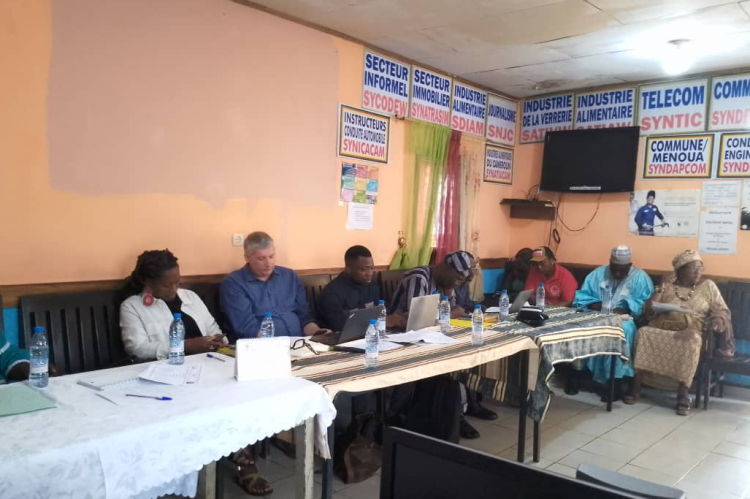
Members of ITUC Africa and NASUWT - The Teachers' Union took part in a delegation to visit union project partners in Cameroon on 7-9 July
The visit was organised to increase the political pressure on the government in Cameroon to include unions in the implementation committees for the African Continental Free Trade Agreement as well as improve engagement with unions and respect for labour rights in Cameroon more broadly. As a result of the visit the government agreed to create a subcommittee for trade unions to feed into the implementation.
The visit involved the following:
a) Meeting with the Inter-Union AfCFTA Committee in Cameroon
The delegation held an intensive working session with members of the national inter-union committee coordinating the AfCFTA project. Discussions centred on reviewing the progress made, the challenges encountered, and prospects for scaling up union engagement. The meeting allowed for a frank and constructive discussion on trade union implications on development issues especially on trade in Cameroon. 23 local people took part (15 men and 8 women).
b) Press Conference for Public Awareness
A press conference was organized with national media to raise public awareness of the AfCFTA project and highlight the proactive role of workers’ organizations in Cameroon. The event served to amplify union voices and spotlight the critical need for social partners' involvement in regional integration processes.
See media report: https://www.facebook.com/share/v/19zyMbJ4Vh/
c) Meeting with Chief trade negotiator
As part of its official engagements, the ITUC-Africa delegation was received by Eppoh Parfait, Chief Negotiator and Coordinator of the Technical Secretariat of the National AfCFTA Committee.
The meeting provided an opportunity for a rich and constructive exchange on the state of Cameroon’s AfCFTA implementation process. He acknowledged the critical role of workers’ organizations and reiterated the government’s commitment to fostering social dialogue in the trade governance space. The minister said he recognized the importance of the involvement of unions in the related discussions.
While trade unions have not yet been granted full membership in the National AfCFTA Implementation Committee (due to limited number of seats), Eppoh Parfait expressed the government's openness to their involvement in associated technical activities. Notably, he welcomed the idea of entrusting trade unions with leadership of one of the thematic subcommittees to inform the implementation committee, thereby recognizing their legitimacy and expertise in addressing labour-related dimensions of the AfCFTA.
This visit laid the groundwork for deepened collaboration and offered a pathway for institutionalizing trade union participation in national trade policy and implementation mechanisms.
To consolidate gains and intensify trade union participation in the AfCFTA process, a six-month implementation roadmap was discussed, reviewed, and validated by stakeholders during the mission. The roadmap outlines key activities, responsible actors, and timelines.
Progress report February 2025
In this reporting period officers of the four union centres in Cameroon taking part in the project – CSAC, CSTC, USLC and CSP –cascaded what they learnt in the training session run in Year 1 of the project to union members.
A workshop was run in the province of Manjo which brought together reps from the four union centres with NGOs including women’s and youth rights organisations to develop joint lobbying to influence the implementation of the African Continental Free Trade Agreement (AfCFTA).
Union officers continue to run social media campaigns on the importance of union being involved in the implementation of the AfCFTA
Four members of the CSAC union centre – which is coordinating union activities on behalf of ITUC Africa in Cameroon - took part in ILO ACTRAV training on ‘labour provisions and decent work in trade and investment agreements: the role and actions of trade unions’
The political climate is very difficult for trade unions in Cameroon – the ILO committee of experts has expressed concern that the government is denying legal recognition to education unions in particular as well as supressing the ability of unions to strike due to ‘anti terrorism’ laws
The anti-union political climate has made it difficult for unions in the project to get a response from the government to the letters they sent requesting union involvement in the National Implementation Committee for the AfCFTA
The TUC is discussing with ITUC Africa how ITUC Africa can increase the political pressure on the government in Cameroon, working with Cameroonian union partners
Progress report January - March 2024
- Meeting of the leadership of the four national trade union centres to discuss successful project implementation
- Collaboration between ITUC Africa and the national coordination team to prepare for the national capacity building workshop in April – at this workshop trade union officers will be trained in ways to influence trade talks
Progress report March - June 2024
- A two-day national capacity building workshop on the AfCFTA was organised from April 9 -10, in Yaoundé, Cameroon for unions to build their capacity to influence the protocols being negotiated for AfCFTA and be involved in monitoring groups for the agreement
- In total, 30 unionists in Cameroon from both public and private sectors attended the workshop
- At the end of the workshop the unions attended resolved to continue to work together to influence the AfCFTA talks and encourage their union officers and members to be involved in this work.
Progress report July - December 2024
- The CSAC, CSTC, USLC and CSP union centres have continued their advocacy for trade unions to be involved in the National Implementation Committees monitoring of the implementation of the African Continental Free Trade Agreement (AfCFTA) and prevent the agreement undermining good jobs, workers’ rights and public services
- The unions have written to the government in Cameroon to request for unions to be involved in the National Implementation Committees monitoring of the implementation of the AfCFTA and are pushing for meetings with ministers to discuss this request
- The unions held a round table discussion with unions on the importance of workers’ involvement in the AfCFTA implementation on the World Day for Decent Work
- The unions are running adverts on radio, social media and on TV which has been effective in raising awareness amongst the wider public about the need for workers to be involved in the implementation of the agreement the promote good jobs, workers’ rights and protections for public services.
The video below was made during the workshop.
Progress report July - December 2024
- The CSAC, CSTC, USLC and CSP union centres have continued their advocacy for trade unions to be involved in the National Implementation Committees monitoring of the implementation of the African Continental Free Trade Agreement (AfCFTA) and prevent the agreement undermining good jobs, workers’ rights and public services
- The unions have written to the government in Cameroon to request for unions to be involved in the National Implementation Committees monitoring of the implementation of the AfCFTA and are pushing for meetings with ministers to discuss this request
- The unions held a round table discussion with unions on the importance of workers’ involvement in the AfCFTA implementation on the World Day for Decent Work
- The unions are running adverts on radio, social media and on TV which has been effective in raising awareness amongst the wider public about the need for workers to be involved in the implementation of the agreement the promote good jobs, workers’ rights and protections for public services.
The video below was made during the workshop.
Stay Updated
Want to hear about our latest news and blogs?
Sign up now to get it straight to your inbox
