
No worker left behind
Black Workers’ Experiences at Work – Findings from No worker left behind (2026)
Black workers continue to face racism, insecurity and unequal treatment at work across the UK. The findings from No worker left behind demonstrate that despite greater awareness of racial inequality in recent years, many Black workers still encounter hostile workplace cultures, structural barriers to progression and unsafe working conditions.
This research builds on earlier trade union studies, including Is Racism Real? (2017), Dying on the Job (2020) and Still rigged: racism in the UK labour market (2022). In 2024 the TUC also published ‘’And then it clicked...’ a seminal piece of research looking specifically at Black women’s experience of sexual harassment in the workplace. Together, these reports track the experiences of Black workers over nearly a decade. The latest findings demonstrate that while there have been some improvements in reporting and accountability, racism, discrimination and harassment remain widespread and, in several areas, have worsened since 2020.
Racist “jokes” or workplace “banter” remain among the most commonly experienced forms of racism. While often dismissed as informal behaviour, these actions contribute to toxic workplace cultures and can have a cumulative impact on workers’ mental and physical wellbeing. These repeated “low-level” behaviours create an environment where racism becomes normalised and where many workers feel unsafe or unsupported.
More serious incidents also persist. Black workers continue to report higher levels of verbal abuse, intimidation and threats of physical violence in the workplace compared with white workers. Reports of witnessing or experiencing physical violence and intimidation have increased since earlier surveys with a leap between 19% in 2020 to 26%. This research shows that Black workers are more likely to report experiences of racism or discrimination than in previous surveys, however the incidents being reported appear to have increased in severity. Of those reporting, 69% reported that their employer took their reports seriously. Confidence in raising complaints or grievances with employers has increased slightly, but this is against an already low bar (from 16% in 2020 to 21%) and fewer workers report taking no action when behaviours considered ‘low level’ discrimination occurs. Satisfaction with employer responses also remains uneven.
Six years on, the findings from No worker left behind shows that many of the structural inequalities highlighted during the pandemic remain embedded in UK workplaces. It’s crucial that unions retain the confidence of their members and challenge discrimination and racism wherever it occurs.
Research findings
Introduction
In June 2020, the TUC launched a call for evidence inviting Black and minority ethnic workers to share their experiences of working during the Covid-19 pandemic. Over 1,200 workers responded, providing evidence that directly informed the Dying on the Job report.
Dying on the job detailed the experiences of Black and BME workers during the pandemic. During the pandemic, existing inequalities became even more visible. Black workers were disproportionately represented in frontline roles - from health services and public transport to education and delivery services - often undertaking high-risk work with inadequate protections. Many reported being assigned tasks that increased their exposure to infection while lacking sufficient workplace safeguards such as PPE, social distancing measures or protective barriers.
No Worker Left Behind (2026) highlights how the boundaries of the workplace have expanded. Racist behaviour increasingly occurs not only in formal work environments but also in work-related social spaces and online environments connected to work. Black workers report experiencing racist content in workplace social media groups and exclusion from work-related social events. Such behaviour reinforces exclusion and contributes to feelings of isolation and “othering”.
This research shows, as with previous research into discrimination and racism in the workplace, that reporting racism continues to carry significant risks. Some workers report facing negative consequences after making complaints, including workplace isolation, transfers to different roles, or even disciplinary action against individuals who raise the concerns.
Black workers have told us that when reporting racism or discrimination to an employer there is a lack of consistency. And while some organisations are taking complaints seriously and responding promptly, others are failing to respond effectively.
Black trade union members report high levels of satisfaction with their unions, with 73 per cent of Black members expressing satisfaction compared with 64 per cent of white members. Members particularly value unions for providing advice on workplace rights, negotiating improved pay and conditions, and strengthening health and safety protections. Our research highlights that community and family are a key point of contact for support. It is of note that although trade unions remain an important source of protection and support for Black workers, there are still members who’ve reported that they were not satisfied with the support their union has provided.
For Black workers, advice on rights at work is the most valued form of union support. Members also highlight the importance of legal advice, training, equality initiatives and assistance in cases of bullying or discrimination.
These findings demonstrate the critical role that trade unions play in challenging workplace inequality and supporting workers facing discrimination. It is for these reasons why the work of the TUC Anti-Racism Taskforce is a crucial framework for trade unions to ensure that they are serving their Black members in an approach that meets their needs and expectations.
Experiences of work
The TUC commissioned Hold Sway to carry out a survey to find out more about Black workers’ experience of work. This was a nationally representative survey of 1,590 workers aged 16 and over in Great Britain carried out in January 2026. The sample included 1,044 Black workers, as well as 509 white workers so comparisons could be made. We previously carried out a Black workers’ survey in 2020 for our Dying on the Job report 1 . Some of the same questions have been included in this survey and, where relevant and possible, comparisons between the findings of the two surveys are made.
Unfair treatment at work
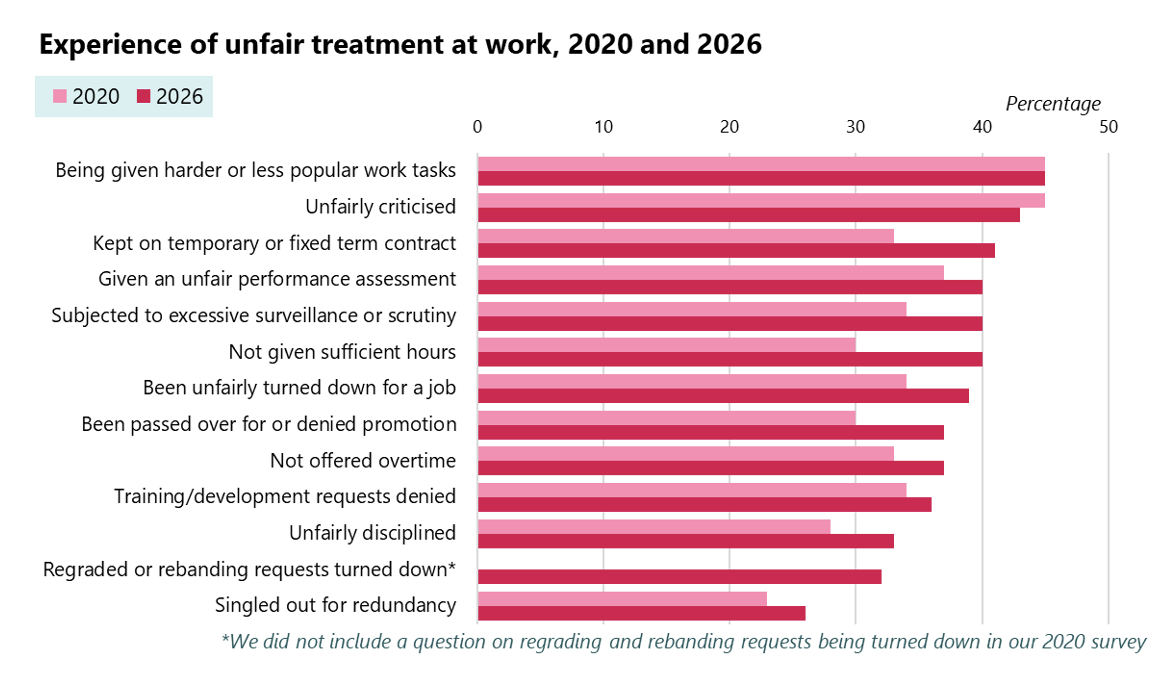
Our survey found that Black workers face a range of unfair treatment at work, with the most common being:
Given harder or less popular work tasks (45 per cent of all Black workers)
Receiving unfair criticism (43 per cent)
Being kept on temporary of fixed terms contracts (41 per cent)
This is consistent with our 2020 polling, when being given harder or less popular work tasks was also the most common form of unfair treatment. The largest changes since 2020 all relate to contracts and working hours:
The percentage of Black workers reporting not being given sufficient hours has increased from 30 per cent to 40 per cent
In 2026, 37 per cent of Black workers say they have not been offered overtime, compared to 30 per cent in 2020
The percentage of Black workers reporting being kept on temporary or fixed term contracts has grown from 33 per cent to 41 per cent
Experience of each form of unfair treatment that we listed has increased since 2020, with two exceptions. The percentage of workers reporting being given harder or less popular work tasks stayed the same (45 per cent), and the percentage reporting being unfairly criticised dropped slightly (45 per cent to 43 per cent).
- 1 Dying on the job – Racism and risk at work, TUC (2020). Available at: https://www.tuc.org.uk/research-analysis/reports/dying-job-racism-and-risk-work Polling in this report was conducted in early March 2020, before social restrictions due to the pandemic were brought in.
Black Women and their workplace experiences
There are some gender differences in Black workers’ experience of unfair treatment. Black women are more likely than Black men to report being kept on temporary contracts (44 per cent compared to 37 per cent), having requests for training turned down or development opportunities denied (38 per cent compared to 34 per cent), and being given harder or less popular tasks (46 per cent compared to 43 per cent).
Black men are more likely than Black women to report being singled out for redundancy (31 per cent compared to 22 per cent) and being passed over for or denied promotion (40 per cent compared to 35 per cent).
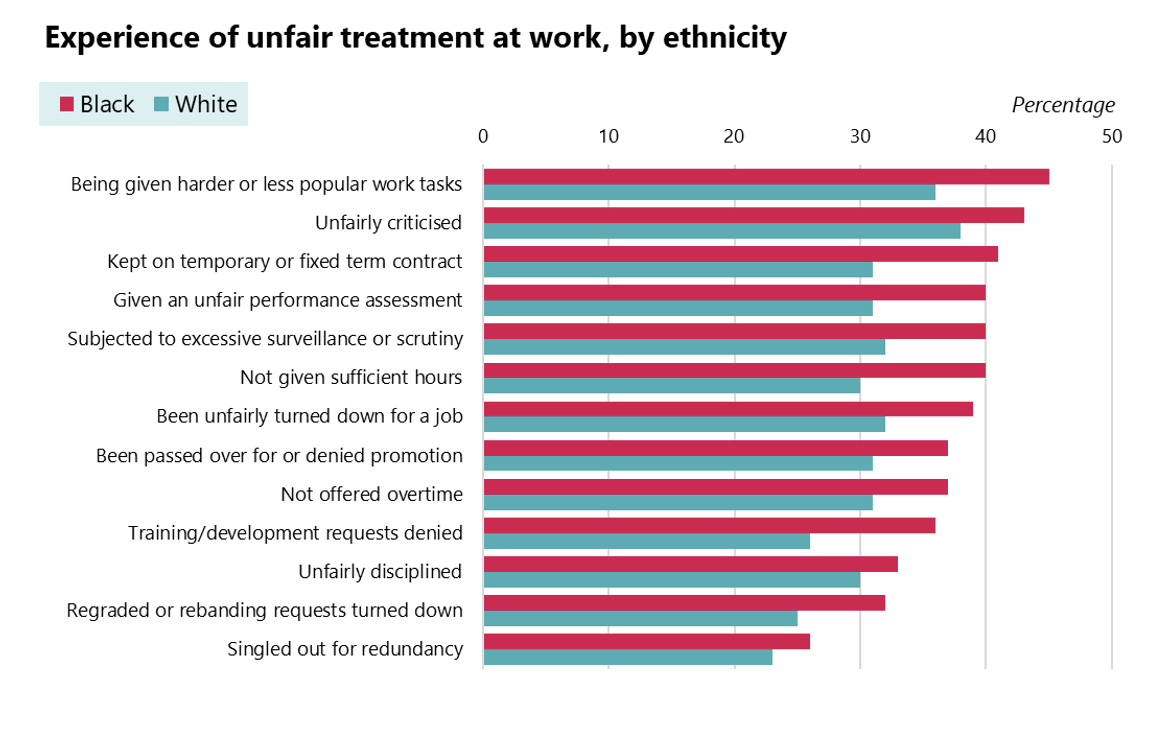
Black workers are more likely than white workers to receive each type of unfair treatment that we asked about. Black workers are particularly more likely to report:
Having a request for training turned down or development opportunities denied (36 per cent, compared to 26 per cent)
Not being given sufficient hours (40 per cent, compared to 30 per cent)
Being kept on temporary or fixed terms contracts (41 per cent, compared to 31 per cent)
Racism and harassment at work
Racism and harassment at work takes different forms, from exclusion to racist jokes to physical violence.
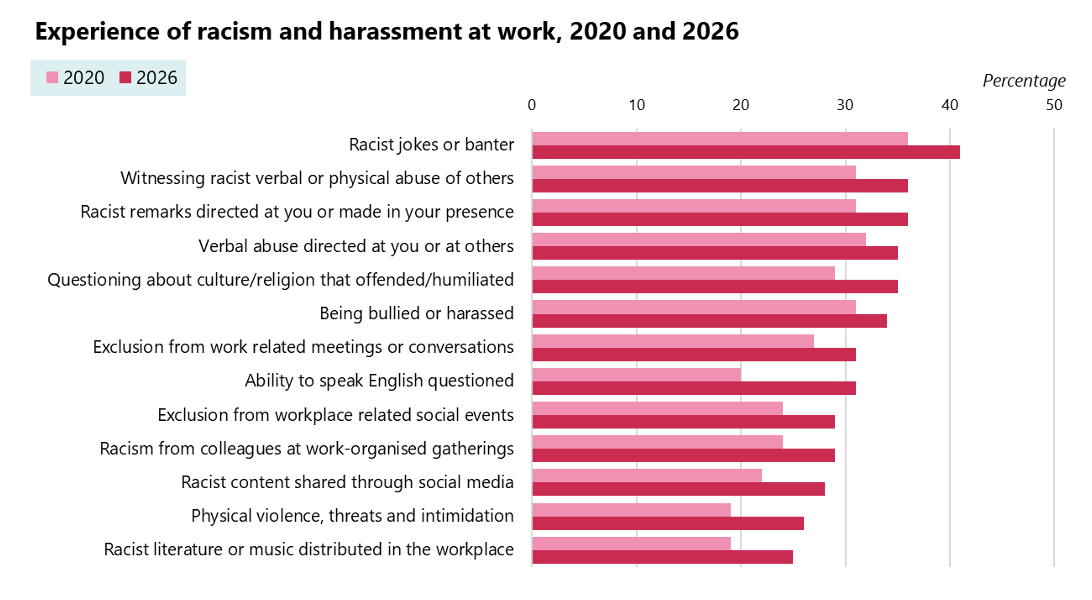
For Black workers, the most common forms or racism and harassment experienced at work are:
Racist jokes or “banter” (41 per cent of all Black workers)
Witnessing racist verbal of physical abuse (36 per cent)
Racist remarks at you or in your presence (36 per cent)
Verbal abuse at you or others (35 per cent)
Questioning about your culture or religion in a way that was offensive or humiliating (35 per cent)
Language competency
Concerningly, the percentage of Black workers experiencing each type of behaviour and harassment we asked about has increased since 2020. The largest change is in the percentage of Black workers who have had their ability to speak English questioned. When we asked about this in 2020, one-in-five (20 per cent) of Black workers told us they had experienced this at work. In 2026, this has risen to just under a third (31 per cent).
Violence and racist content in the workplace
There has also been a concerning rise in the percentage of Black workers who have experienced physical violence, threats and intimidation at work. It’s gone from an already too high 19 per cent in 2020 to 26 per cent in 2026.
There has also been a rise in the sharing of racist content through social media (up from 22 per cent in 2020 to 28 per cent in 2026) and racist literature or music being shared in the workplace (19 per cent in 2020 to 25 per cent in 2026).
Black workers are significantly more likely than white workers to face each form of harassment or racist behaviour that we asked about in our survey. Black workers are around twice as likely than white workers to:
Face questioning about their culture or religion in a way that is offensive or humiliating (35 per cent compared to 18 per cent)
Have their ability to speak English questioned (31 per cent compared to 16 per cent)
Have racist remarks directed at them, or hear them said in their presence (36 per cent compared to 19 per cent)
The perpetrators of unfair treatment, racism and harassment
We asked Black workers about their most recent incident of unfair treatment, racism or harassment. The most common perpetrator was a direct manager or someone else with direct authority (28 per cent), but Black workers also faced this from:
Colleagues (22 per cent)
Other managers (16 per cent)
Customers, clients or patients (12 per cent)
Junior colleagues (7 per cent)
The most common perpetrator varies by whether the most recent incident was unfair treatment, bullying or explicit racism 2 . The perpetrators of unfair treatment are more likely to be direct managers (35 per cent) or other managers (19 per cent). Bullying is most likely to come from direct managers (30 per cent) and colleagues (28 per cent). Explicit racism is most likely to be perpetrated by colleagues (33 per cent) and customers, clients or patients (22 per cent).
In comparison to 2020, the most recent incident of unfair treatment, racism or harassment has become less likely to be perpetrated by a direct manager and more likely to be perpetrated by a colleague or customer. This reflects the aforementioned growth in racism and harassment in the workplace since 2020.
Our survey also shows that incidents are lasting for longer. In 2026, 40 per cent of incidents were one-off incidents or lasted for less than a week. This a fall from 46 per cent in 2020. But now around 3-in-10 incidents last from one week to six months (29 per cent, up from 23 per cent in 2020). And just over one-fifth are lasting for longer than six months (21 per cent, compared to 19 per cent in 2020).
The impact of unfair treatment, racism and harassment
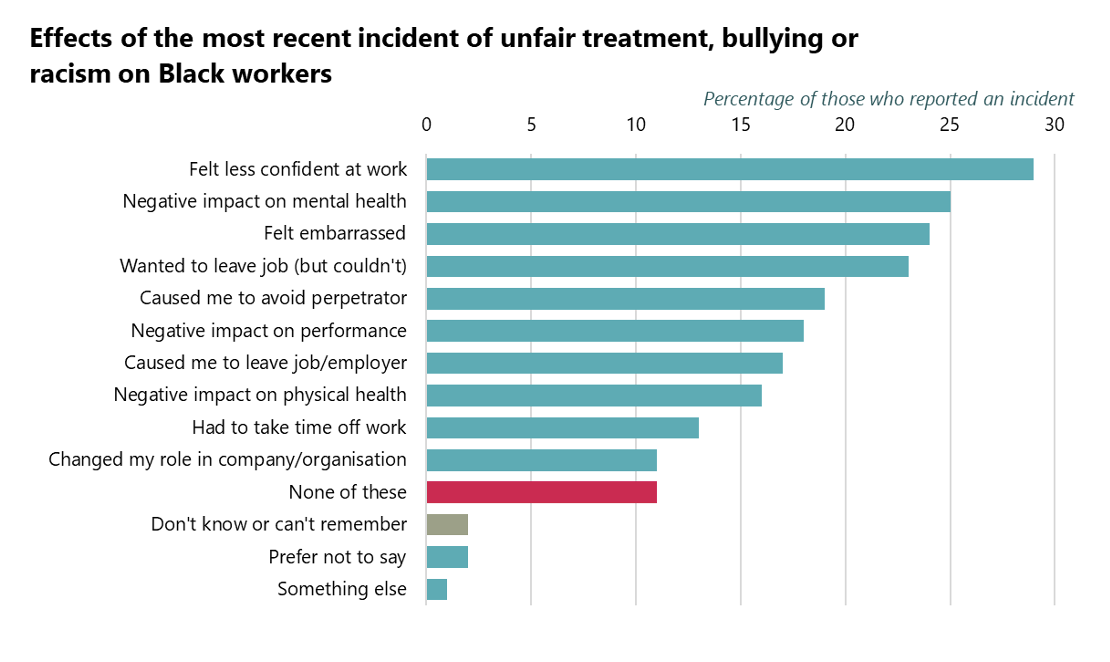
Experiencing unfair treatment, racism and harassment inevitably has a clear negative impact. It leaves workers feeling less confident, stressed and embarrassed. It also drives workers into wanting to leave their jobs, and in some cases doing so. 17 per cent of Black workers who have experienced unfair treatment, racism or harassment told us that the most recent incident led to them leaving their job. 23 per cent said it made them want to leave, but they were unable to do so.
- 2 For the purposes of analysis, the issues faced by Black workers have been grouped into three categories: unfair treatment, bullying, and explicit racism. A breakdown of where each issue fits can be found in the appendix.
Sources of support for Black workers
When asked about what actions they took after facing the most recent incident of unfair treatment, racism or harassment, around a quarter (23 per cent) of Black workers told us that they did nothing. This is down on when we asked the same question in 2020 (28 per cent).
The most common forms of action that were taken are telling a friend or family member (30 per cent) or telling a colleague (27 per cent). Only one-fifth (21 per cent) of Black workers reported the incident to their employer. This is low, but up on 2020 when it was just 16 per cent. Those who face bullying (26 per cent) or explicit racism (27 per cent) are more likely to report it to their employer than those who are subject to unfair treatment (16 per cent). This likely reflects that it’s often a manager that is carrying out unfair treatment.
Other forms of action taken include:
Raising a grievance (11 per cent)
Seeking legal advice (10 per cent)
Seeking help from their trade union (10 per cent)
Seeking support from a community organisation (10 per cent)
Taking an employment tribunal case (9 per cent)
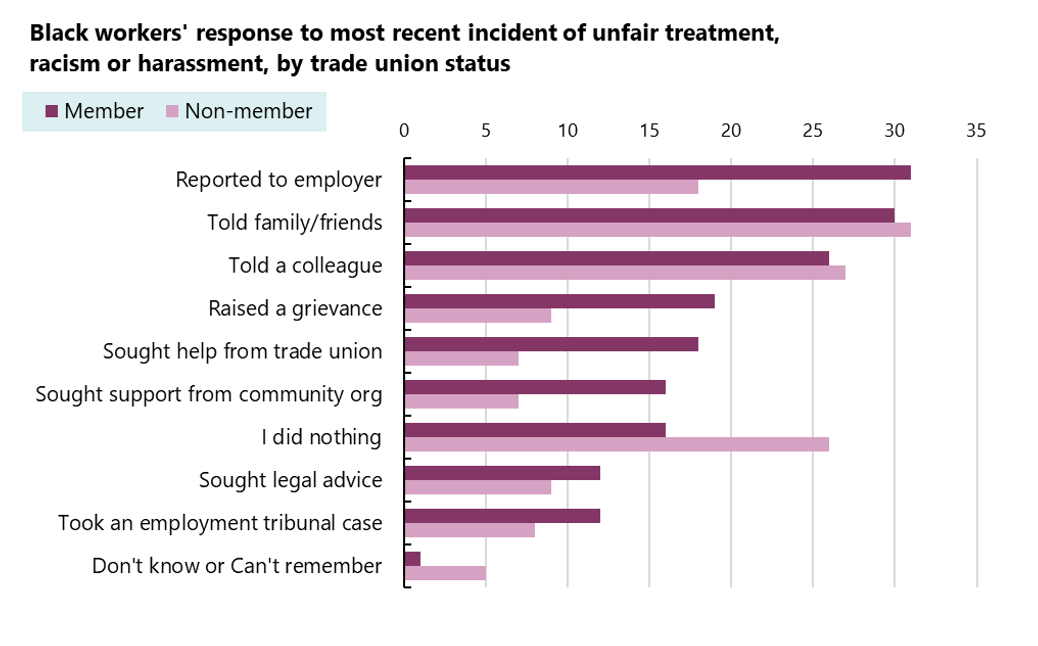
Trade unions play an important role in empowering Black workers to speak up and seek support when issues arise. While only 10 per cent of Black workers reported their most recent incident to their trade union, this increases to 18 per cent among union members. Increased reporting to trade unions is positive, but more needs to be done to ensure Black workers are able to access the support they need.
More broadly, trade union members are significantly more likely to take action and reach out for help. For example, 31 per cent of Black union members reported their most recent incident to their employer, compared with 18 per cent of Black non-members. They are also more likely to raise formal grievances, seek support from community organisations, or pursue an employment tribunal case.
Employer response to a complaint
Of those who did report to their employer, 69 per cent of Black workers said that their employer took the issue seriously. Just under a third (31 per cent), however, said their complaint wasn’t taken seriously. This means that their complaint was either ignored, not believed or not formally investigated. The percentage of Black workers telling us that their employer did not believe their complaint has almost doubled since 2020, rising from 11 per cent to 19 per cent.
63 per cent of Black workers told us that reporting the incident meant they were treated better by their employer. 15 per cent, however, told us that it made treatment worse. For 20 per cent, there was no change.
This speaks to how employers’ reactions to a complaint vary drastically. Some employers took action to prevent future harassment (24 per cent), took disciplinary action (24 per cent) or other actions (13 per cent) against the perpetrator, or carried out informal (15 per cent) or formal (19 per cent) investigations.
Other employers, however, responded negatively. 16 per cent of Black workers who reported the most recent incident of unfair treatment, harassment or racism to their employer told us they were transferred to another department or workplace as a result. This has shot up from 5 per cent in 2020. 13 per cent told us they were isolated from colleagues (rising from 3 per cent in 2020), and 7 per cent were disciplined or were subjected to a counter complaint.
Six-in-ten Black workers who raised the incident with their employer ended up being satisfied with their employer’s response. 18 per cent were dissatisfied, and 21 per cent were neither satisfied or dissatisfied.
Of those who chose not to report the latest incident to their employer, there were a wide range of reasons for not doing so. The most common were having no confidence that the incident would be addressed (17 per cent), being concerned that it would make the situation worse (17 per cent), or not thinking the issue would be taken seriously (16 per cent). Most reasons given relate to the negative impact that reporting could have on the worker.
Views on their trade union
As part of our survey on experiences of work, we asked trade union members how satisfied they were with their trade union.
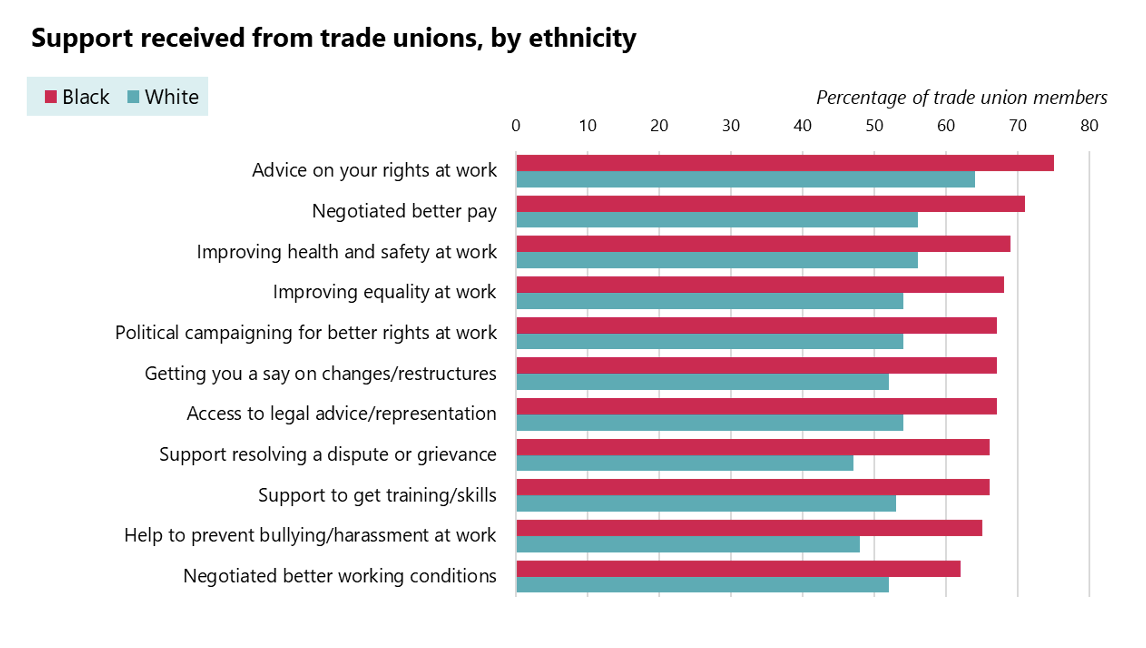
73 per cent of Black trade union members told us that they were satisfied with their trade union, with 8 per cent telling us they were dissatisfied. Black workers are more likely to be satisfied with their trade union than white workers (64 per cent).
We asked union members about the support received from their unions, and it’s clear that members are seeking and receiving support on a wide range of issues, from pay negotiations to support getting training to helping to prevent bullying at work. Across each type of support we listed, Black workers are more likely to have received support from their union. This includes advice on rights at work, negotiations for better pay and improving health and safety at work.
Views on government
In 2024 the UK government announced an intention to extend pay gap reporting to include ethnicity and disability. In June 2025 the TUC responded to a government consultation on the Equality (Race and Disability) Bill which would be the legislative tool to introduce ethnicity and disability pay gap reporting. The government response to the consultation included support for mandatory ethnicity pay gap reporting for all organisations with 250+ employees, with smaller employers encouraged to voluntarily report their ethnicity and disability pay gaps. Proposals would also see employers tasked with publishing mandatory pay gap action plans to address pay disparities. It is in this context that we asked Black workers about their views on this Bill and the government more generally.
The majority of Black workers (68 per cent) had not heard about the commitment before. This speaks to a wider lack of awareness, 75 per cent of all respondents had not heard about it. However, support for ethnicity pay gap reporting was strong. 77 per cent of Black workers supported its introduction, and it’s also supported by a majority of white workers (61 per cent).
When asked about whether more government action against racial and ethnic discrimination in the workplace is needed, 59 per cent of Black workers felt that more action was needed. 44 per cent of White workers felt the same. Black women in particular supported more action (64 per cent).
Recommendations
The Government:
Legislate at pace to introduce mandatory ethnicity pay gap reporting for employers with more than 50 employees and require action plans to address identified disparities.
Strengthen enforcement of equality legislation by providing ring-fenced funding for the Equality and Human Rights Commission.
Enforcement and regulation through the Worker Protection Act 2024 to require employers to prevent harassment where protected characteristics intersect
Fully deliver and enforce plan to Make Work Pay including statutory rights for equality representatives
Employers:
Treat racial, and racialised sexual, harassment as a workplace health and safety issue requiring proactive prevention measures.
Implement comprehensive ethnicity and intersectional monitoring, including recruitment, retention, promotion, pay and grading, ethnicity pay gaps, training access, and disciplinary processes.
Embed racial equality commitments within collective bargaining agreements.
Ensure flexible working opportunities are available and applied fairly across the workforce.
Trade unions:
Strengthen Black leadership programmes and improve representation in union decision-making structures.
Negotiate pathways out of insecure employment and into permanent work
Train and recruit more specialist representatives, particularly Black women, to support members experiencing harassment.
Document the disproportionate exposure of Black women to workplace harassment and strengthen reporting and prevention mechanisms.
Conclusion
The findings from No worker left behind (2026) shows that racism continues to shape the working lives of many Black workers in the UK. While progress has been made in raising awareness and encouraging reporting, structural inequalities remain deeply embedded. Whether these are individual or institutional, racism towards Black employees devalues and minimise the day-to-day contributions made in the workplace by Black people. In turn, this has wider repercussions within communities, social and cultural cohesion through the creation of divisions and distrust that is easily exploited by those stoking hatred locally and nationally.
Creating fair and safe workplaces requires coordinated action from government, employers and trade unions. Through stronger legal protections, transparent accountability and collective workplace action, meaningful progress toward racial equality at work can be achieved.
Stay Updated
Want to hear about our latest news and blogs?
Sign up now to get it straight to your inbox