
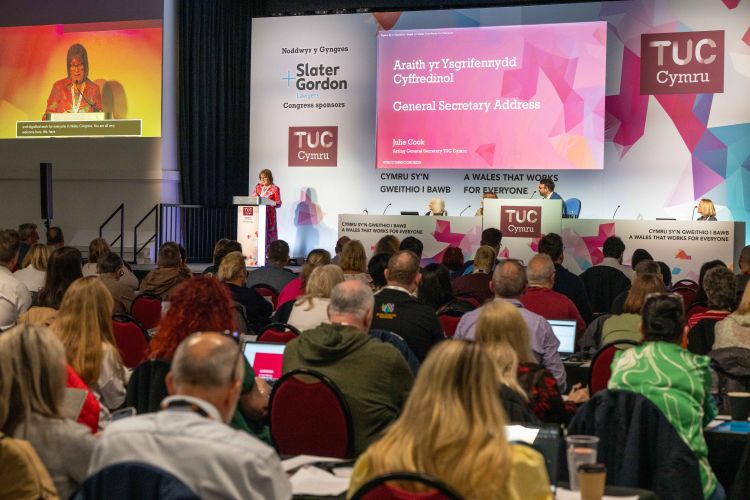
TUC Cymru Congress 2026
TUC Cymru is the voice of Wales at work. Every other year, workers from across Wales gather to decide our priorities.
Each of our unions sends a delegation who debate the big issues in workplaces and pass resolutions which state our policy and priorities.
This supplementary report to TUC Cymru’s 2026 Congress lists every resolution which was agreed by delegates.
High Quality Public Services
- The Full Funding of Education in Wales
- Provide earmarked funding to Local Authorities for local libraries and leisure centres
- Full funding for Wales Campaign (public services)
- Short Term Funding and the Impact of Delayed Government Decisions (Local Growth Fund staff)
- Science Funding
- Funding for public services in Wales and the Barnett formula
Good Well-Paid Jobs
- NHS Wales Pay – Time for direct pay negotiations in Wales
- Act Now for Fair Work and Creative Careers
- Fair Work for Freelancers (creative industries)
- Executive headship expansion (schools)
- National Care Service for Wales
- Public Contracts only for Organisations that Recognise a Trade Union
- Safe Staffing within Maternity Services in Wales
- Term-time only pay traps thousands of women in poverty (school support staff)
Equality for All
- Fighting racism in Wales
- Disability benefit cuts in Wales
- Protection of the values we hold in relation to Curriculum for Wales
- The far right and misinformation (journalism)
- Ensuring Cultural Competency Compliance Across Welsh Health Boards
- Funding and Implementation of the Anti Racist Wales Action Plan
- Reasonable Workplace Adjustments for Neurodivergent Workers
Governing for the Future
- The Future of Progressive Politics and Trade Union Engagement in Wales
- Devolution of Water: Protecting Workers’ Rights During Welsh Water Sector Reform
- Devolution of prisons, police and justice for Wales
- Navigating a New Political Landscape in Wales
- Social Partnership
- Date of TUC Cymru Congress
Worker Health and Safety
- Publicly owned rail and keeping public transport workers safe
- Health Monitoring for Firefighters
- Violence and Abuse of Education Workers in Wales
- Women’s Health, Workplace Equity, and the NHS Workforce
- Protecting NHS staff from patient abuse
Workplace Organising
- Health visitors’ dispute
- Llyfrgell Genedlaethol Cymru - Pensions dispute National Library
- Unions, bilingualism and opportunities for workers to learn Cymraeg
- Organising Young Workers
- A Shorter Working Week with No Loss of Pay for Welsh Workers (AI and automation)
- Reduced Working Week - Parity with NHS Scotland
A Modern High Skills Economy
- North Wales economy, Wylfa SMR (nuclear)
- Employment, security and investment in the rail and maritime industries
- Paid Release for Workers to Upskill in Carbon-Intensive Industries
- Strengthening Access to Maritime Careers in Wales
- Welsh language lecturers and tutors on 'zero hours' contracts
- Fair funding for Post 16 Education in Wales
- Qualified Teachers for Teacher Absence Cover
- Support for Welsh Manufacturing
- Artificial intelligence
- Wales Union Learning Fund: Work-Based Learning Delivered Through Trade Unions
TUC Cymru Congress 2026 - Reflections on our work since Congress 2024
- The Full Funding of Education in Wales
The education system in Wales needs fully funding.
Congress recognises that the Welsh Government has remained committed to a public education system that subscribes to the comprehensive ethos and ideals, is staffed by qualified teachers and is democratically accountable through local authorities.
However, Congress notes that for many years there was a funding gap between England and Wales and that education in Wales has been consistently underfunded at a time when the Welsh Government has introduced a number of reforms in the Curriculum, Qualifications and Additional Learning Needs.
Our members are seeing an increasing rise in challenging behaviour across schools and colleges, compounded by unmet needs.
Eighty per cent (80%) of respondents in a union survey said that there aren’t enough resources available in their school / college to provide the education the students deserve. Two thirds of members said that pupil behaviour would be helped by increasing the number of support staff in the classroom and providing more support for children with Additional Learning Needs (ALN).
Congress believes that the aspirations of the Welsh government have foundered on a lack of investment in schools, colleges, central services and the education workforce.
Congress calls upon TUC Cymru to campaign for the Welsh Government to:
- Invest in the Wales education service
- Evaluate the true cost of education in Wales and fully fund it; therefore realising the promise of the Curriculum for Wales, so children and young people have access to the education system they deserve
- Ring fence education funding to Local Authorities to ensure that the money is spent on education at the point of delivery
- Fully fund an above inflation pay-rise
- Restore pay levels for teachers, lecturers and support staff, prevent them leaving the profession, and introduce collective bargaining with the workforce
- End the damaging cycle of redundancy in schools and colleges
- Dismantle Local Management of Schools
- Investigate the waste of public funds in Local Authorities through poor employment processes such as extended suspensions and failed tribunals
- Fully fund ALN reform
- Ensure every pupil has access to the support they need
- Fully fund a qualified teacher in every classroom
- Make sure supply teachers have access to school teachers’ pay and conditions – including pensions
Moved by NASUWT Cymru and NEU Cymru
- Provide earmarked funding to Local Authorities for local libraries and leisure centres
Congress recognises the vital role that local libraries and leisure centres play in smaller communities, especially for children, young people, older people and people with disabilities, for whom travel costs and logistics often make town centre hubs difficult or impossible to access.
Congress notes that in 2023, the Senedd’s Local Government and Housing Committee produced a report, saying it was ‘apparent’ that local authorities placed ‘insufficient emphasis on social value when determining how best to deliver leisure and library services’. They called for immediate support for local libraries and leisure centres – and a long-term strategy to ensure their future sustainability. This has not happened – despite their finding that these services could be considered ‘a key preventative measure and investment for our health and care’.
Congress is grieved to see that Wales comes 24th out of 25 European nations for cultural spending (which includes libraries), allocating 32% of the average. And yet, libraries cost little. In Caerphilly, where the local trades council has been fighting to keep ten local libraries open, only £477,492 would be saved over three years – according to the council’s own figures – if all ten libraries closed.
Congress believes that the best way to secure the future of libraries and leisure centres is to keep them in local authority control.
Congress therefore calls on Welsh Government to provide earmarked additional funding – at a level adequate to ensure all existing libraries and leisure centres remain open.
Moved by Caerphilly Trades Council

- Full funding for Wales Campaign (public services)
This congress notes:
- The lack of progress in securing a needs-based funding formula that would provide the services we need across Wales and halt and reverse the cuts
- The overall low pay rates in Wales exacerbated by pay restraint in the public sector
- The cost-of-living crisis continues to put enormous pressure on our members and communities
This congress instructs the General Council to:
- Build an effective trade union-led campaign for full funding for Wales to meet people’s needs in our communities, for the restoration and delivery of fully staffed quality public services. We recognise that to achieve progress on our demands we need to provide the lead as a trade union movement
- Work with affiliates to calculate the overall figure that is needed to deliver pay restoration for the devolved public sector with no worker falling below the TUC demand of £15ph. This figure to be included in our campaigning for the funding we need in Wales
- Produce campaigning material in advance of the Welsh Government budget for affiliates and trades councils to use to mobilise branches, activists and members to get actively involved in the campaign and promote our demands
- Place demands on politicians at all levels in Wales to join our campaigning and take action to stop implementing cuts
- Support campaigning to put forward no-cuts alternatives including demands for councils to draw up plans to effectively use reserves and borrowing powers to offset any further cuts this year whilst fighting for the necessary funding
Moved by PCS
- Short Term Funding and the Impact of Delayed Government Decisions (Local Growth Fund staff)
The introduction of the Shared Prosperity Fund intended to replace long established European structural funding, was significantly delayed. Its technical start date was 1 April 2022, practical delivery did not begin until 1 August, forcing organisations such as Menter Môn to retain staff and deliver programmes “at risk” for several months, relying on partial funding information.
The 2025/26 bridging fund was similarly reduced in scale and delayed, beginning in April but not effectively delivered until June, requiring organisations to issue further “at risk” letters and continue operating without certainty.
The sector now faces the same instability with the new Local Growth Fund. Despite consultation closing in December 2025 and delivery expected in April 2026, decisions will not be discussed until “early 2026”, leaving organisations without clarity or indicative proposals and unable to undertake work at risk.
This extreme short termism has resulted in 18 staff facing redundancy within Menter Môn, threatening community support, long term development, and sustainability of organisations dependent on consistent funding. There is further concern that 2026/27 may become yet another “bridging year”, perpetuating uncertainty.
Congress believes repeated delays and short-term funding cycles cause avoidable harm to workers, organisations, and communities, and that approaches used in Scotland and Ireland—based on consolidation and multi-year commitments—provide a more effective, worker centred model.
Congress therefore calls on TUC Cymru to lobby for stable multi-year funding frameworks; press for earlier, transparent communication on allocations; and advocate for consolidated models that support workforce stability, organisational sustainability, and stronger community outcomes.
Moved by Prospect
- Science Funding
Congress welcomes the government’s commitment to reviewing the UK’s resilience framework, recognising this as an essential step toward strengthening national preparedness. The national risk register continues to highlight significant vulnerabilities across national security, environmental and natural hazards, transport infrastructure, and human, animal, and plant health. These challenges are being exacerbated by ongoing public sector budget cuts, reduced regulatory capacity, and sustained underinvestment in the skilled workforce required to operate and safeguard critical systems and services.
Wales plays a vital role in this landscape. Its ten universities, government sponsored bodies, specialist businesses, and charitable organisations conduct essential research and monitoring of natural resources, contributing not only to national resilience but to wider European understanding of environmental systems. Yet, the frontline of scientific resilience work has seldom appeared more precarious. Whether through research, monitoring and early warning systems, or emergency response, this capacity must be strengthened urgently as Wales faces an increasingly complex and evolving range of threats.
Congress therefore calls on TUC Cymru to urge the Senedd to take decisive action to:
- Review current funding landscape for Research and Innovation in Wales, building on the 2021 Senedd review.
- Ensure relevant bodies, including incident responders, are properly resourced and supported to retain and develop skilled staff.
- Rebalance core and competitive research funding to deliver long-term financial stability.
- Strengthen cross departmental collaboration to improve knowledge sharing and best practice.
- Lead a national public debate to highlight the importance of this work and counter the growing spread of misinformation.
Moved by PROSPECT

- Funding for public services in Wales and the Barnett formula
Congress notes the findings of the 2009 Holtham Commission that:
- It is a long-held principle that as an equal part of the UK, Wales is entitled to public services of the same quality as those delivered in other parts of Britain
- Therefore, the funding Wales receives from the UK government should reflect the higher cost of delivering public services here, just as similar parts of England receive higher levels of funding
- The costs of delivering public services in Wales includes our sparsely populated rural areas, our older population and our higher levels of deprivation
Congress also notes the findings and recommendations of a 2025 report by the Wales Fiscal Analysis team at Cardiff University that:
- The UK Government’s funding for the Welsh Government is calculated using the Barnett formula. Since 2016, this formula includes a significant needs-based factor, which reflects the higher costs of delivering public services here. The Welsh budget in 2027-28 is set to be over £500 million larger than it would have been because of its inclusion.
- There is evidence that actual relative spending levels in Wales are lower than official estimates, which highlights the need for an updated assessment.
- Wales loses out when there are disputes about when and how the formula should be used. For example, Wales lost out on £845m relating to the construction of a high-speed railway between London and Birmingham, which should have led to consequential funding here. Such disputes should be resolved by an independent third party and not the UK Treasury.
- The overall cap on Welsh Government borrowing for capital spending should be increased significantly and linked to the share of the Welsh Government’s resource budget devoted to servicing debt. Limiting debt servicing costs to 1% of day-to day budget would imply an overall cap of £3.3 billion. The current cap is £1 billion, which was set in 2016 and has not been uprated since.
- Wales’ relative spending is substantially higher for devolved public services (such as health and education) than it is for services that remain reserved to the UK government (such as rail infrastructure and justice), where spending is below a population-based share. If these services were devolved, Wales would receive more funding for them.
Congress resolves to call on the Welsh Government to demand a fair share of UK Government funding for public services in Wales by seeking:
- An updated assessment of the needs-based factor in the Barnett formula
- An independent third party to resolve disputes over Barnett allocation
- A new capital borrowing limit for the Welsh Government, linked to the share of its resource budget devoted to servicing debt.
Congress notes that:
- The Wales Fiscal Analysis report’s findings that if services such as rail infrastructure and justice were devolved, the Barnett formula would mean that Wales would receive more funding for them.
Moved by: General Council