
Worker-centred technology: An opportunity for trade unions
- A worker-centred approach to designing technology places primary importance on the needs of workers as users of the technology.
- TUC Cymru hosted a workshop for over 20 representatives and officers to investigate participants’ current experiences of workplace technology, and how they thought technology at work could become more worker-centred.
- Participants shared a variety of experiences of technology at work, including new and old technologies, and diverse use cases across different sectors, and developed their own ideas for worker-centred technology.
- Themes emerged from the workshop discussions as central to worker-centred design: developing and implementing systems that workers can trust, that maintain and develop skills, that are subject to human oversight and subject to appropriate guardrails/safeguards and have strong co-governance mechanisms in place.
- Further investigations of how existing products could be adapted to be more worker-centred or new systems co-designed would be profitable, including piloting technologies in a receptive and strategically important sector in Wales. This work would require thorough collaboration and partnership between workers, unions, employers and the Welsh Government.
Introduction
Continuous technological change has always defined workplaces. We are currently in a moment of rapid change. The success, or otherwise, of an organisation’s investment in new technology intended to make work processes more efficient and support their staff depends upon the design of the technology and how it is introduced to its new users. There have been high profile examples of poor implementation, where workers were failed on both accounts with significant implications for the organisation and its users or customers. For many workers in the UK, the use of technology at work is a source of significant concern and anxiety.
One way of improving the design of new tools is adopting the principles of user-centred design: adapting technologies to the needs of their users. In employment, we can develop a more specific iteration of this idea: ‘worker-centred design’ of technology. More intuitive tools enable individuals to be more productive, ensuring that the technology does not “get in the way” of tasks and workflows. Investigating what ‘worker-centred design’ might look like in the future was a central task of a recent workshop hosted by TUC Cymru, facilitated by Sandy Gould and Philippa Collins.
Bringing the idea of ‘worker-centred design’ to life also means protecting workers from the potential downsides of technology adoption. Participants in the workshop highlighted, for example, risks of data privacy breaches, concerns about inequality and discrimination between individuals and groups, lack of transparency about decision-making, and the effect of technology use upon the pace and expectations of work. Making a piece of software or enhancing a workflow in a way that is truly worker-centric will mean confronting these risks and concerns and devising concrete ways to manage, mitigate or remove them. In the workshop, participants discussed their experience of technology use in the workplace and how the demonstrable pitfalls can be avoided for the next generation of workers. How can workers be put at the centre of technology design and adoption, with benefits for organisations, workers, and service users alike? The position of unions as a facilitator of dialogue, with the benefit of their members’ knowledge on the ground, renders them uniquely well placed to encourage employers to move towards ambitious technology programmes that are responsive to the needs of the work and the organisation.
Participatory Workshop
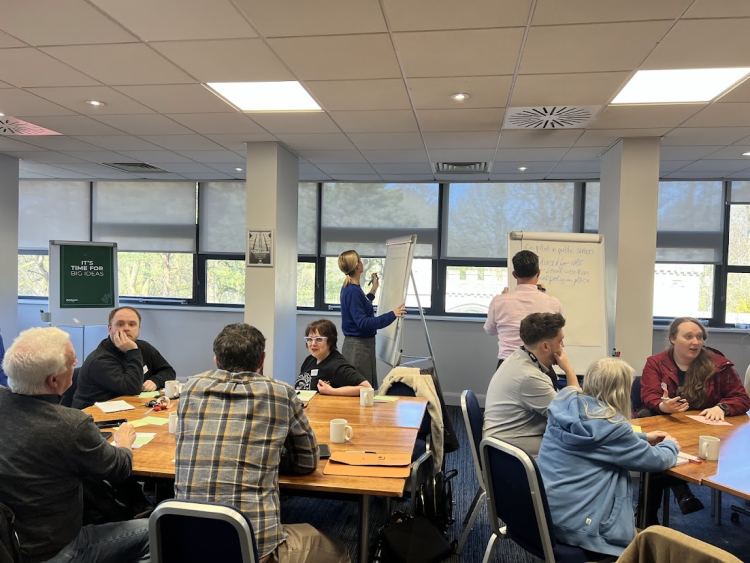
Over 20 trade union lay representatives and officials from public and private sector unions participated in an in-person one-day workshop. Participants were recruited through TUC Cymru’s networks.
The main components of the day were:
- Exchanging experiences of technology in specific workplaces
- Thinking about large-scale changes in workplace technology (including through participation in an interactive activity)
- Exploring the idea of work-centred technology
- Applying the idea of worker-centred technology reflexively to current workplaces
- Workers’ experience of technology
After a warm-up task, participants were asked to describe their individual experiences of technology at work. This task opened the discussion amongst participants and gave a sense of the state of the art, a baseline from which we could speculate on how things could be different.
Participants were given file cards, pens and were asked to briefly outline an example of a technology that is currently being used in their workplace. They were asked to response to four prompts on their file cards:
- What’s the technology?
- Is it new or old?
- What’s context and use?
- What are the benefits and challenges?
These prompts were designed to elicit both facts about technology and individual reflections. Participants were allocated a discussion group based on the uses recorded and discussed their experiences of the relevant technologies with each other. Discussion groups then reported back discussions.
- What technologies are in the workplace and how are they used?
Participants’ individual examples covered a wide range of technologies. All examples were of digital technology, although it was not specified that they should be. They included newer technologies, like LLMs, or photogrammetry (digital mapping of objects and people using photos), but also things that have been in workplaces for a long time like customer relationship management systems or USB storage devices.
Technologies are used to accomplish a variety of tasks, reflecting the cross-sectoral make-up of the workshop. Most examples were using technology in an assistive capacity, rather than as a decision-making agent. Tasks included (most prominently) the generation of text (meeting notes, emails, records), case management, security, and sector-specific functions like parcel tracking. There was one example of automation, which was automated email responses to common queries from service users.
It was notable that conversational, assistive AI was mentioned by seven participants (out of a possible 16 use cases recorded), and in the workshop there was strong awareness of the use of generative AI in workplaces. Co-pilot and ChatGPT were referenced as being used by employees, either as part of pilots or established work patterns or privately to assist with tasks. As above, the technology was being used for a variety of tasks: drafting research and reports, creating minutes, and summarising documents, setting goals for staff, and composing emails.
It is interesting to reflect on what – beyond automated decision-making – was not in the use cases brought by participants. Although there has been a great deal of discussion of the use of AI/technology to manage people at work, this was not reported as occurring in most workplaces. Only three uses in this category were mentioned by participants: the use of technology in recruitment (particularly initial CV reading); monitoring employees’ calls with service users, which was then used in disciplinary proceedings, and managers using generative AI to draft performance development paperwork.
- What are perceptions of the benefits and challenges of these technologies?
Whilst participants could see that there were some benefits brought about by the use of technology, the discussions mostly focused on the challenges and difficulties raised by technology for the participant or the members they represented. The discussion raised a diverse group of concerns, ranging from operational to ethical.
Firstly, we can examine concerns about the quality or accuracy of new systems. In several instances, participants expressed concerns that the product being used was not fit for purpose or reaching different conclusions to a human decision-maker. For example, one said they were ‘not sure whether [the system] is recruiting the right candidates’ and another participant reported that ‘every bit of technology they introduce doesn’t work initially’. Reflecting on both the quality of the system and how workers interact with it, one participant stated that ‘[conversational AI tool] is not fit for purpose and it is used as if it’s always accurate. This means people don’t check what [it] produces and its invariably wrong.’
The poor performance of a system was observed to have several effects. One is a constant churn in new systems as previously introduced technology fails to perform as promised. Particularly with generative technology like ChatGPT or co-pilot, participants observed that they would repeat work done by AI because the output was not accurate enough or is ‘invariably wrong’. A consequence for collegiality was also observed by one person, noting that they had begun to doubt the authenticity of their colleague’s work and therefore were losing trust in outputs produced by others.
Operational challenges associated with new, and even well-established, systems were also noted. The particular issues observed, with relation to case management systems, for example, was that systems are often not interoperable, making it difficult for workflows to move across different pieces of software. The need for data mobility was also seen as clashing with the need to observe the requirements of GDPR. Participants also noted a concern that organisations may become reliant on a particular piece of software, with escalating maintenance or renewal costs, and locked into potentially disadvantageous contracts with software suppliers.
Participants also noted a lack of consultation with representatives, as well as other risks or potential compliance issues. Most common concerns cited were about data protection and equality issues. The potential that employees may not consent to how their data is used, shared or reused and the extraction of valuable data or information without recompense was similarly a concern. Participants noted the impact of reliance on English-trained and developed systems upon the use and understanding of the Welsh language, and also the usability of voice-related systems for those with stronger accents. The possibility (although note above that there was limited evidence it is occurring currently) of outsourcing decision-making to technology with inadequate human oversight was also raised.
The wider impact on work and the workforce was a strong theme of discussion throughout the workshop. The use of software to monitor employees led in one case to performance management and loss of jobs, particularly notable as human managers had not raised issues before the technology’s introduction. This example demonstrates the concern raised that for individuals, some use cases can have substantial individual effects (e.g. commencing performance management) and union members feel additional pressure by reason of being monitored during every task. Outsourcing decisions or tasks led to a concern about the atrophying or loss of skills in the human workforce.
The most prominent concern raised consistently was about the future shape of the workforce and loss of roles entirely. One participant noted that lower paid members in their union were particularly concerned about the impact of technology on the availability of jobs and the standard of wages. This anxiety was echoed by other participants; e.g.:
- Jobs would be ‘put at risk’
- ‘lack of human intervention has led to gradual reduction in lower grade HR roles’
- ‘obvious benefits to management with headcount reductions’
- ‘the employer has admitted that if they manage to modernise the service, it will help them reduce the number of employees’.
- Worker-centred technology design
In the second part of the workshop, we moved from documenting current use, experiences and attitudes to thinking speculatively about what it would mean for participants to have worker-centred technology at work and what would be required to move to that position. We started this part of the workshop with a short plenary about worker-centred technology design. Participants then worked in groups to think about what the concept might mean for the tools they use day-to-day. We finished the session with a plenary discussion of participants’ ideas and reflections.
The plenary at the start of this part of the workshop was a short talk to introduce worker-centred technology design that we gave as facilitators. Design approaches can centre different things. User-centred design centres the operator of a particular piece of a technology or system. Age-centred design centres the needs of particular age groups in relation to a particular technology or system. Human-centred design is about prioritising humanistic values in system and tool design. Worker-centred technology design puts worker needs at the heart of tools and systems.
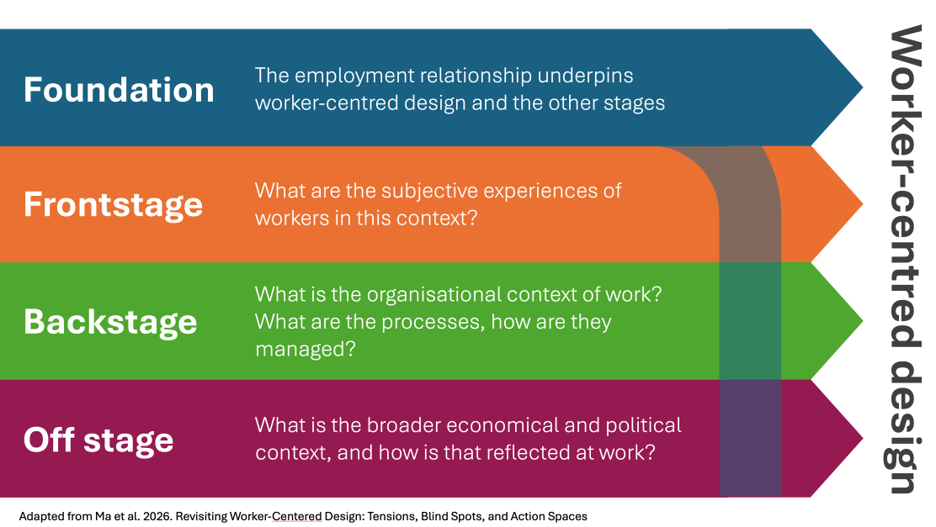
The labour context is complex and includes workers and their immediate representatives, the trade union movement more broadly, employers, third-party technology vendors and regulators of both labour and technology. It can be difficult to know where to start, so we walked through an existing framework that breaks down the worker-centred technology design process into four stages: Foundation, Frontstage, Backstage and Off stage.
The Foundation represents the relation between worker and employer, characterised by the employer having power over an employee (power that trade unions seek to balance). Technology that centres worker need must accommodate this differential in its design. Whatever work is done in the other stages cannot produce worker-centred outcomes if they don’t fully incorporate the Foundation.
In the Frontstage the subjective experiences of workers doing the job are considered. What do they enjoy, what is stimulating, what are the pressures, what are the challenges? Design at this stage focuses on protecting positive aspects and ameliorating pressures and challenges. What role is technology playing on both sides of this calculus?
The Backstage is about the broader context of the workplace. What is the management structure? How do workers collaborate? Is technology in-house, or bought-in? New technology for individual workers does not exist outside of this workplace context; technology that is worker-centred must be cognisant of this.
Finally, the Off stage encapsulates the broader context outside the workplace that has significant influence inside it. This may include legislative and regulatory influences, or current economic policy – perhaps around AI – that materially impact on work, and so need to be factored into the design of worker-centred technologies.
These stages were described to participants with the purpose of providing structure to the speculative discussions that followed the plenary.
- Exploring worker-centred technology
The groups produced four case studies that applied the idea of worker-centric technology to challenges and concerns that participants voiced about their current workplace technology. As facilitators, we kept contemporaneous notes of participants’ discussions in their group and in the plenary. We kept the artefacts they had produced as part of these discussions (flip-chart pages, file cards). Each of the four case studies builds on a different work context and provides a different perspective on worker-centred technology.
Work allocation:
Group 1 were interested in how worker-centred technology could relate to the idea of a shorter working week. They hypothesised that a technology-supported worker-centred approach to rotas could permit greater efficiency that could lead to a shorter working week for workers. The core of the idea was that staff would have greater flexibility over which tasks they would take on each week, trusting staff to know which tasks would most suit them. Technology supports an allocation that respects preferences and that facilitates the allocation of unclaimed tasks to the rota.
Private domain:
Group 2’s idea also related to the allocation of work and they were particularly concerned with where the technology gleans data from, preferring tight controls on input data to ensure trust in the output. The system would only be accessible to workers internally, with limited access for managers in order to co-ordinate work allocation, and with human decision-making guaranteed. The sources of data and boundaries for the system of recommendation would be the worker’s contract, the terms of a collective agreement, existing case loads, and their working hours and patterns. The recommendations produced would be tailored to the preferences and capacity of the individual.
Co-Worker:
Group 3 had similar concerns to the private domain group, but they instead focused on the development of an AI assistant and sought to make it ethical. As with other groups, they sought to limit the input into the system to only organisations that themselves are considered ethical and the group recommend an annual check of the system and its outputs. Other limits this group considered were constraining the system to providing factual answers and ensuring no life changing decisions were made by AI. One use they considered was as a teaching tool to upskill the workforce. There were also implementation measures considered, such as collective agreements and conducting equality impact assessments and GDPR impact assessments. Users would also be required to establish a set of ethical values that would guide the decision-making of the AI agent in areas of ambiguity.
Keeping it real:
Group 4 focused more on the general governance requirements and operational limits that would be required for any type of system developed for the workplace. They recommended standardised tools to enable worker mobility between teams and employers. A human override of a system’s output – built into the operation of the system – and mechanisms to prevent the over-collection or over-retention of data (such as time bound data collection) were also part of this group’s idea. Any system should ensure there is adequate shared social time for staff, guaranteed by collective bargaining, whereas legislation should be used to ensure that automated systems are not used for particular types of decisions, including sifting job applications, applications for promotion or performance development reviews.
- Themes of worker-centric design
Each group took the task in a different direction and the results were varied. Thematically, however, there were similar concerns motivating the discussions and choices made by the groups. Analysing the artefacts from across the workshop has allowed us to draw out four themes that that represent critical considerations for developing worker-centred technology.
Trust:
A central value (and indeed one that seems to have been lost for many working with technology systems) was trust. This value was sought on a variety of layers. When designing a system in the final task, trust in two factors was featured strongly: the provenance and veracity of the information put into the system and that the system would respect boundaries necessary for individual workers (such as their contractual conditions and any collective agreements). At other points in the workshop, trusting outputs was more relevant, in terms the accuracy of response (particularly of assistive AI agents like co-pilot) and avoidance of errors.
Skills:
In open conversation, the maintenance of human capability and skillsets and the risk that over-reliance on technology would erode those skills were mentioned several times. Participants shared a sense that there were some parts of most jobs that could not and should not be replicated by artificial intelligence and that organisations needed to continue investing in staff skills alongside any new software developments. The second point, connected to trust above, is that humans working alongside technology need to maintain their own skills and understanding in order to understand what the machine is doing and to check the validity of the outputs.
Human oversight and other Guardrails:
In the design task, each group focused on what the new technology should be prohibited from doing, either in terms of types of decisions or operational options that should be impossible. All groups wanted humans to exercise what could fairly be described as high levels of control over the system at all stages, although the groups focused less on how outputs would be arrived at, which is understandable given the wide sectoral expertise in the room. In terms of types of decisions, groups were unwilling to automate or give technology power to make decisions with significant effects for the individual, an impulse that aligns with the current regulatory framework contained in the GDPR. Examples given were recruitment, promotion, and performance review paperwork; final say on work allocation or shifts, and marking exam scripts. This inclination for preserving human agency over decision-making is also reflected in all groups opting for a recommendation-based system, where a human is required to verify or affect the final decision.
Co-governance:
One form of human control that was mentioned throughout the design task was the need for collective agreements. Groups believed that collective agreements should be created to establish proper boundaries for the system before its implementation and that social partners should be involved in evaluating the system’s outputs. Other pre-implementation stages, such as ethical use policies and impact assessments were also mentioned. Collective bargaining on other topics was also considered by several groups to be an important source of input and boundaries for the system’s output. In essence, groups were keen to make sure that the implementation of new systems did not disrupt or undermine respect for agreed principles between unions and employers.
- The future of worker-centred technology design in Wales
Wales is the right place to explore what worker-centred technology design can do for workers, organisations and wider society. Wales has higher union density than the UK average, and has primary legislation that requires partnership working between worker representatives and employers in the public sector, which is a significant part of the Welsh economy. The Minister for Enterprise, Connectivity and Energy has recently signalled a desire to see Wales make the most of the opportunities presented by new technologies. Co-design, co-development and co-implementation of new technologies through worker-centred thinking offers a chance to get the most out of both the technologies and the workers using the tools. Even in a short space of time, the participants at the workshop demonstrated the range of possibilities that are open for exploration in the next phase of a worker-centred project.
Based on the findings of our workshop, we recommend that a publicly-funded research project should be undertaken urgently with strong collaboration between workers, unions, employers and the Welsh Government. The project would entail, in the initial stage, two elements. The first is to develop a framework for Welsh worker-centred technology design. The second is to conduct a pilot study that seeks to bring worker-centred principles into implementations of new technology in strategically important sectors. These recommendations align with many aspects of the TUC’s pro-worker AI innovation strategy.
There are many ways to implement worker-centred technology design. Some approaches will suit the needs of Welsh workers and organisations better than others. Any attempt to achieve worker-centred design in practice must be led by a set of agreed values and principles – an idea that was highlighted by the workshop participants themselves. This guidance should bring together the state of the art from the theory and practice of worker-centred design, as well as being tailored to the context of work in Wales and reflecting the unique regulatory requirement of working in social partnership in the Welsh public sector.
Drafting such a framework could draw strongly on the principles already set out in guidance adopted by the Welsh Workforce Partnership Council (more recently the Public Sector Future Workforce Forum). This guidance sets out a social partnership approach to all stages of the lifecycle of technology in the workplace. There are strong thematic commonalities between the guiding principles and the content of the workshop discussions (e.g. social partnership, human oversight, and fair, inclusive working conditions) as well as highlighting the need to building capability across the workforce, which would be essential to any worker-centred project.
The second component of the project –a pilot, or group of pilots– could consist of procuring and adapting existing technologies already available in the market or co-designing a bespoke system for a particular employer or service. Pilots should be placed in strategically important sectors that have established ways of working in partnership with unions and workers. A sector like social care would provide an opportunity to build on existing efforts to understand what new technologies can do for workers, organisations and society more widely. In our workshop, AI-based technologies were the ones that participants saw as having most impact on their work now and in the future. This suggests that any pilot would likely involve making progress towards worker-centred AI technologies. We would suggest that the Office for AI would be the appropriate body to lead any trial, with guidance and oversight from the Strategic AI Advisory Group and the Social Partnership Council or Public Sector Future Workforce Forum.
The arrival of new technology is inevitable. Worker-centred technology design is a way of working with new technologies that benefits workers and in turn their organisations and communities. Trade unions have a vital role in developing ways of bringing worker-centred technology design principles into workplaces and facilitating their implementation in practice. The discussions from our workshop suggest workers are ready to think in new ways about technology coming into their workplace – trade unions and organisations have important roles to play in supporting them in this promising endeavour.